

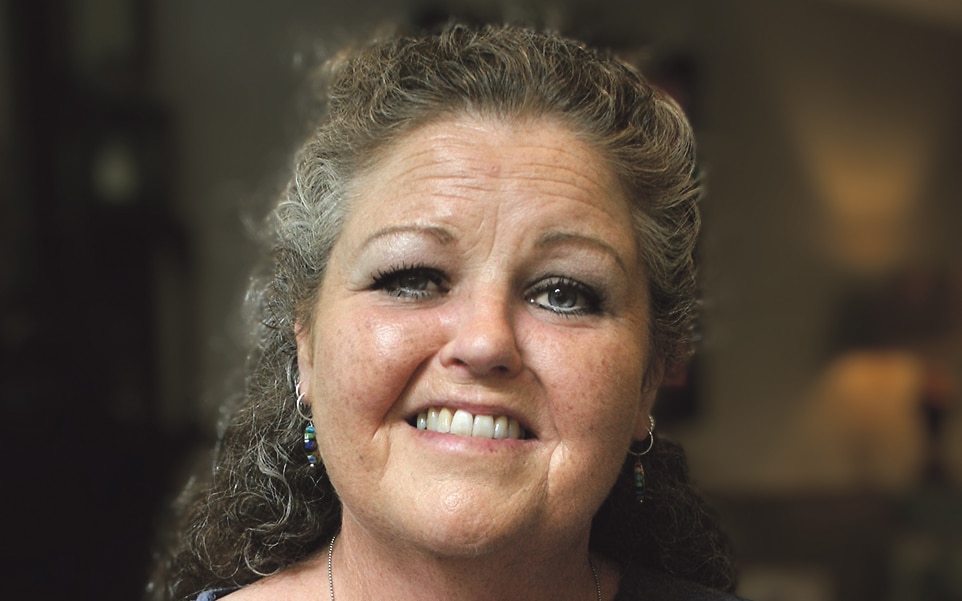
After going into heart failure at the age of 40, Martina Conroy was told she had 18 months to live unless she underwent surgery. In that moment her life changed forever. “You learn what fear really feels like and you stop taking life for granted,” she tells Mary O’Brien. Handed back the gift of life by cardiothoracic surgeon, the late Aonghus O’Donnell, – who died unexpectedly, aged 49, six weeks after operating on Martina – the surgery marked the start of Martina’s journey of self-reflection, with which came the realisation that simply surviving isn’t enough. She had to learn how to live again but to live in a different way.
Martina was first admitted to hospital in 2009 with what felt like congestion in her lungs and pain across the bottom of her back. A scan showed fluid in both lungs and she was diagnosed with double pneumonia. A few months later she woke in the early hours of the morning experiencing severe breathing difficulties. After a series of tests it was discovered that both her lungs were retaining fluid because her heart wasn’t functioning properly.
Six months after she first started feeling unwell, Martina was told by the cardiologist that she was in heart failure and had rheumatic heart disease. One of the valves in her heart had stopped working completely and another was damaged as a result of the rheumatic fever she had developed as a child.
Advised before the surgery to get her affairs in order, Martina went home to Dunmanway confronted with her own mortality. She planned her funeral, wrote her will, and said her goodbyes to loved ones, just in case.
At this stage Martina’s heart was unable to provide her body with enough blood and oxygen so she couldn’t get to the end of a sentence without running out of breath and the surgery was high risk.
She remembers the normality of the backdrop to the surgeon’s stark words – the feel of the sun through the window in the office, the sounds of children playing outside. Then the feeling of being punched in the stomach.
“Something inside you changes when you hear those words,” she says.
“When death hovers, you cling as hard as you can to life, but you’re unaware that it’s about to be rewritten.”
To understand how profoundly this experience changed Martina, it’s important to understand her life before it. She grew up in a close-knit Catholic family in East Cork and attended the local convent school. From a young age, she knew her sexual orientation was different, but struggled with the conflict between her sexuality and her religious upbringing, before eventually coming out to family and friends in her late twenties.
She has always been a very determined person. After failing maths in her Leaving Cert, which thwarted her plans to attend university, Martina entered a religious order with the intention of becoming a nun, although she left after just a few months. At 26, she returned to education as a mature student, working three jobs to fund her studies before completing bachelor’s and master’s degrees in Social Science and Psychology.
Her career took her into support and advocacy work, including roles with Edel House and the Cork Deaf Association. Then after moving to West Cork to be with her long-term partner, she joined Bantry Citizens Information Centre, where she remained for 18 years.
Throughout those years, Martina threw herself into helping others, building a busy and, what she considered at the time, to be a purposeful life. Looking back now however, she recognises that she had become so focused on fixing things for other people that she ended up losing sight of herself along the way.
With her surgery scheduled for September 22, in typical Martina fashion, she continued to work until the end of August.
But her surgery marked a watershed moment. “I learned that life after serious illness isn’t necessarily the life you had before. Life is about thriving, not just surviving,” she shares.
Martina woke up from the seven-and-a-half hour surgery covered in tubes and wires and bruises. “You can’t laugh, cough or roll over without feeling like your chest might split open. You need help doing things you once did without thinking.”
Then the realisation hit that it was never enough just to survive.
‘When you survive something like this, everyone assumes the hardest part is over,” says Martina. “It isn’t.
While the physical recovery was hard, the emotional recovery was even harder.
“The fear. The trauma. The grief. The constant awareness that your heart has failed you before and the terrifying thought that it could happen again.
“You feel broken – because for a while, you are,” she shares.
Each little step forward is a triumph.
The tube being taken out and her lungs not collapsing.
The first sip of ice cold water trickling down her throat. Brushing her teeth. Walking.
Then six weeks on, she received the news that Aonghus O’Donnell, the surgeon who had saved her life, had passed away unexpectedly. “I wasn’t prepared for how hard that news hit me. His skill and dedication had given me another shot at life and then he lost his own,” she says.
Throughout her very slow recovery, Martina started to really look inwards. With the support of her partner and with the help of counselling, she started to find the answers she was searching for.
That first year Martina spent a lot of time seeking out solitude. “I felt completely out of step with people so I’d take off in the car by myself with just my camera,” she says. “The things that other people thought were important, celebrations, activities, just felt frivolous.”
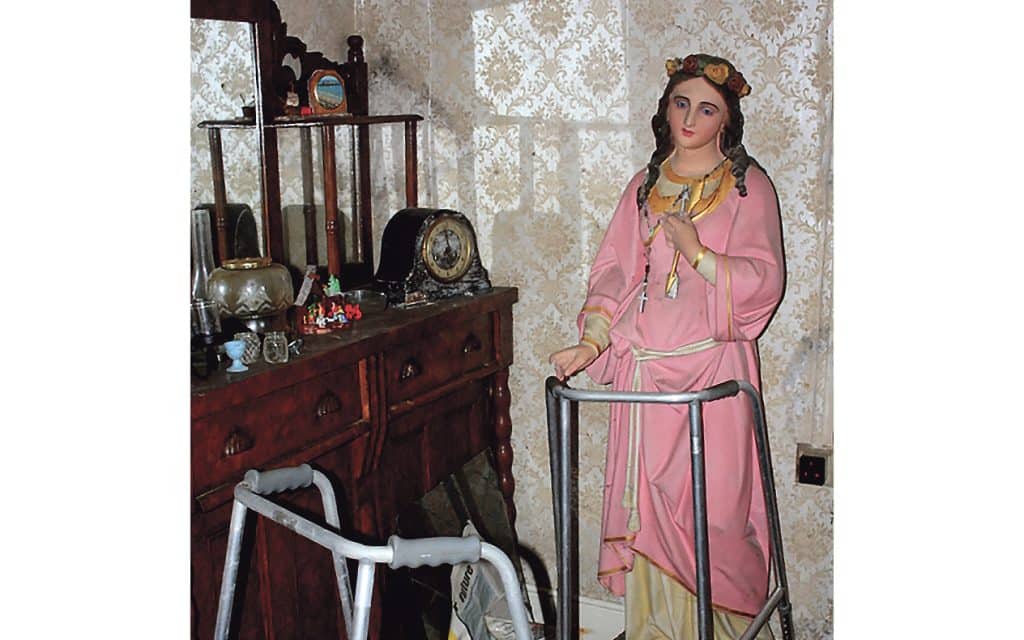
While trying to piece her own life back together, Martina found a sense of peace traipsing around abandoned old houses photographing the remnants of other people’s lives.
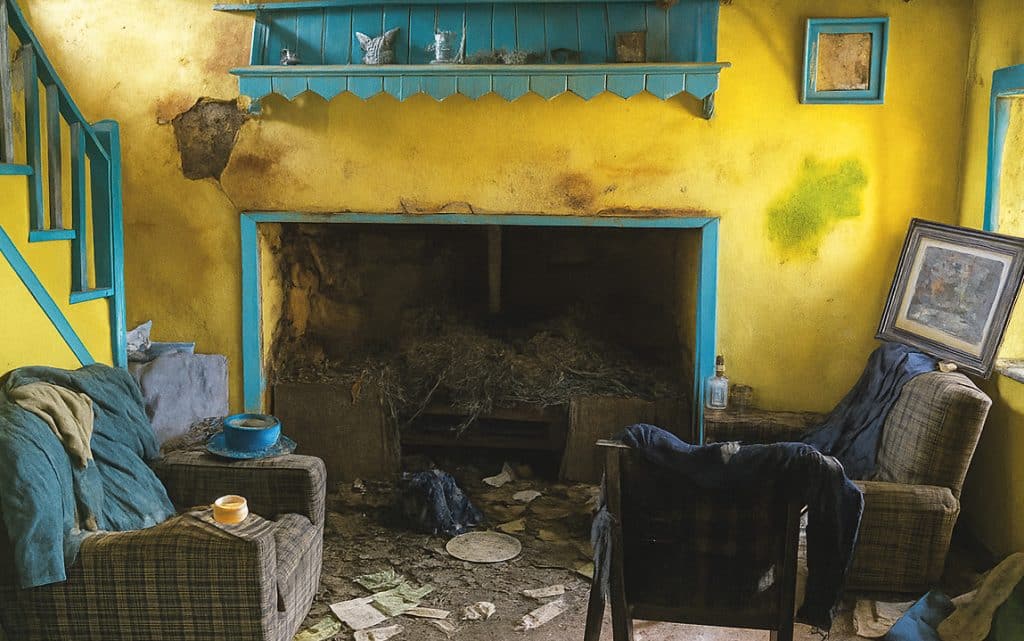
“These houses never felt empty to me,” she says. “Everywhere I looked there were traces of the people who had once called them home – a chair left beside a window, a cup in a cupboard, wallpaper someone had chosen decades before. I began to wonder who they were, what happened to them, and why they left. Their stories were gone, but something of them remained. That sense of lives once lived stayed with me long after I put the camera down.”
Through photographing the remains of lives that had already ended, she finally began to process the fact that her own life had almost ended.
Martina made the decision to retire from her job three years ago after developing an arrhythmia.
Today she volunteers at a local charity shop and is contributing to a book about talking therapy.
She has held a number of exhibitions of her photographs entitled ‘Remnants’ dedicated to the memory of the surgeon who saved her life.
“My experience made me realise that what I had in the past was a surface happiness. That fades fast,” she says.
Today Martina doesn’t look too far ahead. Joy is found in the little things…