

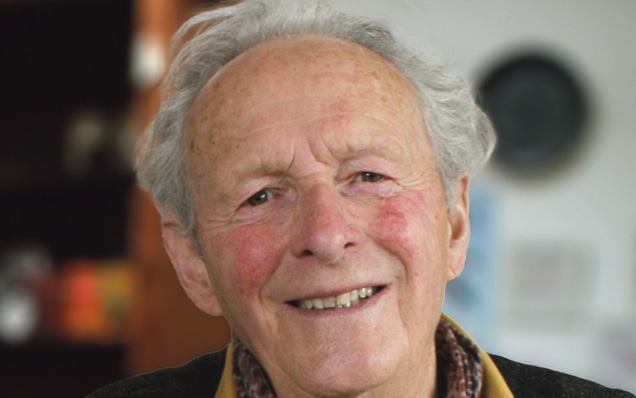
There’s a heavy drizzle falling on the country road. Framed by the lush green of the softly humming hedgerows, a man sits on his bicycle in the mist, waiting to greet the farmer coming his way. “Soft,” remarks the cyclist with a smile, acknowledging the weather. “Soft indeed,” replies the farmer with a nod. Dreamer Fred La Haye moved from the Netherlands to Ireland almost 50 years ago drawn by the possibility of a self-sufficient lifestyle. These are the sort of interactions that kept him here. “It’s beautiful you know,” he tells Mary O’Brien. “To be able to hold a conversation around just one word. I love that about the people in this country.”
Words, but perhaps more importantly listening, are all-important to Fred, (78), who is well known around West Cork for being a passionate proponent of dialogue, as well as for his pioneering work introducing sustainable practices into local communities.
A poet and philosopher, Fred’s writing is inspired by the thoughts and writings of the philosopher and scientist, Pierre Teilhard de Chardin, a French Jesuit priest, who sought to bridge the gap between faith and science by showing they are interconnected. He also looks to the teachings of American physicist and philosopher, David Bohm, who believed that beyond the visible, tangible world there lies a deeper, implicit order of undivided wholeness; and that transformation in society could be brought about by dialogue.
“Listening to the world is essential and the quality of listening so important,” says Fred passionately.
In his poem ‘Noosphere’ Fred describes ‘The ringing out of a thousand million human vibrations! / A whole layer of consciousness exerting simultaneous pressure on the future! / And the collected and hoarded produce of a million years of thought! / Have we ever tried to form an idea of what such magnitudes represent? / Have we?’
After discovering a shared interest in the ideas of Teilhard de Chardin, musician Justin Grounds composed the oratorio ‘The Embracing Universe’ to elevate Fred’s poetry, which shares the thoughts and writings of the visionary French philosopher.
“Teilhard de Chardin was banned from lecturing and publishing his own work, as he was told by his superiors that the Jesuit society was not founded to support religious pioneers,” explains Fred. “I wrote this work to rescue him from historical oblivion.”
Actions speak loudly too for Fred, who got his first taste of community activism as a young man in the Netherlands when he hitchhiked to Amsterdam to join the thousands of demonstrators opposed to the Vietnam War and the expansion of nuclear energy. “We were so furious, so angry that we couldn’t even celebrate Christmas,” he recalls.
Although he struggled at school and dropped out early, Fred’s hunger for change and ambition to fight injustice led him back to education and eventually to study law at university specialising in criminology, in particular institutional and structural crime.
Married with a young child and eager to explore the possibility of living a self-reliant life in a more natural environment, Fred moved with his family to West Cork in 1978. The original plan was to continue his law studies in Ireland, however life and its struggles got in the way of that ambition, with the young family finding themselves focused on mere survival. “It felt like we had stepped back about 25 years in time going from a modern city in the Netherlands to rural West Cork,” he shares.
Fred found work in a piggery six days a week that brought in eight pound a day and, with the help of other odd jobs, eventually the couple saved up enough to buy a ruin of a cottage near Ballygurteen.
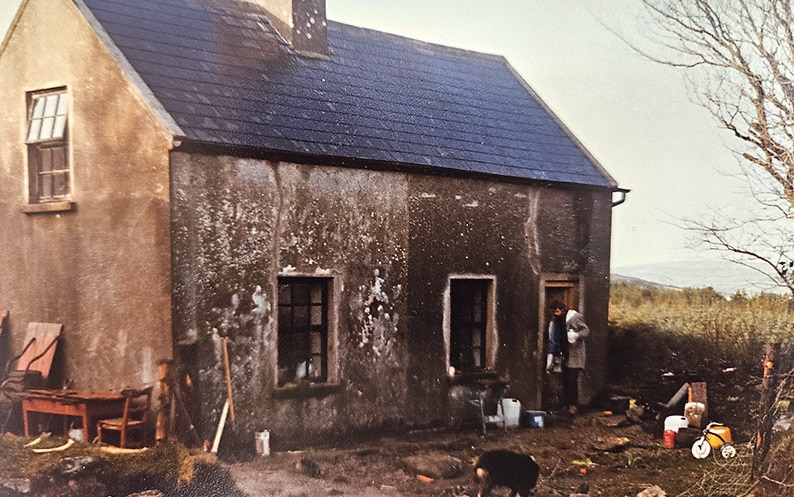
“Life was so basic but our surroundings – the wildness of the land, the ocean – were so fantastic, that it made the challenges and insecurity bearable,” says Fred. “The questions we asked ourselves at that time were very simple: ‘Will we keep the roof on tonight or will it blow off!’.” The family didn’t have a car for the first year and Fred recalls cycling to the village of Ballineen from Rossmore to do the shopping. “All I came home with was a white loaf, a floppy cabbage and a few carrots,” he laughs.
While life wasn’t easy, there was a strong sense of community with many lifelong friendships forged. “We were a part of the community and participated in many ‘meitheals’ – bringing in the hay or cutting the turf with our neighbours, helping to do up each other’s houses, that kind of thing,” says Fred.
A member of the West Cork Organic Growers cooperative, which he helped to get off the ground in the mid-eighties, Fred grew a selection of vegetables on their acre of land, as well as rearing fowl, which were sold through the distribution centre at Bridgemount House in Dunmanway.
A mix of different nationalities mainly farming in the Ballineen area, the West Cork growers broke new and exciting ground in 1987 when they were granted use of the brand new IOFGA (now known as the Irish Organic Association) soil symbol. “It stood for produce grown without the use of pesticides and fertilisers in high quality soil,” says Fred. “We belonged to the first wave of organic farming in Ireland and our aim was not only to grow high quality food but to show our farming neighbours the advantages of organic methods and to influence the way Irish food is produced.”
After he and his wife separated, Fred moved to Clonakilty for a period, where he lived in a tiny flat, finding work with the local Council and joining the famous street theatre group, Craic na Coillte.
In the early 90s, after his divorce was finalised, he settled in Bantry with his two children. It was while living here that he met his longterm partner of 35 years, gardener Julia Kemp. In 1992, they were both involved in the start-up of the healthfood store Essential Foods – better known today as Organico – with Alan Dare, a project which began on a shoestring budget. Around this time Fred was also instrumental in the setting up of the country market in Bantry.
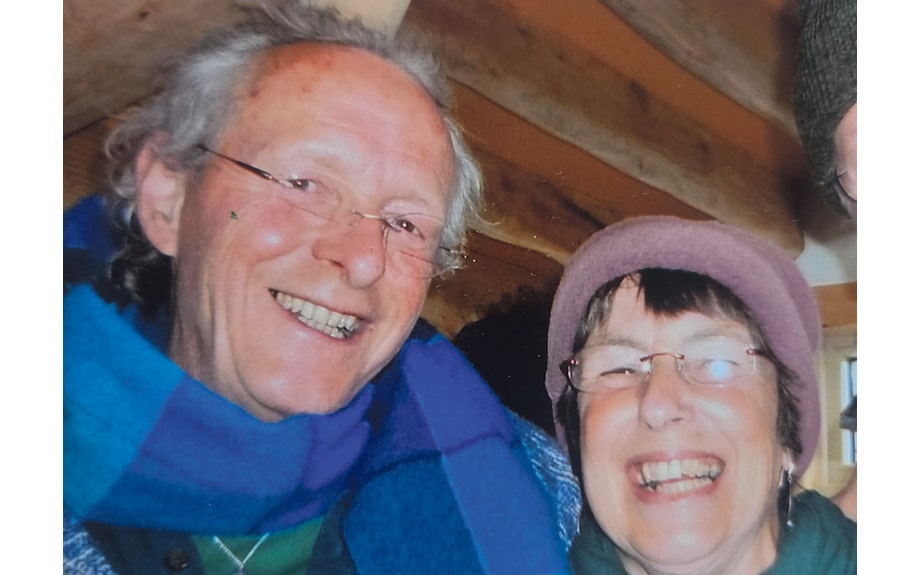
A few years later, in 1996, Fred chaired a group that set up a system of trade in the Bantry area that worked without money, through which people exchanged goods and services.
The LETS (Local Exchange Trading System) in Bantry had its own currency known as BATS (Bantry Area Trading System). It encouraged people to help each other out, operating successfully for a number of years with transactions recorded by means of cheques written in LETS units.
“We traded in whatever anybody had to offer, knitting, babysitting, walking the dog, you name it” says Fred, who was best known for organising ‘meitheals’ and bringing a chef along.
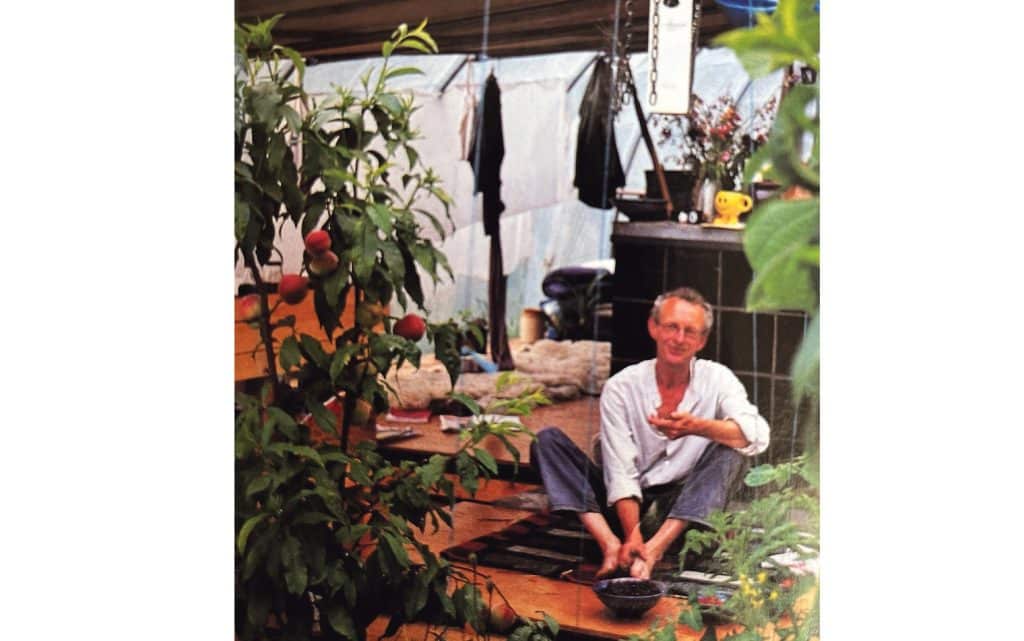
Then the opportunity arose for Fred – who at this stage was an enthusiastic advocate of organic growing and sustainable agriculture – and Julia to be part of a collective purchase of 30 acres of land edged by the River Lee in Ballingeary. They lived at this site, which they named ‘Slí an Uisce’ (Way of the Water), for over 20 years, during which time Fred – living by the principles of permaculture – earned the moniker ‘the man who lives in the polytunnel’, after creating a home and a garden within the confines of a tunnel measuring 9m x 16m. “I wanted to live among my plants,” he says of this extraordinary lifestyle. “It was a continuous learning experience and experiment and inspired so many people.”
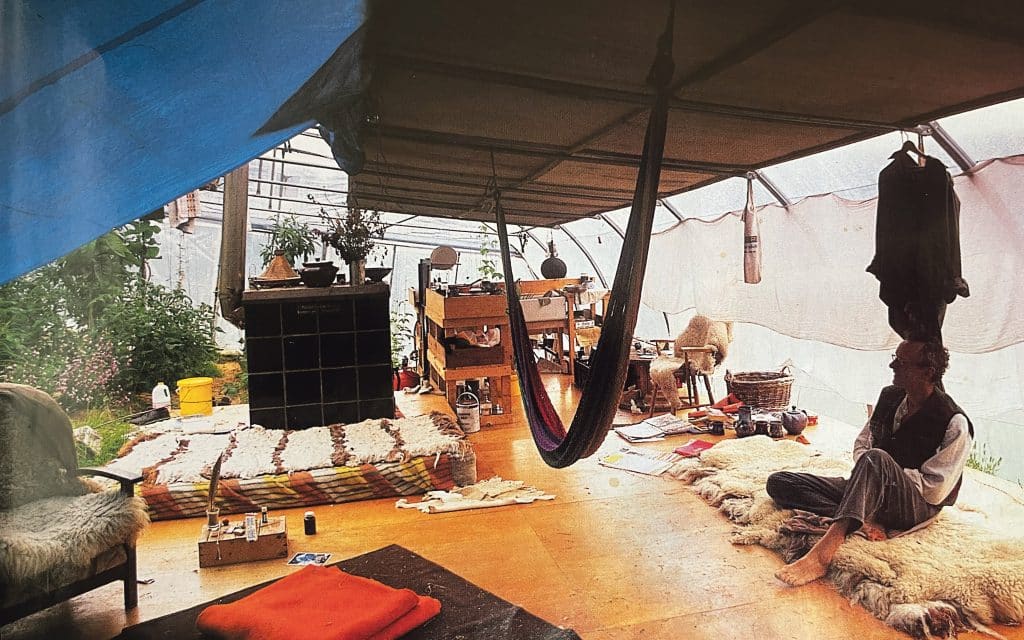
In the summer the tunnel was opened up to allow fresh air to circulate and in the winter it was heated by a large stove. Nothing was wasted, with ‘grey’ water and tea leaves emptied directly around the base of the plants to feed them. Fred shared his home with frogs (who helped keep the slug population down), lizards and a friendly musical robin. At night it transformed into a space lit by candles and the full moon. With the smell of flowers, ripening peaches and grapes filling the air during the summer and fresh beans an arms-length from the cooker, it was as close to Utopia as he could get.
Eager to share their experiences and learnings and to bring the community together around food growing, Fred and Julia launched the ‘Bia Ghleann na Laoi’ group, hosting a number of innovative talks and workshops on sustainable practices at Creedon’s Hotel in Inchigeelagh and raising important points around peak oil and food security to different community groups in the Mhúscraí area
A Harvest Festival initiated by ‘Bia Ghleann na Laoi’ provided the launching pad for a farmers’ market in Inchigeelagh and a community orchard in Ballingeary. Designed by Julia and kindly sponsored by local plant nursery Future Forests – ensuring that local children would be able to pick fruit for years to come – the orchard was planted in collaboration with the village Tidy Towns.
“We wanted to bring the people who produce food and the people who consume it together and open up new ways of doing things in the community, particularly around food resilience,” shares Fred.
In 2016, on World Water Day, the group organised an initiative entitled ‘Salmon Come Back’, focusing on the health of the River Lee and its impact on local communities.
With the current oil crisis and the world’s food systems dangerously dependent on fossil fuels, Fred’s hope is that the work done by ‘Bia Ghleann na Laoi’ will continue to make a difference at local level.
Fred eventually retired to Bantry back to the same house he lived in before. It’s on a quiet street overlooking the town with a garden that mostly looks after itself. The house is small but comfortable, easily heated by a large stone stove and filled with books, plants and interesting items collected over the years.
He gets around locally by walking or cycling and, if he needs to travel further afield – for instance to visit his children and grandchildren in Glengarriff who he values spending time with – he plans his route using the bus timetable. “We used to be so isolated in West Cork but we have such a good public transport network nowadays that it’s very easy to get around without a car,” he says.
While the Dialogue sessions in Clonakilty ran their course, he still hosts a regular session in Bantry, at the Bridge Street Community Cafe every fortnight on Wednesday mornings.
After a lifetime of doing, today the soft-spoken Dutchman is happy to mostly just be. From his kitchen he has a view of the hawthorn and the wildlife that visit his untamed patch. Fred spends a lot of time here at his table…writing, thinking, listening.