
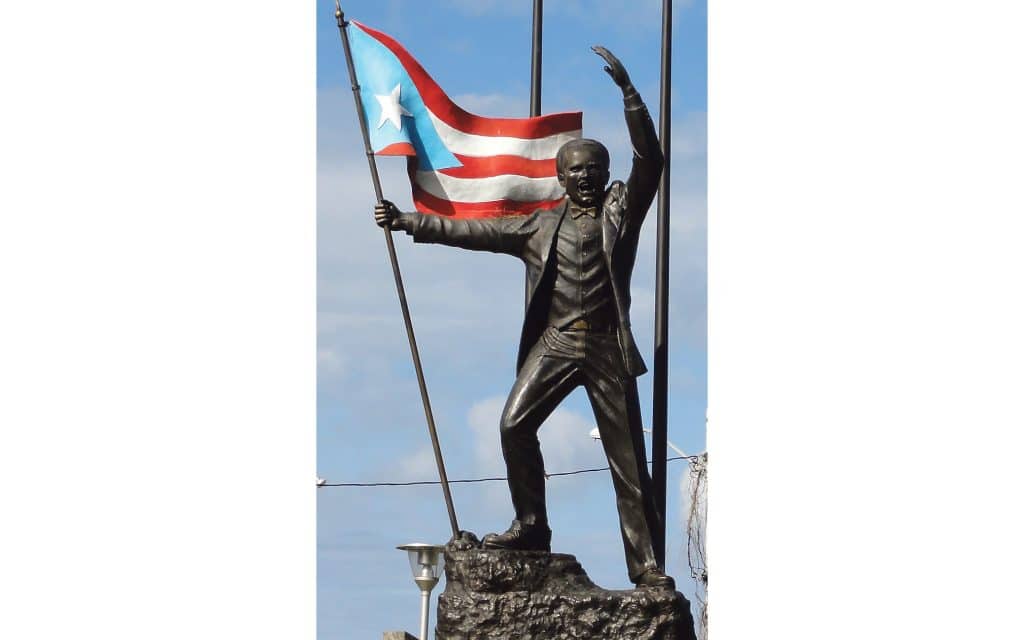
It was while reading the compelling story of Puerto Rico’s nationalist failed uprising against American colonialism that I stumbled onto a connection between the leader of the uprising, Pedro Albizu Campos, and Eamon de Valera. Nelson Denis, author of ‘The War against all Puerto Ricans’ wrote that ‘Albizu Campos had helped Eamon de Valera draft the constitution of the Free State’ – which of course is incorrect because Dev and his anti-treaty republicans bitterly opposed it. But like all historians, we carry that most necessary trait – curiosity. While Nelson Denis may have erroneously mentioned the Free State constitution, he certainly was correct that Albizu met Dev, and what’s more, modelled his Puerto Rican revolution on the 1916 Rising.
It turns out that Campos was something of a child genius and despite his improvised background, gained entry to Harvard University in Cambridge, Massachusetts. After serving patriotically and bravely in World War One for the US, he returned to Massachusetts, this time completing his law degree in Harvard in 1921, becoming the first Puerto Rican to graduate from that great institution. It was here in Harvard, where he met Eamon De Valera who of course was engaging in a fundraising American tour between June 1919 and December 1920. There is British Pathe footage of the massive crowds that assembled to meet and support Dev in Boston, where he was welcomed with vibrant enthusiasm by adoring Irish Americans, many first generation émigrés or descendants of The Great Famine.
Swept up by a wave of Irish euphoria, it seems Campos was well placed to meet and learn from Dev about the Rising in 1916, Sinn Fein and the Irish War of Independence that was in full sway at this time. Looking closer at Nelson Denis’s footnotes, he mentions a Puerto Rican writer with Irish heritage – Aoife Rivera Serrano’s, quoting her book ‘Ireland and Puerto Rico; The Untold Story’ in reference to this event. Digging a little deeper, I went in search for more of this, only to find that Ms Serrano has also published (in 2012) a book entitled ‘The Quickening of Albizu Campos: How Fenianism Galvanized the Last American Liberator’. In it she claims that Albizu was influenced by Fenians. They were very active in American circles since 1870, under the flagship of Clan Na Gael, and were the supporting body that organised Dev’s tour of America. In that book she reveals how Campos was initially exposed to ‘members of the American Anti-Imperialist League and Irish American Union, whom Campos encountered in Harvard Library’. From them, Albizu Campos would learn that many Irish soldiers ‘fought for the Union to learn skills they could take back to Ireland in the struggle’, something he would do in his own homeland. Whatever the Irish connection, there is certainly one thing both movements for independence shared – tiny resources against a mighty adversary.
One of his greatest attributes was his rhetorical and oratory skills. At a lecture in the Sanders theatre at Harvard, he was outspoken in support for Irish independence. Lord Miller, a British imperialist nobleman in attendance, admitted ‘it was the most brilliant speech on the matter I ever heard’. Campos would also visit the Irish dominated administrative wards in Boston to canvass for money for Sinn Fein and the Irish revolution.
The geopolitical situation in 1898 brought into conflict, the once mighty but increasingly brittle Spanish imperialistic powers, with the world’s fastest growing military power, the USA. The Americans also ‘liberated’ the Philippines in that year yet continued to occupy them until finally relinquishing power in 1946. In 1898, they also added Hawaii and Puerto Rico to their imperialistic real estate. The irony in Puerto Rico’s case, was that the Spanish had promised the islanders independence not long before the Americans ‘liberated’ them from Spain.
Their freedom from Spain was only the beginning of their colonisation by the US. Within a decade of saving them, their Spanish tongue, like Irish, was slowly being obliterated. (The Spanish as we know were as bad a coloniser as any country and had long wiped out the indigenous Taino tongue from memory). An act in 1902, made law that all public office, courts and local government departments use English as a coequal language. By 1909, English had become the dominant language of instruction in schools. Later, The Puerto Rican flag and their national anthem, ‘La Borinquena’, was outlawed under the 1948 Gag Law (‘Ley de la Mordaza’). By 1922, the year Albizu formed the PR Nationalist party, the country was declared a territory by the USA supreme court, as it remains to this day. This means that the protective rights of the American constitution did not apply to the people. Economic hardship already a factor in life, became worse particularly for the sugar cane workers which was the dominant employer. Without the protective rights, they endured colonial taxes, devaluing of the peso all intended to squeeze them out of land ownership, only to be hoovered up by large American corporations, intent on gaining access to the ludicrous cash crop and creating American monopolies. By 1934, 80 percent of the sugar cane farms were owned by American syndicates and it would even get worse.
Albizu became a champion of the workers and, using his lawyer credentials, tried to help the workers and backed their strikes. In an age where communism was growing globally, any nationalist movement that had a socialist agenda as part of its manifesto, was easily tarnished with the stigma and threat of red terror. This is what would happen to Campos and his nationalist party to try to discredit his socialist agenda. Even today, some in Puerto Rico only know him erroneously as a ‘communist agitator’. What Campos was witnessing, was the development of a feudal type grip over Puerto Rico that was not only impoverishing the natives and enriching the Americans, but also attempting to eradicate any sense of national identity. Puerto Rico was ruled by a set of military governors in those days, rather than civic politicians. The most notorious was General Blanton Winship, whose goal was to crush the labour strikes, and to dismantle and destroy the nationalist party, which had been gaining popular support. In moves reminiscent to British rule in Ireland, Winship imprisoned leaders, prohibited public demonstrations and banned speeches at funerals (Campos would have known and understood the power of those such as O’Donovan Rossa’s funeral and Thomas Ashe’s funeral, as powerful catalysts for the Irish revolution movement).
Winship’s iron rule was best demonstrated by the 1937 Ponce massacre, where 17 civilians, including a child of seven, were shot dead and clubbed in the streets while out demonstrating. Over 200 more were injured by the Insular police force sent there to crush it. This too had shadows of the cold-blooded massacre of twelve Irish civilians in Croke Park in 1920, at the hands of the Auxiliaries. In both cases there were false claims by the ruling authorities of shots being fired at the police forces. Neither were there repercussions for the ruling power. However, unlike Ireland, the Ponce massacre, was erased from popular history, and would have remained so, if it was not for the amateur footage taken by a young film maker, Juan Emilo Viguie. Despite having actual evidence of the atrocity, he knew to release it publicly would have led to its censorship or destruction by the omnipotent power that was the USA. Albizu and other leaders would be rounded up, exiled or imprisoned. But their spirit would live on and would re-emerge in the 1950 revolution.
Albizu had to painstakingly build up the movement once again that had been savagely suppressed. But worse was to come. It was the era of the Red Scare all over the US, which had created a culture of paranoia against anyone who was un-American. US intelligence agencies increasingly monitored and infiltrated nationalist movements during the early Cold War period. The US was now the global dominant power after World War Two and the nationalist movement was poorly armed and low in numbers. Albizu knew any rising would only be a way to draw the world’s eyes to the cause of freedom and abuses within Puerto Rico, similar to Easter 1916. The revolution was easily put down, not before the town of Jayuya was bombed from the air, the only time the US has bombed its own citizens (again – parallels to the British burning of a British city – Cork in 1920). What garnered even more attention was how close two Puerto Ricans came to successfully assassinating the president Harry Truman, days later.
Unlike MacSwiney, or Padraig Pearse, or Tomás Mac Curtain – the US would not make a martyr of Campos. He and the other nationalist were not shot but arrested. The men were locked into cells in horrendous conditions in San Juan, in what we must not forget was American territory and under American law. Many of the men were tortured to ‘supply names’ of other nationalists, including methods such as electrocution. It had mirrors of a cold war movie, but it’s not the maligned Soviet’s doing the torturing, but the so called ‘good guys’. The strangest event were the lesions, headaches and burns Campos was getting, but not from overt abuse. Doctors (selected by the USA) declared he was going mad but when he finally got independent medical attention, via massive international pressure, his wounds were akin to radiation exposure. The United Nations denounced it as torture and demanded his extradition abroad in 1952 but to no avail. The swelling, burns, headaches continued until he eventually suffered a stroke, which silenced the most outspoken voice of Puerto Rican nationalism. By 1956 he was dead and with him a nationalist dream for independence. But unlike the Irish story where from the attempts to silence our martyrs, grew screams for freedom; the echoes of the ghost of Campos, sadly are still only a whisper today.