

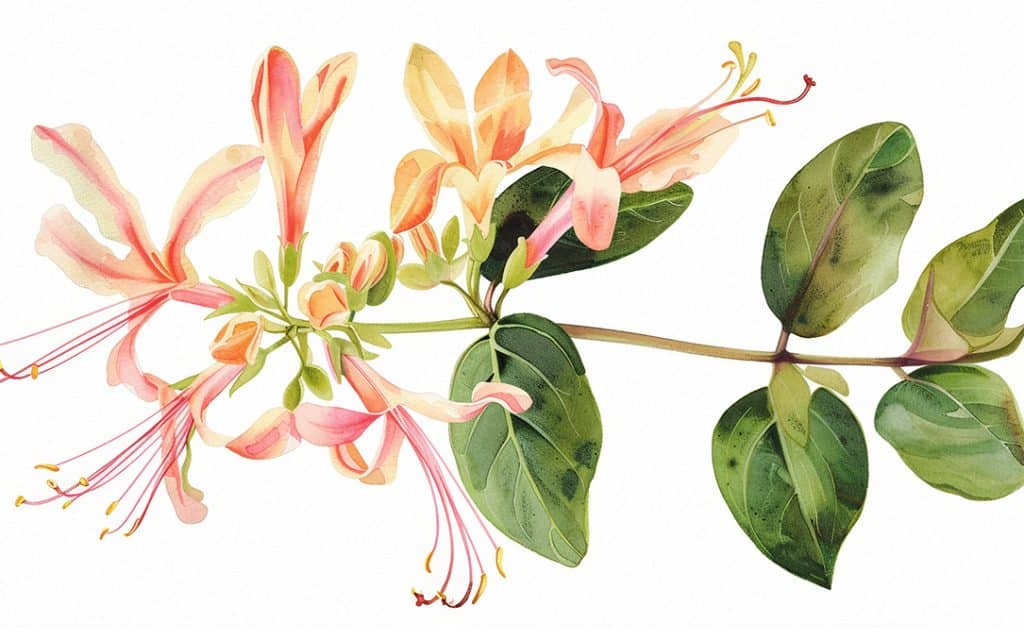
Honeysuckle, with its bright flowers and sweet perfume, is a symbol of beauty and summertime. However, the wood of honeysuckle, although it begins life soft and flexible, becomes very hard as it matures, with the ability to choke off the growth of any other wood by binding it tightly in its grip. This has made it a symbol in Irish legend of strength and slow inexorable power, which led to the Irish saying that anything that was hard to break was ‘chomh righin leis an táith-fhéithleann, as tough as the honeysuckle.
In Ireland, honeysuckle was believed to have a power against evil spirits and it was used in a drink to cure the effects of the ‘evil eye’. In parts of Scotland on May Day farmers put pieces of honeysuckle and rowan over the doors of the cow houses to prevent the goodness of the milk being stolen by witchcraft. In the Hebrides, they used to make a death of ivy, honeysuckle and rowan and placed it over the lintel of the cow house and under the vessels in the dairy to safeguard the cows and their milk from evil. On the Isle of Man, honeysuckle was considered good ‘to keep milk from stinginess and butter from blackness’.
The flowers of honeysuckle are full of nectar and a favourite pastime of children was to suck them for their sweet taste and this trait gave honeysuckle its name. Honeysuckle is also known as woodbine. In Irish it has several names – ‘féithleann, táith-fhéithleann, bainne gamhna’ (calves’ milk), ‘lus na meala (the herb of honey), ‘mil ghabhair’ (goat’s honey). In the 1950s, in West Cork we called it ‘táith-fhéithleann’.
In England, honeysuckle has romantic associations. If it is brought into a house then a wedding will follow and, if its flowers are placed in a girl’s bedroom, it will bring her dreams of love. Honeysuckle is mentioned by Shakespeare in a romantic context, ‘Sleep thou and I will wind thee in my arms / so doth the woodbine – the sweet honeysuckle gently entwist’.
In Irish, the name ‘bainne gamhna’, (literally calve’s milk) refers to the idea of something sweet for sucking. The name appears in the well-known old Irish song, ‘Samhradh, samhradh, bainne na ngamhna, Thugamar féin an samhradh linn. Samhradh buí na nóiníní glégheal / Thugamar féin ansamhradh linn’. (Summer, summer, the honeysuckle / we brought the summer with us / Golden summer of bright daisies / we brought the summer with us). The song was traditionally sung at Maytime as part of the festivities, when there was singing and dancing and making garlands of flowers.
In the great Irish tale, ‘Táin Bó Cuailgne’ (The Cattle Raid of Cooley), Cuchulainn is goaded into fighting the great friend of his youth, Ferdia. Ferdia had left Ulster and fought with the Connaght men and Queen Maeve against Ulster, whose greatest warrior was Cuchulainn. None of the Connacht champions could beat Cuchulainn. Maeve’s last chance was to force Ferdia to fight his friend. Cuchulainn was goaded by the words that Ferdia “has bested you as a woodbine binds trees”. Later, when Cuchulainn finally turned the table on Ferdia, he himself uses the same image. He tells Ferdia to stand aside or ‘I will entwine you as a woodbine binds trees’. It is not the gentle embrace of love that is meant here, but the crushing of an enemy in an iron grip.
Honeysuckle’s themes of love and strength come together in the Irish tale of the love between the youth ‘Baile Mac Buain’ and the princess ‘Aillin’. Their love is ill-fated and they both die of broken hearts and are buried separately. A yew tree grows from Baile’s grave and an apple tree from Aillin’s and, after seven years, poets made writing tablets out of each of them. It so happens that the two poets later attend a feast at Tara at the same time, and the high king, Cormac Mac Airt, is impressed by both poems. He asks to see the two tablets and, as soon as he takes them into his hands, they spring together and become entwined like honeysuckle around a branch. So tightly are they intertwined that no-one could part them.
In traditional herbal medicine the flowers of honeysuckle have been used to make a syrup to cure diseases of the respiratory organs and asthma, and a decoction of the leaves has been used for diseases of the liver and spleen. The most common cure was to use the leaves and flowers for gargles and lotions for inflammations of the mouth, especially thrush. The bark of honeysuckle was used in counties Leitrim and Cavan as a cure for jaundice and in Cork and Wicklow as a cure for whooping cough. In other parts of Ireland, people used to chew it as a cure for toothache. Beekeepers used to smear their hives with honeysuckle flowers so that the bees would regard them as their homes and return to them. The leaves were a favourite food of goats, hence the Latin name for the honeysuckle family comes from ‘capri folium’ (goat’s leaf).