


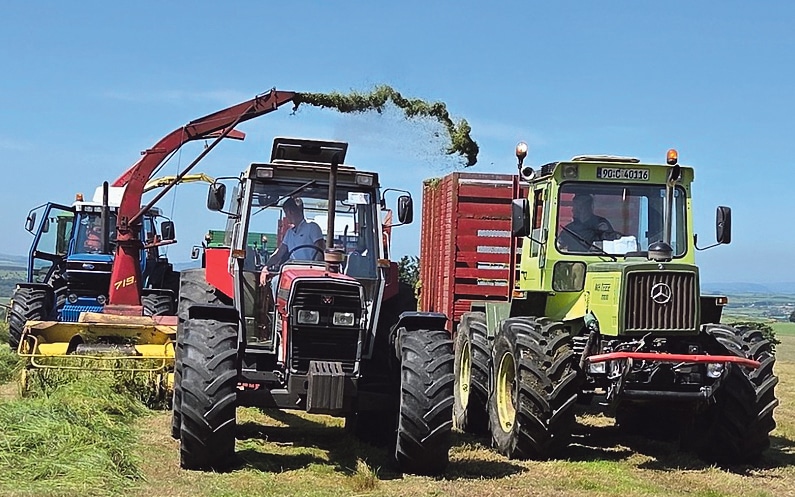
Vintage machinery in fine fettle at this year’s West Cork Harvest Day in Ballinascarthy
Himself works off farm but when it comes to the farm machinery side of things, he does most of the operating and maintenance on the gear we have. Much to his disappointment we don’t have a fleet of tractors and machinery so a phone call to our contractor is necessary when silage time comes around.
When the first fleet of silage contractors passes by our gate, it’s as if some sort of fever takes hold of him. I am immediately pestered to check the fertiliser dates and take grass samples to Teagasc or the Co-op to test the nitrogen and sugar levels, so that all-important phone call can be made. For a couple of hours, we have all the gear on the farm, and this is when he beams with pure joy.
Over 30 years ago, I did my stint drawing silage for the farm family I worked for. I was given a Massey 165 and a dinky little trailer, and all was going well until something metal cracked on the trailer. They replaced it with one twice the size. Three loads later, I was flying it. I backed up, tipped the trailer and pulled away, not noticing that the load had stuck. As I drove over a raised section of the yard, the trailer came off the tractor and beached itself on its side like a stranded whale. I can still clearly remember the swearing and the hands on heads that followed. Needless to say, my nerves were shot, and I was promptly relegated back to milking cows, a skill I went on to perfect instead.
On the morning of the West Cork Harvest Day in Ballinascarthy, himself excitedly suggested we head over for a look at the vintage tractors and harvesters. How could I possibly refuse such an exciting offer?
We made it into the field just as the vintage machinery was lining up for the first harvesting demonstration and, much to my surprise, I actually enjoyed watching it (no PTSD!). All of the tractors were in great fettle and were clearly the pride and joy of their owners. We even got notions about restoring our well-aged little David Brown at home, which these days either scrapes the yard or has the power hose attached to it.
That, of course, led to him reminding me that we need a higher-horsepower tractor to pull the LESS tanker up the road to the silage ground. It’s a regular conversation in our house because when the LESS tanker was being bought, the chief financial officer (me) said, “We can buy that tanker, but the tractor you have must be able to pull it.” Technically, it can, but hauling full loads of slurry uphill to the silage ground seems to be taking its toll on our 15-year-old tractor, which definitely wasn’t built to stand the test of time like those vintage machines.
The conversation ended abruptly, as it usually does, with me saying, “Have you seen the price of tractors? It had better keep going for another few years.” I took out a five-year loan and applied for a TAMS grant to buy the LESS tanker, and with all the volatility in global milk prices, the thought of taking out another loan for a tractor gives me chills. Deep down, though, I know that day is coming, and when it does, we’ll need a tractor that’s capable of seeing us through the next 15 years.
A quick Google AI search tells me that a new 140-150hp tractor would set us back somewhere between €120,000 and €165,000 (plus VAT), so a spanking new tractor is definitely off the cards. The only realistic option for us is to go down the second-hand route, where a 2022-24 model would still cost between €85,000 and €115,000 plus VAT. It’s crazy money for a farm our size and highlights one of the major expenses many farmers eventually have to face.
It’s important to remember that every farming enterprise is different, whether it’s the scale of the operation, the level of debt from previous investments, labour requirements, whether it’s run on a full-time or part-time basis, the stage the business is at, or the year-to-year price volatility that affects every sector. Farmers are price takers, and regardless of the enterprise, there are countless challenges to securing a steady income that allows you to confidently approach a financial institution for a loan.
According to the recently published Teagasc National Farm Survey, 2025 was an exceptional year, with welcome increases in incomes across all farming systems. The average farm size nationally is 45 hectares, and average family farm income rose to just over €53,800 in 2025, an increase of 49 per cent compared with the previous year. These results highlight the positive impact that a period of strong milk, cattle and sheep prices can have on farm viability.
Thirty hectares is the average size of cattle rearing farms, which typically focus on suckler beef production. In 2025, average family farm income rose by 74 per cent to almost €24,100, an unprecedented level for this sector. Significantly higher young cattle prices contributed to a 22 per cent increase in gross output, while costs changed only marginally, allowing much of the additional output value to flow directly into higher farm incomes.
Other Cattle farms, including beef finishing and store cattle enterprises, recorded an 81 per cent increase in average income to €32,800, based on an average farm size of 34 hectares. Much stronger prices for finished and store cattle drove a 31 per cent increase in gross output, more than offsetting a 12 per cent rise in direct costs associated with higher feed and fertiliser expenditure. Farms operating dairy-beef systems also performed particularly well in 2025.
Average income also increased on Sheep farms in 2025, although the rise was more modest. Based on an average farm size of 53 hectares, family farm income increased by 7 per cent to just over €29,300. Gross output remained broadly unchanged, reflecting higher lamb prices alongside a reduction in output volume. However, a 9 per cent reduction in direct costs, combined with stable overhead costs, supported a further improvement in income compared with 2024.
Tillage farms (with secondary cattle enterprises) saw incomes rise by 33 per cent in 2025, reaching €54,900 (70 ha). Due to a substantial global grain harvest, grain prices were lower in 2025, but this was offset by a significant improvement in Irish cereal yields. This led to a seven per cent increase in gross output in 2025. Costs rose only slightly, allowing the improvement in output value to feed through to additional farm income. Data from specialist tillage farms (without livestock) will be reported in the final NFS report for 2025 due to be published later this year.
Dairy farm incomes increased by 41 per cent in 2025, rising to an average of €153,300 (69 hectares). The improvement in 2025 was driven primarily by stronger milk prices, an increase in milk output due to good weather, and higher prices from calves and cull cows, which contributed to an increase in gross output on the average dairy farm of 13 per cent. While the average income on dairy farms considerably exceeds that of other farm systems, the intensive, full-time nature of dairy farming means that they require a higher level of labour input than any of the other farm systems.
An outsider looking in might think that this is reflective of what farmers make every year, however the reality is very different. Go back to the 2023 NFS and you’ll see the average dairy farmer’s income dropped by 69 per cent, sheep by 22% per cent, cattle rearing by 15 per cent and tillage by a whopping 71 per cent in one year.
Will there be a loan taken out for a tractor? Himself is living in hope and has great faith in the magic wand waved by this farm’s chief financial officer. So he has been given the go-ahead to start the search. Perhaps we’ll make an offer to buy one of those big old vintage tractors that have stood the test of time?