


By Nicholas Mitchell
If you visit one of West Cork’s estuaries during July and August, you may notice something puzzling. Two Black-tailed Godwits standing side by side can look remarkably different, even though they belong to the same subspecies, ‘Limosa limosa icelandica’, which breeds in Iceland.
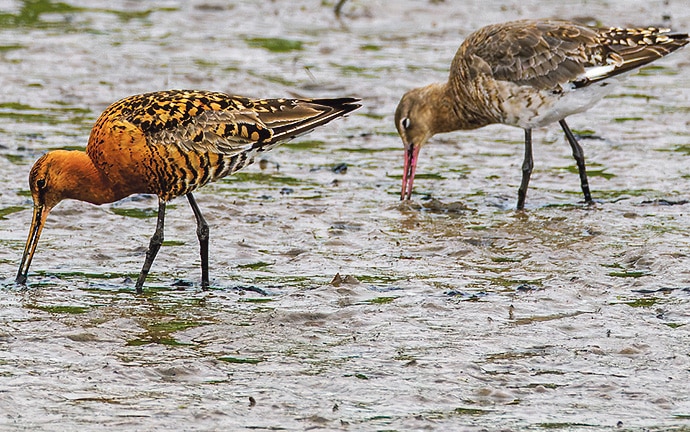
I photographed the two birds in the first photograph on Rosscarbery estuary in early July. One has a bright orange bill and rich chestnut breeding plumage, while the other is much duller with a pink bill and patchy grey feathers. So why the difference?
The plumage of the bird on the left indicates that it almost certainly remained in Iceland long enough to breed successfully. Females often leave the breeding grounds first, immediately after the chicks hatch, leaving the males to finish raising the young. This is why brightly-coloured adults in breeding-plumage start appearing in Ireland from late June onwards on their return migration, and why this is more likely to be a female. She is also just beginning her moult and transition into winter plumage. Over the coming weeks, the bright orange bill will fade to a dull pink, and its rusty feathers will be replaced by grey ones, providing a more suitable camouflage for muddy estuaries.
The bird on the right tells a different story. With its pink bill It could either be an adult that failed to breed successfully or an immature bird spending its second summer in Ireland. How can we tell?
Failed breeders have patches of rich chestnut-orange feathers on the neck, breast, and belly. Because they were in breeding condition only a few weeks before, they are actively shedding their bright feathers, creating a somewhat messy, patchy mix of bright orange and new grey winter feathers. They will also be hungry and feed intensely on the mudflats.
On the other hand, immature (non-breeding) birds never developed the rich chestnut breeding plumage in the first place. Their feathers are uniformly dull grey-brown, heavily worn and faded after a year without moulting. They have remained in Ireland throughout the summer instead of migrating to Iceland, and generally spend much more time roosting than feeding.
The bird that I photographed was feeding actively and still showed a patchy orange chest with distinct dark horizontal bars and a lower belly that looked ‘dirty’ and mottled, as it moults out of its summer coat. This is strong evidence that it was an adult failed breeder rather than an immature non-breeder.
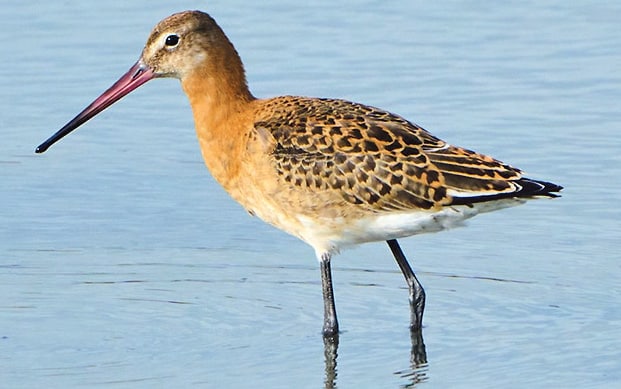
By the time you read this, a new generation of Black-tailed Godwits will be arriving in Ireland on their first migration, south to their over-wintering grounds. Juveniles are particularly attractive birds. They have a lovely bright plain peachy breast and dark grey-brown upper feathers with neat, pale buff edges, that gives them a scaly pattern (see the second photograph, kindly provided by Ciarán Cronin).
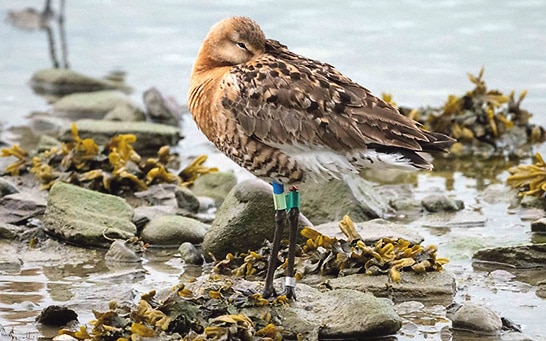
Next time you visit one of West Cork’s estuaries, take a closer look at the Black-tailed Godwits. With a little practice, you may be able to distinguish between newly arrived juveniles, second-year birds that never migrated, and adults returning from their breeding grounds. While you are out watching the waders, also keep an eye out for birds with colour leg-rings. Recording and reporting these rings allows scientists to track migration routes, survival rates and breeding success. All that information helps to improve conservation measures for these remarkable birds. The third photograph, taken in August 2019 on Clonakilty Estuary, shows a colour-ringed Black-Tailed Godwit. This bird was ringed as an adult in Portugal in November 2011. it has since been recorded in Portugal, the Netherlands and Ireland, illustrating the extraordinary journeys these birds make each year.
If this has sparked your interest, and you would like to learn more about the birds that are on the estuaries near you, then why not join us in August, either in Timoleague or Rosscarbery (details below)? Families and beginners are especially welcome.
BirdWatch Ireland
West Cork Branch News
Upcoming outings being held by the Branch are:
Sunday, August 9:
Timoleague Educational Garden
Sunday, August 16:
Heritage Week – Rosscarbery
Sunday, August 23:
Pelagic boat trip
Visit our website www.birdwatchirelandwestcork.ie for more information about these events. For more information about the Branch, contact Fiona O’Neill at [email protected].
f@BirdWatchIrelandWestCork
c@birdwatch_ireland_west_cork