

On a recent trip to Antwerp my intrepid partner and I found ourselves in hardhats traversing the city’s historic canals. But for flash lights we were in darkness, walking in a line along a canal bed, for the waterways, known as ‘ruien,’ had been vaulted over, enclosed, for many hundreds of years. We were effectively walking underneath the city, traversing the route that canal barges may have once taken, passing under what once would have been bridges and sluice gates.
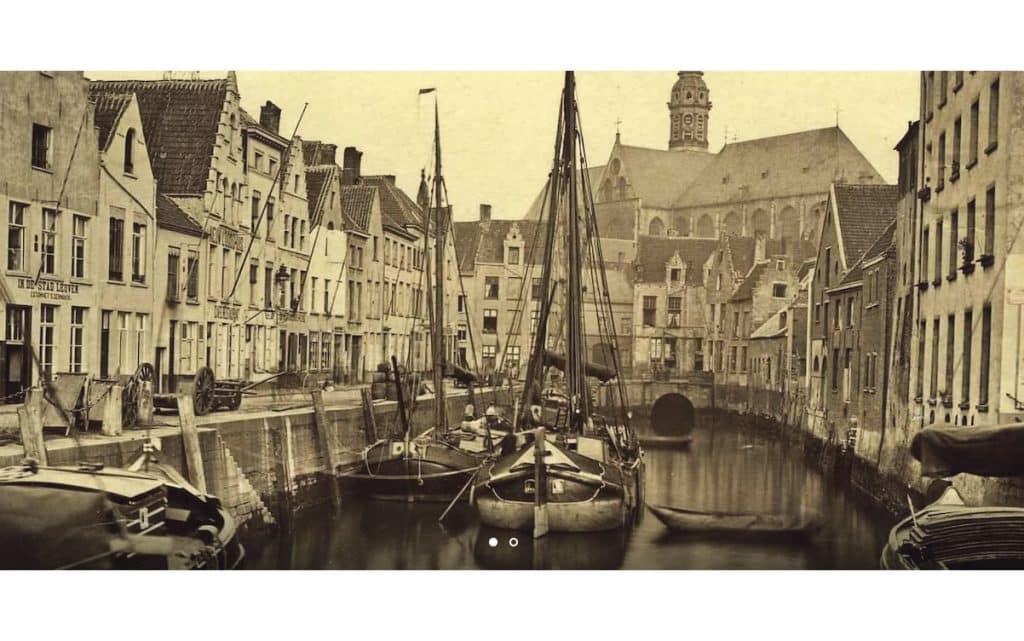
Being a book-hound, I later found a wonderful tome with photographs of the ruien from the 1800s. There, in sepia, standing tall in the openings of the ruien, were ships, slim one-masters huddled hull to hull along the canal walls; and larger three-masters docked along the Jordaenskai, the quay breasting the River Scheldt. The photographs also showed, amongst the tall ships in the Willemdok, the tall, dark flues of steam ships, for this was the age when both the new and the old mingled together, as famously depicted in William Turner’s ‘The Fighting Temeraire.’
Turner’s painting of 1839, set across the channel on a pearlescent River Thames, shows England’s gallant old warship being towed by a dark-flued tugboat. The warship was at the end of its life, a metaphor for what would soon be the end of the ‘age of sail,’ as the industrial revolution powered ahead.
Just as steam power revolutionised shipping, the birth of photography began to revolutionise the way that we see. The photographs reproduced in my fortuitous find stand in stark contrast to Turner’s painting. They are not regarded as great works of art, but as traces of moments frozen by a mechanical device. They are the work of a new technology, of a mechanical eye, that would soon vie with the painter’s hand for supremacy in the realm of simulacra, in the realm of reproduction.
Photographs from the 1800s always feel ghostly: stevedores at work rolling barrels along the quay of the Brouwersvliet (the Brewers Canal), passengers and sailors grouped at the Willemdok, boys wading into the Margueriedok at low tide. The latter are seen in a photograph from 1897, and one cannot help but wonder at the lives they lived. For where a painting of the same may have been in some way staged, edited or invented, our attention taken by the brushstrokes and the whimsy of the painter, there can be no doubt in the photograph, of a moment frozen in time, of the hesitancy of one boy and the daring of another, at the light and shadow of a particular time of day, of the longboats, half in the water, beside them. Who were those boys? What lives did they live? Did they survive the Great War? Did they survive the month? Did they know the legend of ‘Lange Wapper,’ the trickster who would lead one into the waters?
‘Lange Wapper’ is a mythic figure in Antwerp, a shape-shifting trickster of the canals who would lure drunks into the murky waters late at night. A sculpture of the trickster graces the forecourt of the Steen, Antwerp’s ancient fortress facing the Scheldt. As in the photographs of the boys, there is no changing the sculpture’s shape. The ‘real’ Lange Wapper is the spirit of calamity, a legend forged, perhaps, to warn a populace against the treachery of Antwerp’s ruien, the malign spirit of the hungry waters that could cut lives unexpectedly short.
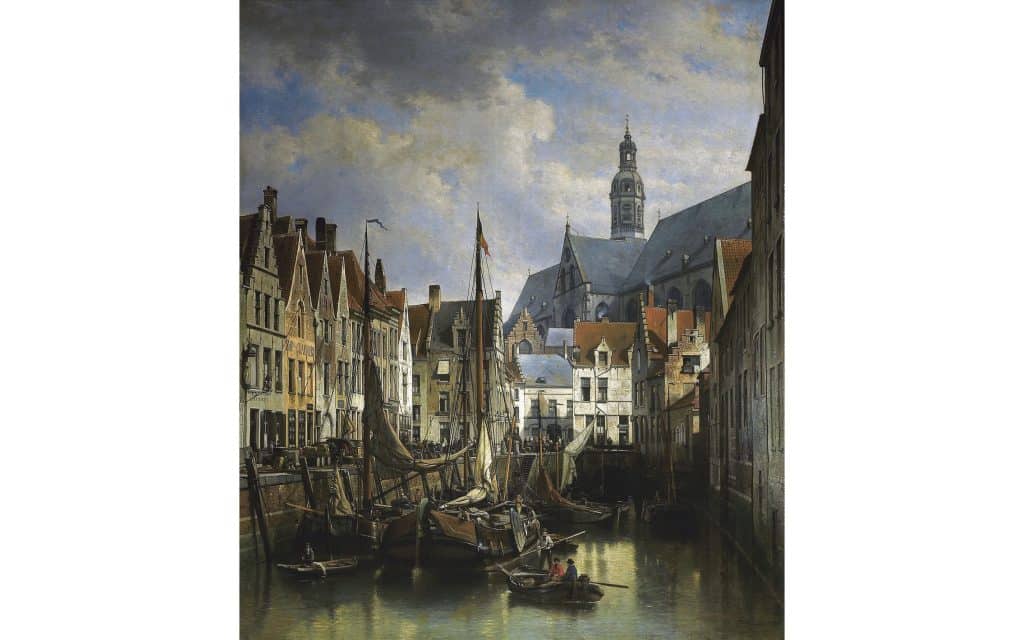
Old photographs haunt; they beg stories of past lives. That is not to say that old paintings don’t; in many cases they are far more alive. The main difference is that paintings are hybrid creatures: they tell us as much about the painter as about their subject, bearing as they do the visceral trace of the painter’s hand. A good example here is ‘A view of the Koolvliet’ (the Coal Canal) from 1875, by Jan Michiel Ruyten, which predates a photograph of the same canal from 1881. Working from life, Ruyten had no way of ‘freezing’ his figures; they are approximations, evocations, rendered with deft economy, giving us an authentic flavour of the life of the canal. The photograph, however, is tantalisingly free of that trace, one step removed from human touch, giving it the aura of time embalmed, at once alluring and distant, at once full of life and the knowledge of its passing.
The dialogue between photography, sculpture and painting, has in our own time, of course, a rich history. Think of Any Warhol’s famous screen prints of Marilyn Monroe, of Gerhard Richter’s series of blurred photo realist paintings. Perhaps most moving of all are Anselm Kiefer’s multitude of lead books, the ‘pages’ of which are endowed with photographic prints, seared and emulsified into the lead. Such ‘books’ Kiefer has, over the years, forged into installations: as mobile library shelves, as sculptural stacks, as the ‘cargo’ of lead model ships, which in turn are attached to monolithic canvases. Through the likes of Kiefer the contemporary artist has swallowed the photograph just as the whale swallowed Jonah, only for it to come out again as something new, an artefact transformed. And so here we are again with the ships; this time they are Kiefer’s: lead effigies of WWII, just as Turner’s ‘The Fighting Temeraire’ was an effigy of Waterloo.