


Summertime is the perfect time to pay attention to our feet. For most of the year they are bundled up in socks and shoes and much neglected beyond attending to their need for warmth. But in the summer our feet can come out to play and experience the earth beneath them as nature intended. It’s the time of year when I like to re-introduce my clients to their feet as they emerge from the cooler months. Our feet are the foundation of our body and strong and flexible feet will ensure healthy transfer of force through our body.
Fascial connections in the body create functional chains from the feet up through the legs and into the pelvis. These connections mean that foot mechanics can influence pelvic alignment and core engagement. The strength of our feet therefore, or lack of, has a direct bearing on our pelvic health and strength, which of course affects our posture and how we hold our body. Our feet are essential in the building and maintenance of a strong core. How are yours holding you up? Some of the spinal nerve roots that supply the pelvic floor also contribute to the nerves that supply the feet. This shared origin helps explain why lower-body mechanics can influence pelvic function.
So where do we start to improve the health and strength of our feet? Well first we need to determine where on the foot spectrum our feet rest.
Flat feet: This is where the arches ‘fall’ or lose structure and collapse. The loss of this longitudinal arch causes the feet to roll inwards (pronation), the knees to roll inward and the pelvis to tilt. Without the support of the arch the pelvic floor overcompensates and this overwork leads to chronically weak or tight pelvic floor muscles. Further up the chain it is harder to recruit strength, so we tend to collapse in the upper body and slump. It leaves us feeling tired, as our intrinsic postural muscles are not doing the work they need to.
There is a common association between flat feet and the formation of bunions at the big toe as the foot rolls in excessively when we walk and begins to drift towards the second toe. Also, plantar fasciitis and hammer toes can arise if we neglect our arches.
High arches
At the opposite end of the spectrum feet with high arches can be more rigid and stiff, which makes them inefficient shock absorbers, as the foot doesn’t flatten and spread sufficiently on impact. In this case the legs and hips overcompensate and the pelvic floor grips to hold the force. This can lead to shortening and tightening of the muscles in the back of the hips. And given the body’s compensation pattern here, gripping or ‘locking’ or bracing up the body through joints and muscles can become a common pattern.
While a flat foot rolls inward a high arched foot often rolls outward (supination), this can lead to plantar fasciitis, pain and inflammation on the ball of the foot (metatarsalgia), hammer toes or claw toes. Ankle instability often arises because the feet rolling outward means there is an increased risk of lateral ankle sprains.
Neither end of the spectrum is ideal for your feet and as you can see, both ends can produce the same conditions. A simple thing to check is where is the wear on your footwear…if your shoes are more worn on the outside you roll out on your feet and more likely fall into the high arch camp and if the wear is on the inside of your shoe you roll in on your feet and may have weak or collapsed arches.
What to do
As with all things prevention is better than cure. There is so much we can do to help ourselves feel better and I’m a firm believer in foot strengthening exercises. Thankfully there is a wealth of information available online these days. Orthotics or inbuilt foot supports are often advised to help with foot issues and indeed they can be a life-saver for many who genuinely need them, however in some cases, and with professional advice, it could be possible to see them as interim measure while foot strength is regained. Your podiatrist will doubtless be the best to advise you on this.
As it is summer we should endeavour to be barefoot as much as possible, so we improve the sensory capacity of our feet. How will we ever build healthy feet when our feet are encased in ever-increasing layers of foam and rubber. The cushioned layers of rubbery comfort sold as footwear these days are doing our feet no favours. Not only do they disconnect us from the ground, but their lack of breathability can create a warm, damp environment where bacteria thrive.
There is a rise in the popularity of barefoot shoes, shoes with much thinner soles that allow us to better feel the ground beneath us and thereby build foot strength, however most of us will need to strengthen our feet before purchasing them especially if we’ve grown accustomed to cushioned footwear. And bear in mind, not everyone is a candidate for these types of shoes; people with conditions such as hypermobility, diabetes and neuropathy or acute plantar fasciitis should get professional advice.
Practical tips and exercises
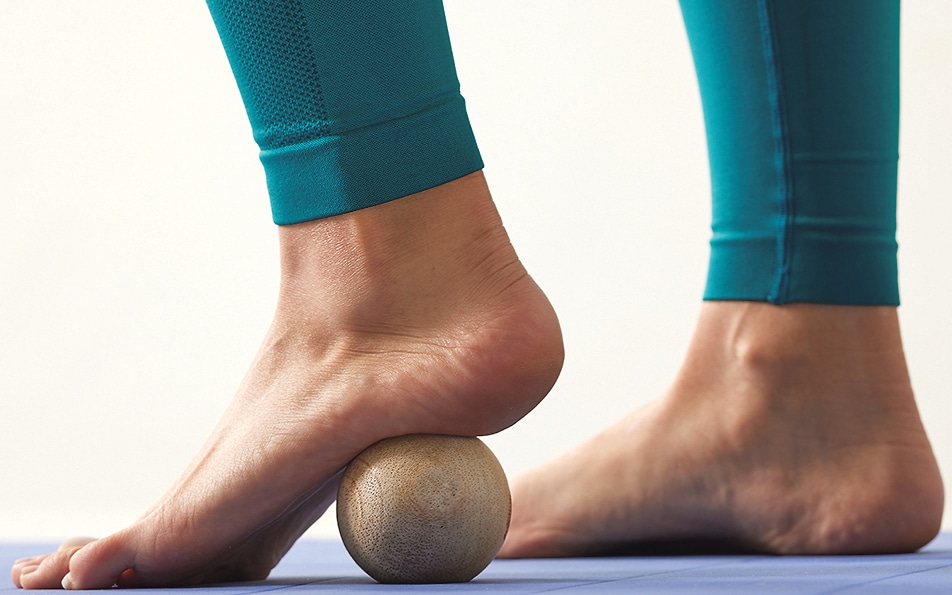
Rolling your foot: This is a fantastic way to increase sense perception in your foot. A tennis ball will work here but if you have a softer ball with a little bit of resistance such as a Franklin ball or something along those lines it is a little better. Gently but firmly press your foot into the ball and do a figure of eight massage for the soles of the feet. Hold it gently down on the arch (quite a tender spot so be aware here) and then lift the big toe towards you, this will give a wonderful stretch to the plantar fascia, the connective tissue on the sole of the foot. A great exercise for those with more rigid feet.
Roll the foot for about one minute and stretch for about one minute. Do take the time to feel the space and sensation you experience after using the ball.
Building your arches: An oldie but a goodie here, the towel stretch. Place a thin towel on the ground and position your toes on the nearest edge to you. Begin to curl your toes and draw the towel in as evenly as you can till you reach the far edge. Once you reach the far edge start to press the towel away with your toes till you have returned to the start. Repeat three times.
Another fun thing to do especially for children with fallen arches is to set a challenge to pick up pencils with your toes, start with picking up one or two and see how many you can pick up before your toes tire.
These are just some basic drills but there are many more out there. I recommend looking up Michelle Edmison’s work on mvmt.101 (on Instagram). She is currently offering a free five-day programme to strengthen your feet. The videos go directly to your email inbox, it’s wonderful to have such a quality resource available for free so avail of the opportunity this summer and get those feet in shape so can they serve you well.