


Dr Laoise Hook explains what can be done about pigmentation and why now is a great time of year to start treatment
After a summer of sunshine, even with SPF, pigmentation tends to be at its most visible right about now. Many of the treatments that work best for pigmentation, such as IPL and peels, work by making the skin temporarily more sensitive to UV light, so they need to be paired with strict sun avoidance and daily SPF during and after treatment. That’s a tall order in June or July, but with the sunshine easing off and the days shortening, autumn and winter give your skin the best possible conditions to heal properly without the risk of further triggering pigment. It’s also simply easier to stay consistent with treatment when you’re not dodging strong sun on the school run or heading off on holidays. Starting now means you can work steadily through a course of treatment over the coming months and be in great shape well before pigmentation has a chance to build up again next summer.
Pigmentation is caused by an excess of melanin, the pigment that gives our skin its colour. When skin cells called melanocytes produce too much melanin in a concentrated area, you get patches that are darker than the surrounding skin. It’s not one single condition. There are several different types, and knowing which one you’re dealing with matters, because the wrong treatment can sometimes make things worse rather than better.
The main types of pigmentation include sun damage, or solar lentigines, often called age spots or sun spots. These are flat brown marks caused by years of UV exposure and typically appear on the face, hands and chest. Melasma is a little trickier, tending to appear as larger, symmetrical patches across the cheeks, forehead or upper lip. It is strongly influenced by hormones, including pregnancy and contraception, as well as sun and heat exposure, and can be notoriously stubborn, sometimes flaring with the wrong treatment. Post-inflammatory hyperpigmentation occurs after the skin has experienced some form of trauma, such as acne, a cut or an aggressive treatment, leaving behind a darker mark as the skin heals and produces extra pigment.
Because pigmentation has different causes, treating it isn’t a one-size-fits-all job. The first step is always a proper consultation, where we work out which type (or combination of types) we’re dealing with. This is essential, because melasma in particular needs to be handled carefully.
From there, a combination approach usually gives the best results:
Homecare is, without question, the most important part of the plan. No in-clinic treatment will hold if the skin isn’t being properly protected and supported at home. That means SPF every day, without exception, plus targeted active ingredients to control pigment production between sessions. Importantly for those with pigmentation you need to be using a mineral SPF every day. The reason for this is that pigmentation is not just caused by UV but also by any visible light including overhead lights and computer screens.
IPL (Intense Pulsed Light) is very effective for sun damage and age spots, using light energy to break down excess pigment. Important note: IPL is not suitable for melasma, as the heat involved can actually aggravate it and make pigmentation worse.
Perfect Peel is a versatile option that can be used for either sun damage or melasma and even PIH, gently resurfacing the skin and encouraging even pigment turnover.
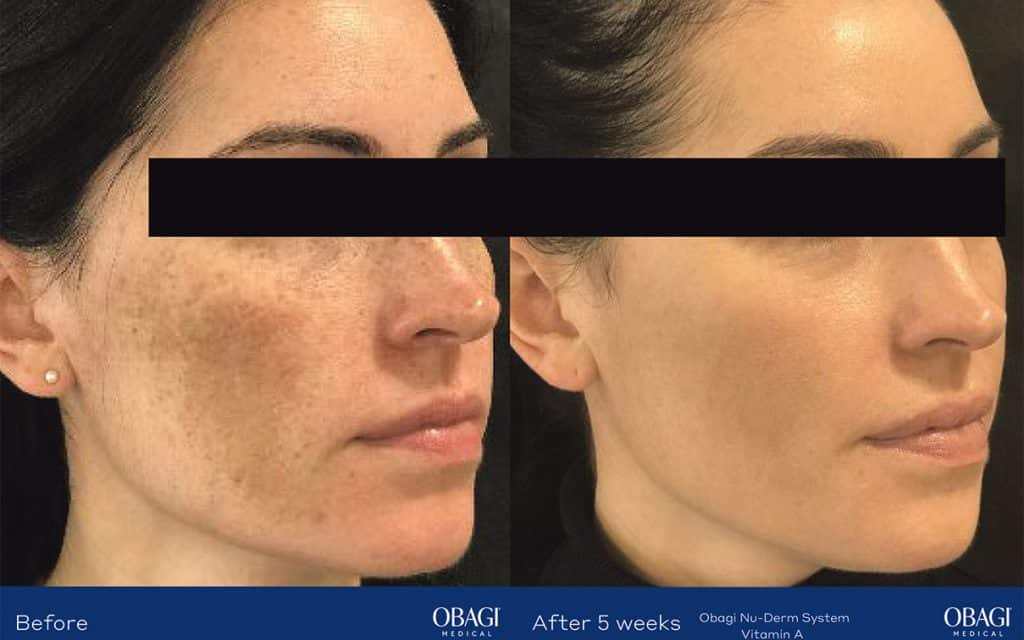
Obagi Nu Derm is a prescription-strength homecare system that we often recommend alongside in-clinic treatments, particularly for melasma. It works over a period of months to regulate pigment production at a cellular level.
Microneedling can help by encouraging the skin to renew itself and improve the absorption of active ingredients, making it a useful addition to a broader plan.
If there’s one thing I want you to take from this, it’s that pigmentation rarely responds to a single quick fix. The best results come from a considered combination of in-clinic treatment and consistent homecare, and homecare really is the backbone of it all. Without daily SPF and the right active ingredients, even the best in-clinic treatment will only offer a temporary improvement.
With the sun behind us for another while, now is the perfect window to get started. If you’re dealing with pigmentation and aren’t sure which type you have or what might help, it’s always worth coming in for a consultation so we can put together a plan that’s actually right for your skin.
www.thehookclinic.ie