


It is one of life’s ironies that in the digital age shipping holds the key to human survival. Without shipping there is no oil. Without oil there is no transport. Without transport shelves are not stocked. On another level, traversing the sea is the last resort of the truly desperate. In Australia I came of age with ‘the boat people’ filling newspaper headlines and dominating elections. How was the government going to stop the boats? How would they stop poor refugees giving all they had to board leaky vessels in Indonesia, in order to make the crossing to the promised land? Implicit in the headlines and the election promises was the idea that people generally agreed with ‘stopping the boats.’ It was an invasion after all. People smugglers were making a mint, and those poor refugees were dying at sea. Many of us, of course, did not believe that years of incarceration was the appropriate response of a civilised, humanist society. For that was the government’s answer: to deter through detention. And yet the boats kept coming.
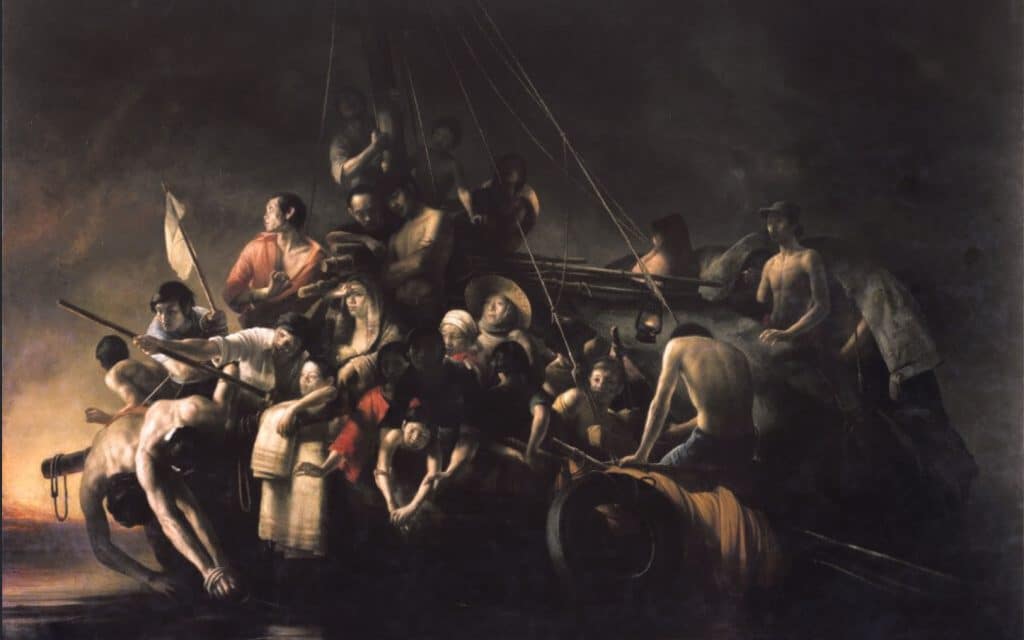
In 1979, Odd Nerdrum–back when he was still concerned with contemporary events–painted ‘Refugees at Sea,’ a monumental canvas (roughly 3x5m) which shone a Neo-Baroque light on the plight of the Vietnamese ‘boat people’ fleeing their country. It is an extraordinary work–a powerful grouping of figures, lit from the left by a setting sun; to paint it was a challenge for the young Norwegian painter to not only rise to the contemporary moment, but also to test his metal against the greats of the Western figurative tradition.
Throughout the 1970s Caravaggio and Rembrandt were Nerdrum’s great exemplars. By 1979 he had already painted two monumental groupings which resonated his Baroque masters: ‘The Arrest’ (1976) and ‘The Murder of Andreas Baader’ (1978). ‘Refugees at Sea’ was larger, more complex, more ambitious; an apotheosis of a decade of Caravaggio-inspired compositions, which allowed him to crest a technical wave of mastery he had not previously achieved. If a large part of Nerdrum’s motivation was to see if he could equal his masters from the past, then he certainly achieved his aim. Ironically, however, ‘Refugees at Sea,’ ‘The Arrest’ and ‘The Murder of Andreas Baader’ did not rise to the contemporary moment; all critics could see was a regressive return to the 17th century, to an outmoded way of painting; his neo-Baroque mode served to take the punch out of the very human drama he conveyed. This did not stop the Modern Art Museum in Oslo, however, from purchasing his paintings.
Such a critical reception was not the case for Jacob Jordaens, who painted ‘The Ferry Boat to Antwerp’ (1623), nor for Theodore Gericault, whose ‘Raft of the Medusa’ (1819) stands as Nerdrum’s most powerful antecedent. The former was possibly Nerdrum’s starting point, having had access to it at the State Art Museum in Copenhagen, whilst the latter must surely be seen as an important exemplar with its Caravaggio-inspired figures and composition. Indeed’The Raft of the Medusa’ is a towering masterpiece of the Western tradition, its historical and metaphorical import underscored by its size (5x7m), which itself would have been a challenge to Nerdrum.
The Medusa was a French frigate, a ship of state which foundered, and thus became for many an allegory of the Restoration (of the French monarchy), following the fall of Bonaparte. The ship, which was carrying the new French governor of Senegal, along with a secret mission to restart the slave trade, was wrecked en route to Africa on 2 July 1816. Of the 400 on board, 250 were granted places in the life boats, the remaining 150 having to make do with a raft lashed together from parts of the wreckage. Of these only 15 survived.
Both as a metaphor for the failure of the state, and an account of human tragedy, ‘The Raft of the Medusa’ is almost without parallel. Nerdrum’s work, by contrast, lacking the specificity of Gericault’s narrative, is tinged with a sense of social conscience and hope; a work more-or-less of social realism in which the down-trodden are made heroic. For where in Gericault’s work most are dead or dying, in Nerdrums’s the majority look with anticipation towards the rising (or setting) sun. Nerdrum would later repudiate his ‘Refugees at Sea,’ stating: “I will never make another picture like that, because not a single individual on board the fleet can guarantee for the quality I gave them. I transformed all of them to heroes, to beautiful saints seeking the good. But I have now come to a different conclusion. I do not think that man is good, but that he can become good… The idea was naive.”
Whatever Nerdrum’s thoughts on his work, ‘Refugees at Sea’ remains a historical touchstone and a powerful painting which resonates on an emotional, metaphorical and aesthetic level. It represents not only the plight of ‘boat people’ (however romanticised), but a continuity of the Western figurative tradition, a Neo-Baroque bridge to Gericault and Caravaggio. It is also a turning point in Nerdrum’s oeuvre. The sun set in “Refugees at Sea,’ not only on the Vietnamese people painted into his drama, but on his ‘social realist’ phase altogether.
Reflecting on this work, one cannot help but think of the recent aid convoys to Gaza, the many refugees who have braved the Mediterranean and the English channel, not to mention the hazardous journey from Indonesia to Australia. It may be the digital age, but it is the vast expanse of the sea that connects us, that is both conveyer and barrier, that is at once a source of hope and despair. Against its perilous nature even the strongest of ships can founder. The sea shows us at our most courageous, and at our most vulnerable; at our most generous and most fearful. Detention, incarceration and expulsion will never make people less desperate. The boats will keep coming as long as there is a sea.