


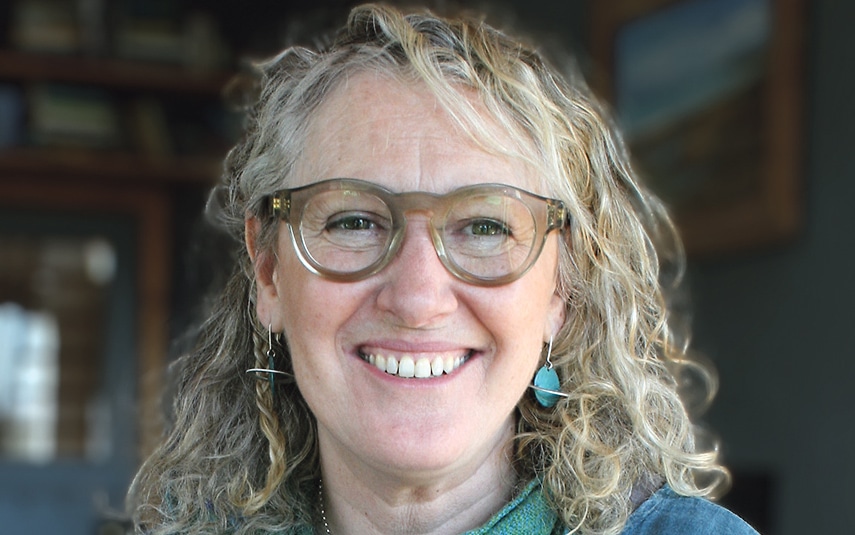
The how and why will always be more important than the finished product to process-driven artist Kathy Kirwan. In fact the end may never be reached, as demonstrated by her most recent and ongoing passion for flax and its many threads writes Mary O’Brien.
Kathy Kirwan’s interest in flax – a plant whose cultivation and use dates back over two thousand years in Ireland – was first sparked close to her home in Clonakilty, a town whose history is inextricably interweaved with this versatile plant in the production of linen. Walks past an old retting pond – where flax would have been soaked to rot away the unusable plant parts – inspired Kathy to explore the labour-intensive process behind flax to fibre and collect stories about the industry from older people in the area.
Born in Birr, Co Offaly, or as she puts it “in the bog in the middle of Ireland”, Kathy has always felt deeply connected to nature. After moving to West Cork to teach geography and PE, she ended up sailing around the world for a couple of years before returning to put down roots with her future husband, a Clonakilty man, and pursue a career as an eco-social artist and educator in sustainability.
As part of the Flax Lín (flax to linen) community, she has been connecting past with present through a ‘Flax – Threads of Time’ project, organising immersive exhibitions and talks and quietly planting the seeds for the revival of flax growing in West Cork. Looking to the future, she says she would love to see the old Linen Hall in Clonakilty turned into a creative space to preserve its rich flax and linen heritage while fostering a vibrant hub that supports local artists, performance, and the evolving cultural future of the community.
This year, 2026, is particularly significant, as it marks 200 years since the collapse of what was once a thriving linen industry in Clonakilty. During the late eighteenth and early nineteenth centuries, the linen industry underwent explosive growth in the area, employing tens of thousands of people until its collapse – almost overnight – in 1826. Local historian Con O’Neill has written a fascinating paper on the economic transformation of Clonakilty through linen in the 18th century. He writes that “the collapse of 1826 was not merely a precursor to the Great Famine; it was the event that dismantled the region’s primary economic defence, leaving a generation of dispossessed weavers and struggling smallholders entirely dependent on the potato…. The long shadow of 1826 stretched across the century that followed, leaving the town economically diminished.”
With the 1936 Flax Bill, the growing of flax experienced a short-lived revival in West Cork, as it offered a good return on investment for local farmers, later encouraged by the guaranteed high price offered for flax following the outbreak of WWII, when linen was needed for RAF aircraft, parachutes and uniforms. “Flax and therefore linen has anti-microbial properties so it was used to make bandages,” adds Kathy. “It was dyed using nettles to create camouflage fabric.”
She shares how flax inspector Patrick Kerr – the father of retired Clonakilty estate agent John Kerr – played a key role in the revival of the flax industry in West Cork following the introduction of the Flax Bill. “Drawing on his extensive experience – particularly from his time in the North of Ireland and Donegal – and comprehensive understanding of the sector, Kerr travelled across West Cork, encouraging farmers to take advantage of the strong opportunity to earn income, emphasising that flax prices were secured at a guaranteed minimum level.”
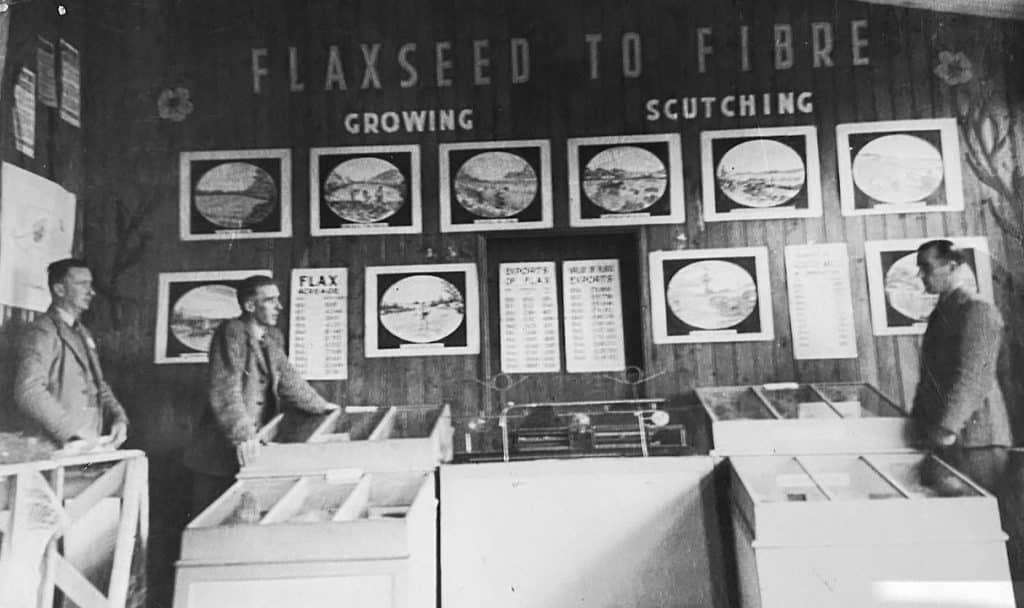
Five years after the War, in 1950, the suspension of the Flax Act (1936) signalled the beginning of the end for the flax industry in West Cork. The rise of synthetic material, increase in cotton production and changing consumer habits, all contributed to the decline of linen in the 1950s.
“I felt an urgency to collect some of those memories before they were lost,” explains Kathy. ‘Some of the older people I spoke to have since passed away.”
Growing flax takes about 100 days. Once the pretty blue or white flowers have dropped and the seed heads appear, the plants are then pulled, gathered into bundles and dried for two weeks before being retted for up to 15 days, which releases the fibre strands, from which linen is produced. In Ireland, retting was traditionally done in streams or ponds and the resulting foul odour of the decomposing plant was notorious. It was then spread out in fields to dry before being bound and stored, ready for transportation to the mill for scutching, which separated the flax into long finer fibres called line, short coarser fibres called tow, and waste woody matter called shives.
“Nothing goes to waste with the flax plant,” says Kathy. “The shives, used for manufacturing composites, are now being used to make car seats for the McClaren Formula One racing team.”
In an article in the Ardfield/Rathbarry Journal, Michael Collins writes how ‘a good acre of flax would produce between fifty to seventy stone of flax plus a certain amount of tow. This would be sold at the Flax Market in Clonakilty, which was held every four to six weeks, when buyers from Belfast and elsewhere in Northern Ireland would be in attendance.’
The late Johnny Crowley, a well-known owner of a service station in Clonakilty, worked in a retting pond as a young man.
He recalled to Kathy how the workers “would scrub themselves with carbolic soap after a day at the retting pond before going dancing at The Lilac Ballroom in Enniskeane.”
“He laughed as he reminisced to me at the petrol pumps, sharing how as the temperature rose in the ballroom, so too did the smell!”
The late Michael Santry from Lisavaird told Kathy how they would “keep the flax in the ‘seomra maith’ (good room) to mind it” before bringing it to the market in Clonakilty on a Friday.
He also remembered his mother using the flax shives for cooking outside in a bothy (small hut). “As flax was highly flammable, the cooking was done outside the home for safety,” explains Kathy.
In‘Ghosts, Gargoyles and Garages’, a book of childhood memories, Michael Pattwell, a retired Irish District Court judge from Clonakilty, recalled the “long queue of flax laden horses and carts” running the entire length of the street where he grew up.
As a young boy, Michael created the enterprising role of minding the farmers’ places in the queue when they “would drift into Santry’s pub for a pint or two or three”.
“I was employed to hold the reins and move the horse along and when the owners turn was about to be reached, to dash into the pub and get him out to take control again.
“With that, shilling in pocket, I ran back up the queue and it wasn’t long before I was employed again. This continued for the entire day – especially when the market was held on days when there was no school – or for the evening if it was a school day. The longer the queue the better, because the longer the farmer was in the pub, then the more he drank and this often blurred the difference between a shilling, a two-shilling piece or even a half-crown.”
Michael O’Sullivan from Rosscarbery, 91, is a treasure trove of memories. He learned about the complex process of flax production from his father, James O’Sullivan, a flax inspector. He shared how his father tested the quality of seed collected from local farmers on blotting paper at their home.
Michael also recalled how fine rushes were placed on the flax in the retting pond before being weighted down with heavy stones to keep the flax from rising. “I remember we had to walk on the flax morning and night during this period to ensure that it was kept below water level.”
His remembers accompanying his father to the Linen Hall in Clonakilty where Wilsons of Belfast would come to purchase flax for linen production. “Very often Wilson’s of Belfast would ask my father to assist them with the vetting process when determining the quality of the flax. This was an unenviable task for my father to have to vet his neighbour’s flax but people trusted his judgement, as he was known to be such an honest man.”
With the once busy mills now lying in ruin around West Cork, memories are all that remain of West Cork’s linen legacy. However, flax enthusiasts like Kathy are driving a resurgence of the hardy and versatile plant in their communities around the world. Kathy is a member of Fibreshed Ireland, a global movement that focuses on regenerative fashion using locally grown fibres. “As demand grows for sustainable fibres, flax may offer a potential diversification route for smaller farms,” she says. “It’s also being looked at as a tool to restore soil health and decarbonise industries.
“You could say I’m obsessed with it,” she admits laughing. “It really is a fascinating plant, even more so because of its history in West Cork”
While she currently has her head down joining pieces of cordage together for the ‘Flax 405: From Mallon to Mizen’ shared island project, which will launch online on May 1, future flax projects are never far from mind.
“405km is the winding distance between Mallon Linen in Co. Tyrone and Mizen Head in Co. Cork so the objective of the project,” she explains “is to engage communities across the island in creating 405 equivalent pieces of flax rope, thread and linen that symbolically weave together our shared past, present, and future.”
Over the coming months, Kathy is organising a number of flax events in West Cork, including the planting of flax around Clonakilty through local community groups and farmers, an interactive experience outside the Linen Hall in Clonakilty as part of the Old Time Fair and a flax harvesting event and craft workshops during Heritage Week.
One of the flax planting projects will take place at Fernhill House Hotel, a site historically surrounded by retting ponds and flax fields. This year’s planting coincides with the bicentenary of both the collapse of the local linen industry and the founding of Fernhill House. In September, Kathy and the hotel will also welcome a group of 25 textile enthusiasts from the United States.