

In my early twenties I developed a compositional structure which I consider to be a visual equivalent to a musical fugue. As a structure it is modular and capable, theoretically at least, of infinite extension. The temptation was then (and still is) to see how long I could make it. What I discovered in doing so was that anything more than a 3:1 ratio (length to height) is too much for the human gaze to take in at once. My largest fugue painting – conceived in egg tempera as an abstract icon – is 4 x 1.5 metres (length by height), which sits well upon the eye. As a corollary to this I have also created fugue sequences in print, and produced them as concertina books. The longest of these is 200 x 11 cm; in ratio terms this equals 18:1, length by height. It is not meant to be seen all at once, though it can be, and such is the case of the great friezes–essentially story boards – conceived throughout history, variously in marble, mosaic, textile and fresco.
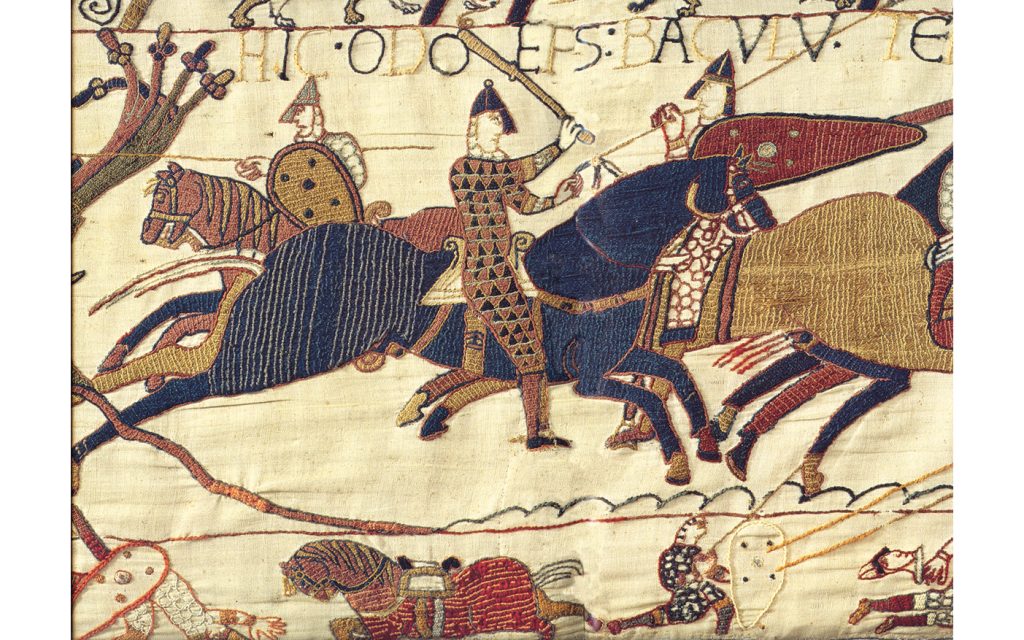
One of these, the Bayeux Tapestry, is now on show in the British Museum, and measures 7000 x 50 cm (70 m x 0.5 m), a ratio of 140:1. It is an extraordinary feat of embroidery, of storytelling through coloured woollen yarn. Despite its name it is not a woven tapestry at all, but nine, joined, embroidered lengths of linen, depicting the Norman conquest of England, itself culminating in the Battle of Hastings in 1066.
Most likely commissioned by Bishop Odo of Bayeux for his half-brother, William the Conqueror, the work is thought to have been undertaken in Canterbury, England, in the 1070s by women needleworkers, who were famed throughout Europe, their fine needlework known as ‘Opus Anglicanum’ (English work).
Embroidered in eight or more colours, with a dominant indigo and red ochre palette, the tapestry reflects the dominant dyes in use at the time of its creation: madder for the reds, weld for the yellows and woad for the blues. In addition, un-dyed wools were used for whites and tans, whilst for dark browns and blacks organic materials like oak galls (ball-like growths on oak trees) would have been utilised (just as for oak gall ink).
One can imagine those fine craftswomen at work, embroidering the Norman ships en route to England on a wavy linen sea, or again, stitching into being the Norman knights on horseback, spears raised, cutting through the stitched Anglo Saxon resistance. Such fine, delicate work, employed to record the brutal violence of male conquest! One can imagine the silence of the workshop, a senior needleworker squinting in the light, being ribbed by another; or a visit, perhaps, from the Archbishop of Canterbury, or the abbot of St Augustine’s Abbey, both postulated as possible composers of the work. A smile as the abbot looks down, the hands of a young needleworker momentarily stilled by his gaze. He moves on and her hands resume stitching an outline, perhaps of a horse, using wool dyed in madder. She is employing stem stitch (or back stitch), whilst beside her an older needleworker (let’s call her Gisela) is couching–laying thread side by side–before securing the thread with a fine perpendicular stitch; this to fill the form of a horse in grey-blue. Underneath the finely stitched hooves, Gisela has embroidered a slain soldier, his head separated from his body.
There is a slim register above the horse’s heads, where the younger craftswoman (let’s call her Marian) has outlined a bird, also in madder-dyed wool. This register is populated by many symbolic animals in a style reminiscent of Anglo-Saxon book illumination, which anyone familiar with the Book of Kells will recognise. Perhaps our Marian knew similar illuminated manuscripts? Certainly the composer of the tapestry did (the abbot of St. Augustine’s at the time had previously headed a scriptorium).
How long did it take these craftswomen to fulfil this commission from their conquerors? It is impossible to say, however seventy metres and fifty-eight scenes later the embroidered tapestry left their careful hands to travel over the channel, presumably to Bayeux Cathedral in Normandy, where it is first recorded in an inventory of 1476. Scholars have since suggested that it was made to fit the south, west and north arcades of the nave, which, if true, would make some sense. In such a setting the faithful could follow the story of the conquest around the church, much as they would follow the story of Christ through the Stations of the Cross.
Great friezes – storyboards in essence – have been, since ancient times, one of the primary means of myth-building, of forging and controlling the narrative of nations, kingdoms, empires. The compositions of such, unless compartmentalised into ‘stories’ (such as with Giotto’s fresco cycle in the Basilica of St. Francis) are often subordinate to the flow of the narrative. It is impossible to take in such an image at a glance. Instead one follows it, walks a symbolic pilgrimage from scene to scene. Such is the case with this marvel from Bayeux.
I am thinking once more about my fugues, those infernal, ghostlike repetitions which rise and fall in my consciousness. Perhaps it is time to return to them, perhaps a four metre concertina book, doubling my previous effort? Or a cycle of paintings, which flow unbroken on the walls, around a room, a secular chapel of colour? I can feel it, a continuous exposition, like a Gregorian chant, seductive in its soft and unifying rhythm. The Bayeux Tapestry, by contrast, is jagged and graphic, a portrayal of carnage. Its figures disturb the silence, haunt the centuries, and will for as long as its fibres last.
James will be giving a seminar on the work of the contemporary Italian painter, Roberto Ferri, on Thursday, August 6, 7:30-8:30pm. Limited spaces. Bookings via: www.clonarts.ie