
Early last November, a beautiful black woman named Xania Monet made world history. Sort of. Her song, ‘How Was I Supposed to Know?’ entered the US Adult R&B Airplay chart at no. 30 and also charted no. 20 on Hot R&B Songs, which ranks the 25 most popular contemporary R&B tracks. It came with relatable live action videos. Scenes of love, neglect and romantic heartbreak playing out across various generations. A drunken father. An abusive boyfriend. And a poignant lyric, written from the point of view of a daughter who is remarkably perceptive when it comes to understanding her own unresolved trauma. “Mama did her best but she can’t teach/What it feels like when a father speaks/So I took every “I love you” too deep/Even when they meant it only for a week. […] Unpacking daddy wounds from every kiss.”
Xania’s voice sounds soulful but also…overly smooth. No wonder. Monet’s claim to fame is that she was the first AI being to enter a US radio chart. Listeners accepted her as a real person. She has a ‘creator’, the poet Telisha Jones, who writes Xania’s lyrics, generates her music, and sees her as an avatar. She got a multi-million contract but also a lot of pushback from human artists and sections of the music industry, which consider this to be an ominous milestone.
AI has since made inroads into many genres. Up to and including the traditional Appalachian music. AI itself describes it as, “raw, historical, deeply rooted … a rich, living blend of Anglo-Celtic folk ballads, African American blues, and West African rhythms that evolved organically on front porches and in the coal camps of the American mountains”. But maybe it is simply blind to the human factor.
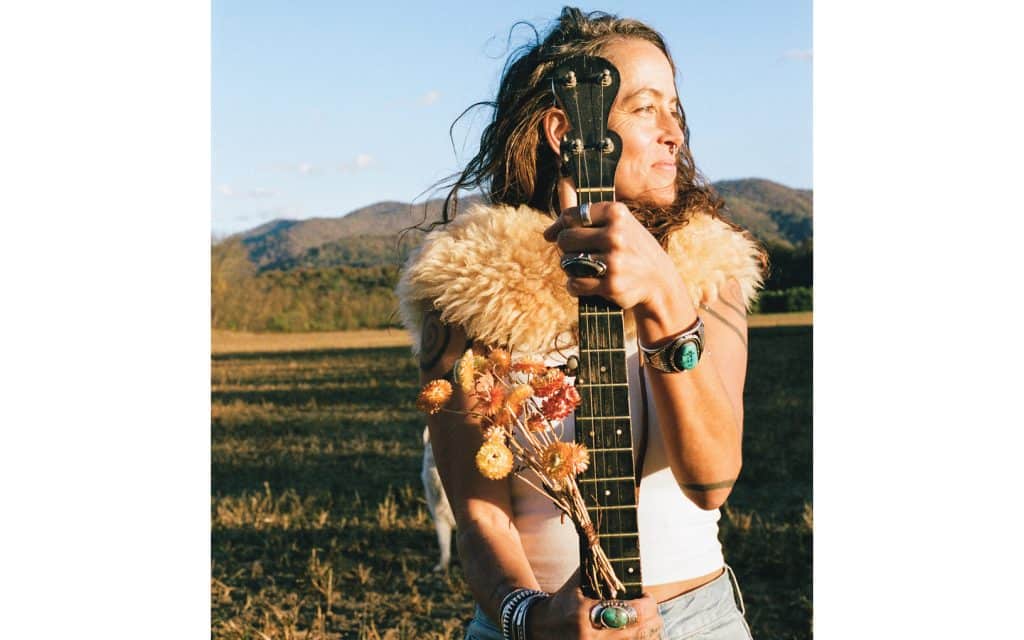
The latter will be strongly represented “in the flesh” at DeBarra’s Folk Club on September 16, the first night of the Clonakilty International Guitar Festival, when the remarkable Leah Song, “Appalachian storyteller, song-catcher, and cultural bridge-builder” will take to the stage. Best known as one of the frontwomen, alongside her sister, Chloe Smith, of ‘Rising Appalachia’. Not the only ensemble from that slightly mystical region with women in the driving seat, whether as instrumentalists, or singers, or both. There were the iconic Coon Creek Girls, an all-girl bluegrass string band which was rather famous in the 1930s and 1940s and hailed from the Appalachian foothills of Eastern Kentucky. (Appalachia stretches across 13 US states and is roughly 6.3 times larger than Ireland). Contemporary women’s bands with Appalachian roots include the Grammy-nominated outfit Della Mae (formed in Boston), the sedately-dressed Sister Sadie (formed in Nashville, a non-Appalachian part of Tennessee), and the Grammy-winning Aoife O’Donovan, whose father grew up in Ardfield near Clonakilty before emigrating to Boston. Her shows in West Cork are mostly sold out. In the US, she’s part of the trio ‘I’m With Her’. It was formed at the Telluride Bluegrass Festival in Colorado in 2014 but is not on the twangy, hard-nosed, lonesome side of the bluegrass vocal landscape. Neither is Rising Appalachia. The band’s harmonies are wonderful, vulnerable, sweet, sometimes soaring to great multidimensional heights.
Now an internationally touring folk ensemble, it started on the sisters’ back porch in Atlanta (Georgia), where they grew up. They also spent seven years in New Orleans where they deliberately moved a year after Hurricane Katrina pounced to help rebuild community. “Both are fabulous, wonderful, diverse, wild Southern cultural hubs,” explains Leah Song. They love busking on urban streets but always seem to have at least one foot in nature. As they write on their website: “In Appalachia, farmers still practice the ancestral tradition of companion planting. Corn grows tall as a trellis, beans climb the corn, and squash provides the ground cover. Rising Appalachia cultivates a similar symbiosis in their music, where Southern folk traditions, New Orleans swamp culture, and Atlanta’s street spirit strengthen each other.”
Leah does the interview from her cabin near Asheville, North Carolina, “right behind a protected 43-acre forest. I’m only here part-time as my life is pretty global. It’s a place that is very rooted in traditional culture, music, craft, and song so I go here to refill my cup. I’m standing underneath a huge oak tree right now. Southern Appalachia is one of the most biologically diverse temperate regions on Earth. You get a whole lot of wildlife. Bears, owls, foxes. Yes, it’s under threat from the current administration; everything is. Two years ago it was devastated by Hurricane Helene, the second-deadliest US hurricane of the last 50 years. We lost about a hundred thousand trees and there were some very scary fatalities. Although there was a silver lining. It did encourage the community to get more self-reliant and interconnected. It now has very strong grassroots underground education and advocacy groups.”
Born to a sculptor (father) and fiddler (mother), the sisters have always been fully immersed in music and other art forms. “The gospel music of our mother, the folklore of our father. All steeped in Southern Appalachian culture. However, our mother started learning the Irish fiddle when we were five years old. She brought us over to Ireland often, to study the fiddle traditions but only found out she had Irish lineage 10 years ago. As an Irish fiddler pointed out to her, there really is a close kinship; you can trace the Appalachian song lines directly to different counties and regions in the Celtic Isles. One of my first trips back to Ireland after many years was when we were still in recovery from storm Helene. I decided that I really needed to be in community with folks who have a long history of survival and of art and music being the tools of handling hardship.”
Before alighting on the guitar festival, where she will sing and play claw-hammer banjo, bodhrán, and guitar alongside fellow Rising Appalachian star David Brown, Leah Song will embark on an extraordinary 11-day journey across East Clare and West Cork, curated by Wild Routes Ireland (Tara De Róiste and Chris Gambatesa). It includes visits to Ballydehob (Kilcoe Studios, Levis Corner House), heritage foods with Max Jones (somewhere in West Cork), somatics and songs with Leah Song. Plus storytelling, coracle weaving, strawcraft and other crafts taught by different experts. It is connected to the slow music movement (see her Tedx Talk). “It is about building longer, slower relationships. Going slow and then fast again. This tour is a homecoming of sorts. A rooted experience where music is just one part of the exchanges between culture and story and place.”
www.leahsongmusic.com
www.clonguitarfest.com