

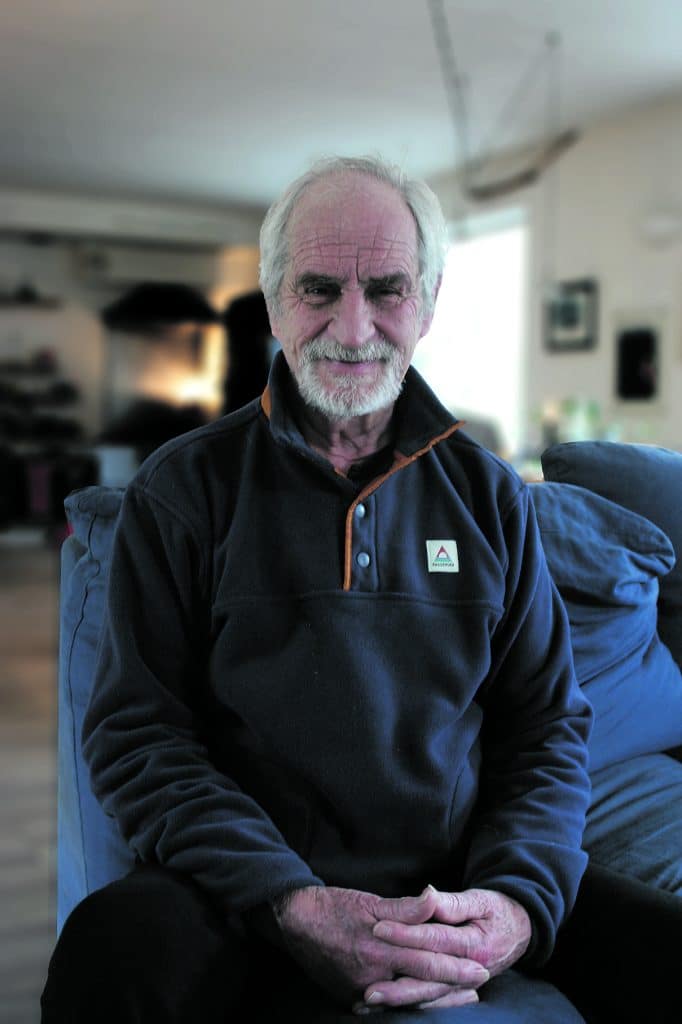
“Smile, breathe and go slowly, says Charlie Stevens, quoting the famous Vietnamese monk and peace activist Thich Nhat Hanh, as he sums up his own life learnings. Charlie Stevens, 78, first sailed into West Cork in the summer of 1975 on a test run before a planned sailing trip around the world. Over 50 years later and he’s still here writes Mary O’Brien, after shaping a lasting legacy on these shores: Charlie was one of the first to introduce yoga to West Cork and the driving force behind the foundation of An Sanctóir, the purpose-built yoga centre in Ballydehob that has become an integral part of the local community and celebrates it’s 30th anniversary this year.
Born into a middle class family in Surrey – his father a surgeon, mother a dance teacher – Charlie ran away from the pressures of his parents’ expectations as soon as he was old enough.
After dropping out of school at the age of 17, he travelled for a while, before moving to London where he found work in a Notting Hill antiques store by day and as a DJ by night – at the famous ‘Tiles’ Mod music venue on Oxford Street. ‘Tiles’ was part of London’s vibrant underground scene hosting many bands that later gained fame, including Jimi Hendrix, Pink Floyd, The Who, and Led Zeppelin and the Bee Gees.
It was an exciting time in London. The streets were flooded with anti-war demonstrations and civil rights movements and the dance floors pulsed with a new energy, fuelled by music that pushed boundaries and a desire to break from the past. Charlie remembers the sound of pockets of pills being emptied onto the dancefloor. ‘Purple hearts’ (a combination of amphetamine and barbiturate) were a popular mood-enhancer among Mods in the 1960s.
Charlie’s journey with drugs began with marijuana before he moved on to psychedelics like LSD, promoted at the time by figures like American psychologist Timothy Leary as a tool for expanding consciousness and spiritual awakening. “We wanted to open the ‘doors of perception’,” he says. Around this time Charlie was introduced to yoga and the teachings of Krishnamurti and Zen Buddhism.
Germany’s first large-scale discotheque ‘The Blow Up’ opened in Munich in 1967 and Charlie’s reputation as a DJ saw him offered a job there. He recalls introducing Deep Purple and The Equals who were big names at the time. After spending a few months working nights and living out of a hotel room, the young DJ decided this lonely existence wasn’t for him. Although offered an attractive opportunity in the music industry in Denmark, he decided to return to his life in London.
The travel bug had however bitten and the young Mod decided to leave his career in antiques behind for the delights of Morocco, where he spent a number of months smoking hash and eating oranges. The dream ended abruptly after he came home one day to find his girlfriend in bed with his friend.
Down and out back in London, Charlie ended up squatting in London’s west end. It was a time when squatters became ingrained in London’s social history. The city was full of young creatives and hippies living on a shoestring, housing was scarce and there were a lot of neglected council houses and flats. Charlie moved into a dismal flat in the east end, where he remembers replacing a light bulb in the corridor only to find it stolen the next day. “All of my friends had moved on, it was difficult to find work, and life was pretty miserable,” he shares.
In a fortunate turn of events, after selling their tennis court, Charlie’s parents decided to pass the proceeds of the sale on to their offspring. Charlie’s share was £2,000. “It could have gone on drugs and rock ’n roll but instead I invested in a friend’s boat and sailed out of London on the ‘Nell’,” he says.
Watching the water turn from brown to blue, as he sailed down the Thames, was very symbolic for the young Charlie. “It felt like I was leaving my ‘low life’ in London behind,” he shares.
Out in the open sea, the beginning of their journey almost marked the end, after the novice sailors got into trouble in a gale and had to be towed to safety by a lifeboat. “It was one of those times when death was more than tapping on my shoulder,” he says.
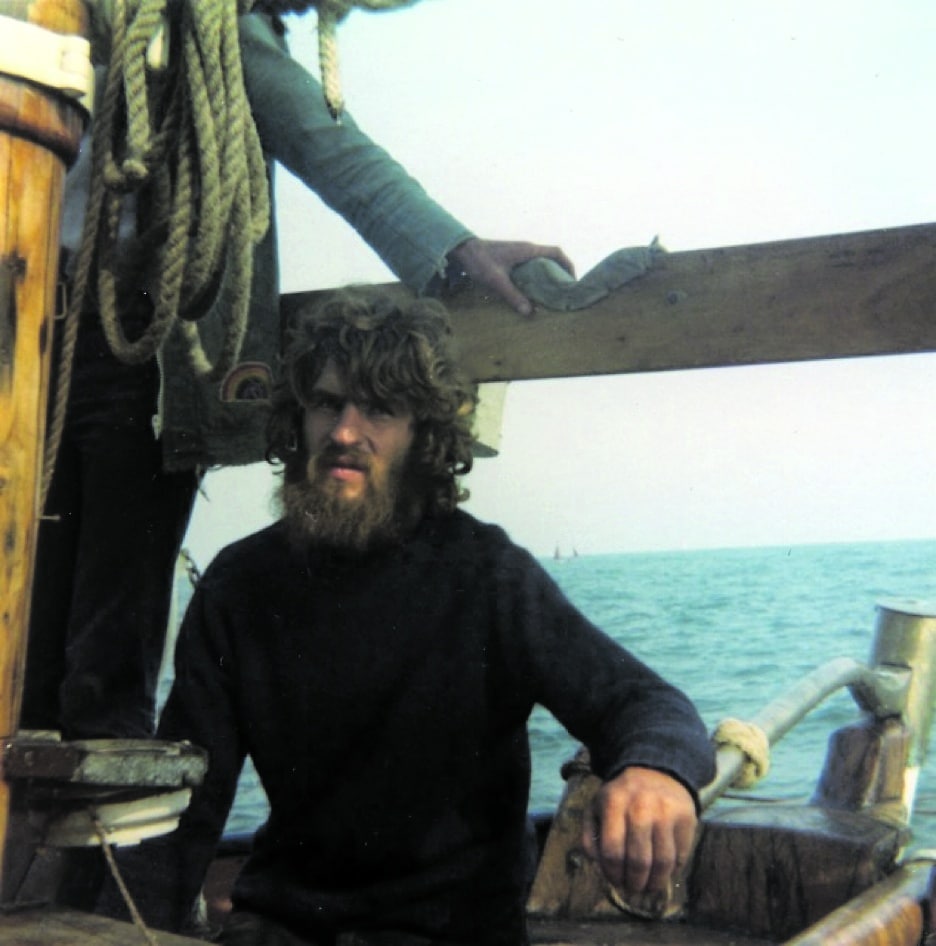
After finally reaching Devon safely, Charlie was fortunate enough to find work as an extra on ‘The Onedin Line’, a BBC television drama series set in 19th-century Liverpool, that ran from 1971 to 1980.
He spent the next two years on the ‘Charlotte Rhodes’ in Dartmouth where most of the outdoor scenes of ‘The Onedin Line’ were shot. He looks back fondly on this fun time in his life, recalling a shoot in June that was supposed to be in the middle of an arctic winter. “It was a roasting hot day and I remember wearing swimming togs under these huge fur coats and boots with icicles stuck on our beards and sweating profusely.”
After a few years in Dartmouth, during which he met his future wife Sue (they are now divorced) it felt like the time to move on.
Charlie bought out his partner in the ‘Nell’ and started a new chapter of his life with Sue. Dreaming of travelling around the world, the couple first sailed down to Cornwall where Charlie spent a month detoxing from drugs and alcohol. “I ate only grapes for 30 days, which amazingly worked!” he laughs.
With Kinsale marked on the map as the ‘shakedown’ before the big trip, Charlie and Sue and another couple set sail on their grand adventure. But like so many ‘blow-ins’ they fell in love with West Cork and their path changed. “The first thing to greet us was a shout from another boat saying ‘Welcome to Kinsale’,” says Charlie. It felt more like an invitation than an arrival. In those days you were supposed to hoist a yellow flag for customs, but when there was still no sign of customs after two days, Charlie went ashore to find the harbourmaster. Greeted with the words ‘Ah sure, don’t worry about it,’ Charlie was charmed and decided to stay awhile.
The summer of 1975 was blessed with sunshine and, after sailing the coves and harbours of West Cork, the couple decided to winter in West Cork. The other couple headed back to England, leaving Charlie and Sue alone on the boat. Soon after, they sold the boat, bought a cottage in Ballydehob and settled into life here, marrying in 1977 and having two children together.
Charlie soon found work skippering boats for holidaymakers. A keen yogi, after spotting an advertisement for a yoga teacher in Clonakilty, he chanced his arm and applied for the job. “I was the only applicant and got the job,” he says.
After training with The British Wheel of Yoga, Charlie started yoga classes all over West Cork, going on to complete yoga teacher training. There were no yoga centres in Ireland at the time and while travelling around the country giving workshops in “cold community halls and classrooms”, the seed of an idea planted in Charlie’s mind. “I had the idea to form a yoga centre in West Cork,” he says.
The ambition was to open a centre that didn’t identify with any particular style or way of being. “It was to be a place that would be available to everybody in the community,” adds Charlie.
Finally, after years of fundraising, the enterprise board awarded a grant for the yoga centre, which was matched by a bank loan. “I can still picture the bank manager in Bandon saying ‘we need more than golf and Guinness in this country’” shares Charlie.
His marriage in trouble at the time, Charlie met his future longterm partner Marianne Gabriel while training his first group of yoga teachers in Ballydehob.
“It was a great time but also a very painful time,” he adds. Charlie and his wife separated just after An Sanctóir opened.
The next chapter of Charlie’s career journey began when a friend gifted him some psychotherapy sessions. His interest sparked, he took a higher diploma in Psychodynamic Psychotherapy at UCC and went on to do a Masters in Integrative Psychotherapy. In 1999, Charlie and Marianne set up Contemporary Yoga, a yoga teacher training school, which they ran together for over a decade. All the while, Charlie was continuing his training in counselling, adding the Family Constellation Method to his psychotherapy practice.
In 2009, he moved in with Marianne in Bandon, running his practice from their home. He went on to qualify as a clinical supervisor for therapists, which is his main occupation today.
“I think the most common problem I’ve seen in my years of practice is that we override our true nature, saying yes when we mean no, and getting caught in patterns from childhood,” he says.
While the method is unproven and somewhat controversial, Charlie is a great believer in the Family Constellation method. “I’ve seen that it works,” he says. “The method can be used, not only to see the possible resolution of hidden family dynamics, but also to explore issues such as systemic causes of illness, blockages in business development, relationship to money or those people with whom you struggle.”
Throughout it all, yoga has been a gift. Charlie still practices every day and feels as flexible and strong as ever. Turning 79 in a few months, he says he doesn’t have an ache or pain in his body. These days, he follows his own advice and moves more slowly, making space for the things that bring him most joy. He loves freeform dance, joins a weekly music session at DeBarras, continues to run workshops with Marianne, and still sees a few clients in his practice. “It’s never felt like work,” he says. “I’ve always just done the things I love doing.”