


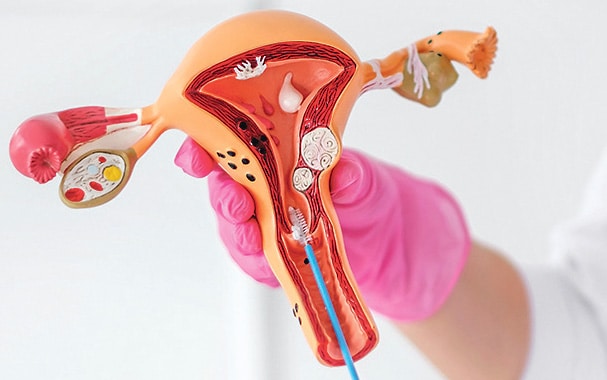
Cervical cancer is a particularly virulent and nasty cancer that most commonly affects women aged 30 to 35 years. Treatment is usually total hysterectomy (removal of the womb) in combination with chemotherapy plus radiotherapy to the pelvis. Both chemotherapy and radiotherapy affect the ovaries, effectively shutting them down. This means that the periods stop and full blown menopause kicks off. This is termed Premature Ovarian Insufficiency (POI) if the woman is under 40 and early menopause if she is aged 40 to 45.
If under 40, a small number of women can start to menstruate again, sometimes several years after her cancer treatment has ended. Fertility, however, rarely returns. Irradiation of the pelvis can have catastrophic longterm effects if strategies are not put in place by the cancer survivor’s healthcare professionals. Pelvic Radiation Disease (PRD) is a term used to describe a collection of symptoms that can arise in non-cancerous body tissues after radiotherapy treatment. The effect of radiotherapy on the pelvic area can be immediate with six-to-eight in 10 people undergoing radiotherapy experiencing acute side effects, which generally start two weeks into radiotherapy and can settle two to six months after the treatment. Nine in 10 patients will have chronic symptoms that persist for more than six months or develop afterwards. Symptoms can affect the bowels with frequent motions or rectal bleeding, the bladder giving painful or frequent urination or the pelvic floor resulting in difficulty passing urine or incontinence. Pelvic radiation can cause chronic pelvic pain, and sexual dysfunction such as pain during intercourse, reduced sexual pleasure and inability to achieve orgasm.
Unlike breast. womb and ovary cancers, cervical cancer is not driven by oestrogen or hormones. Oestrogen replacement with HRT and vaginal oestrogen is completely safe to use after cervical cancer. This is not generally well known. Timely oestrogen therapy, both systemic HRT and vaginal oestrogen plus pelvic floor physiotherapy can prevent many of the symptoms of PRD.
I work in CUMH Complex Menopause Clinic and have seen firsthand the consequences of late or no oestrogen therapy for cancer survivors who have had chemotherapy and pelvic radiotherapy.
What causes cervical Cancer?
The human papillomavirus (HPV) causes almost all of the main types of cervical cancer.
There are more than 100 HPV types but only 14 are considered high risk. Two of these; HPV 16 and HPV 18 cause 70 per cent of all cervical cancer cases.
HPV is a common bug and anyone who has been sexually active is at risk of HPV infection, Infection can be passed on through oral sex, touching in the genital area, vaginal or anal sex or sharing sex toys. Using condoms will not completely stop you catching HPV but will greatly reduce the risk.
For many of us, HPV causes no harm and our immune system clears about half of HPV infections within six to 12 months. But sometimes this doesn’t happen and the infection persists. If that happens with one of the high risk types of HPV, the virus can cause changes to the cells in the cervix. These changes are sometimes called pre-cancers as they could develop into cervical cancer. These pre-cancer cells can be treated and completely removed.
Can we prevent Cervical cancer? And how?
Yes! Cervical cancer is entirely preventable and curable, as long as it is detected early and managed effectively. Yet it is the fourth most common form of cancer among women worldwide, with the disease claiming the lives of almost 350 000 women in 2022.
Vaccination
The HPV vaccination programme in Ireland officially began in September 2010, initially targeting 12-13 year-old-girls. The programme expanded to include boys in 2019. The vaccine is safe, free and school-based.
Screening
Ireland’s national cervical screening programme, known as CervicalCheck, officially started in September 2008, a little later than other countries. In 2008, the cervical screening test was cytology based, which meant taking a sample of cells from the cervix and having these analysed. Research published in 2014 showed that HPV screening was better at detecting cervical abnormalities before they developed into cancer. In simple terms, cytology picked up about 15 out of 20 abnormalities in every 1,000 women screened. HPV testing detects 18 of those 20. The chance of a false negative test is lower with HPV testing. In 2020, Ireland made the switch from cytology to HPV testing and we were one of the first countries to adopt this more advanced screening method. The screening interval is every three years for women aged 25 to 29, and every five years for women aged 30 to 65.
So your smear test is not a cancer test; it is a test for HPV. If you have one of the high risk HPV types, you go for an examination called a colposcopy; essentially a closer look at the cervix. If anything abnormal is found a biopsy is taken. Pre-cancer changes can be treated there and then with what is a simple zapping or cautery type procedure, so you nip it in the bud and no cancer develops. If you have had one of these pre-cancer changes detected, your doctors will keep a closer eye on you and do annual smear tests until you have had a few years of negative smears.
Treatment
Without screening and treatment, women with high-grade abnormalities would have a 31 per cent or one in three chance of developing cancer. With treatment, that risk drops to 0.5 per cent or one in 200. It’s an incredible reduction, demonstrating the effectiveness of cervical screening.
So can we get rid of Cervical Cancer altogether?
That is the aim! In August 2020 the World Health Organisation (WHO) adopted the Global Strategy for Cervical Cancer elimination.
In order to eliminate cervical cancer, an incidence rate of below four per 100 000 women needs to be reached. To achieve that goal the following three targets need to be met:
Vaccination: 90 per cent of girls fully vaccinated with the HPV vaccine by the age of 15.
Screening: 70 per cent of women screened using a high-performance test by the age of 35 and again by the age of 45.
Treatment: 90 per cent of women with pre-cancer treated and 90 per cent of women with invasive cancer managed.
This is known as the 90/70/90 target.
How are we doing?
Ireland formally committed to the WHO global initiative to eliminate cervical cancer in January 2023 and Ireland’s Cervical Cancer Elimination Action Plan was launched November 2024.
Ireland’s current cervical cancer annual incidence rate is 11 per 100,000 women, based on 2021-2023 data. Despite temporary fluctuations during the COVID-19 pandemic years, the long-term trend since 2009 continues to decline.
We are performing strongly against WHO’s 90-70-90 targets and remain on track to actually eliminate cervical cancer by 2040;
Vaccination: HPV vaccination coverage: In 2025, 82.7pc of girls by the age of 15 years were vaccinated and 2022/23 data showed 76.6 per cent of boys in first year had received the vaccine.
Screening: At the end of 2025, 76pc of women aged 25 to 65 have had a smear test in the last five years.
Treatment: 2025 data showed that 97.2pc of cervical cancers treated within one year of diagnosis.
Get a smear test…It might save your life
All the above is great and really positive but the sad reality is that most cervical cancers are found in women who have not had smear tests and sometimes it is detected after it has spread to other organs, resulting in a poorer prognosis. Cervical cancer can be completely asymptomatic.
Ladies, none of us like having our vagina rummaged around in with what looks like a dodgy set of salad tongues. Yes, it can be uncomfortable; yes, it can be embarrassing having your bits out on display to your nurse or GP but, if you have not had a smear in the last three to five years, get over yourself and get one done. Plus, in the near future it is going to be possible to do your own test at home.
When I see a patient who is avoiding smears, I always ask her why? Often the reason is that she has previously had a painful, sometimes brutal and insensitive vaginal examination in the past and is understandably reluctant to repeat it. Sometimes previous childhood sexual abuse or rape in adulthood comes to light. I always thank my patient for sharing such sensitive, painful information. I assure her that I can use a very small instrument and take as much time as she needs. Most importantly if she wants me to stop, we stop.
If this article has raised any questions for you about the HPV vaccine, your smear test or perhaps you are a cervical cancer survivor and not on oestrogen therapy, please go and discuss your concerns with your GP.