


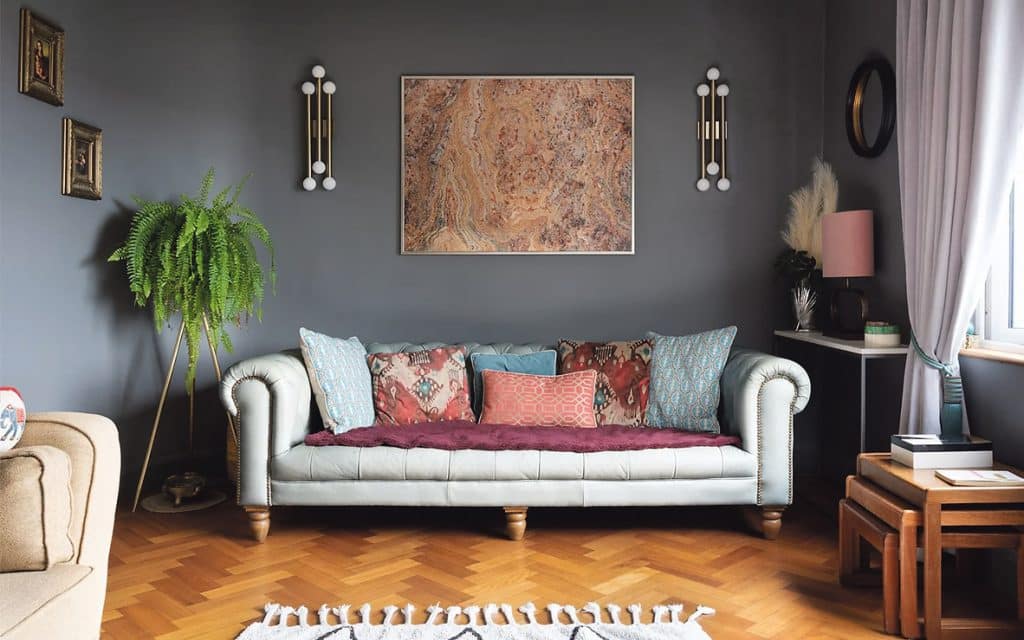
In the first of a six-part series on the nine principles of interior design, Mairead Collier looks at balance, and scale and proportion.
Have you ever walked into a room and felt completely at ease, without knowing why? Or stood in a beautifully furnished space that somehow felt cold and disconnected? The difference, almost always, comes down to design principles.
These are not rigid rules. They are guidelines that professional interior designers use to create spaces that feel intentional, balanced, and genuinely lovely to be in. And the good news is that you do not need a design degree to understand them. Once you know what to look for, you will start seeing these principles everywhere, and applying them in your own home becomes much more instinctive.
Over the coming six months, I will break down each principle and expand on how to apply them in your home. For this first article I will discuss the first two principles; Balance, and Scale and Proportion.
Balance is one of the most fundamental principles of interior design. It refers to how visual weight is distributed across a room. A balanced room is one where its various elements have similar visual weight and aesthetic importance. When balance is right, a space feels stable and calm. The scale, colour and texture of all elements in the room will have an influence on balance. Each object within a room will carry a different visual weight. Large objects carry more visual weight than small objects. Bright and bold colours carry more weight than say pale or cool colours. Likewise, shiny objects versus dull or flat objects. The former has more visual weight than the latter. A busy pattern will carry more visual weight than a simple pattern. The goal is to balance all these elements within the room. When it is off, something nags, even if you cannot quite name it. There are three types of balance. Symmetrical balance is achieved when two identical items are placed on two opposite sides of an imaginary line. For example, two matching bedside tables, a pair of lamps flanking a fireplace. It is formal and reassuring. Asymmetrical balance uses objects of different sizes or types that carry equal visual weight, a tall floor lamp balanced by a low, wide credenza. It feels more relaxed and contemporary. Radial balance arranges elements around a central point, a round dining table with chairs, and a circular rug.In practice, most well-designed rooms use a combination of all three. The key is to step back and ask: does one side of this room feel heavier than the other? If so, something needs to shift. The easiest way to start is to place a focal point centrally, like a bed in a bedroom or a dining table and chairs in a dining room, and work out from this. When deciding where to place an item ask yourself a series of questions. What is the visual weight of the item? Where will it look best within the room? What will need to be placed around the item to give it balance?
Scale refers to how objects relate to the size of the room. Proportion is how objects relate to each other. Both matter enormously, and both are frequently the cause of rooms that feel off without anyone being able to say exactly why.The relationship between scale and proportion is in part a matter of function but also of aesthetics, perspective and how we use the space. An oversized sofa in a small room makes the space feel cramped and hard to move through. To counteract this, designers may often upholster the sofa in a neutral colour, then use a bolder colour on things such as cushions or throws. This stops the sofa from dominating the room but also introduces colour and interest. Tiny artwork hung on a large wall looks lost and apologetic. However this too can be rectified if it provides a subtle visual link to other items in the room through shape, colour or texture. The secret lies in being intentional about adding in an under-scale object and not randomly introducing it to a room. Similarly furniture that is too low for a high-ceilinged room can feel awkward and weightless. Getting scale and proportion right is not complicated. But it does require measuring, and resisting the temptation to buy something simply because you love it, without checking how it will actually relate to its surroundings.The golden ratio and the rule of thirds are both useful frameworks here. But honestly, the simplest test is to stand in the room, look at what you are considering, and ask: does it belong here? Does it feel right in relation to everything else? If you are still unsure or not confident then you could use chalk or painter’s tape and mark out the size of your furniture on the floor. Over-scaling is one of the tools designers use a lot and it is an extremely effective way of improving the overall ambience of a room. It also has the added bonus of requiring only one or two elements to make a big impact e.g. a double height headboard or an oversized antique mirror or pendant.
Mastering balance, scale, and proportion is just the beginning of transforming a space into a thoughtful, harmonious home. Over the next five months, we will explore the remaining principles that bring rooms to life, giving you the tools to trust your own eye. Interior design is an ongoing conversation, and I would love to hear about your projects, whether you are refreshing a single room, planning a full home renovation, or embarking on a complete new build. If you have a tricky layout, a burning design question, or a topic you would like covered in an upcoming column, please get in touch at [email protected] or connect with me online at www.maireadcollierinteriors.com.
Until next month, happy decorating!