


If you’ve spent any time looking into retrofitting an older home in West Cork, particularly fitting a heat pump, you’ve likely come across the advice to insulate first. The general accepted hierarchy for retrofitting your home, and the advice I give my clients, is to first insulate, then look at the efficiency of your heating system, and finally generate your own renewable energy.
It is common sense, really: 75 percent of energy use for an average Irish home is spent on space heating, so it is best to tackle this first by insulating properly. Then, make sure that this heat is generated in the most efficient way, which would usually be some form of a heat pump. Finally, add renewable technologies like solar panels to generate your own electricity.
The Sustainable Energy Authority of Ireland (SEAI) has always preached that we should insulate first, and most of their grant rules are set up to reflect this. Before you can even think about qualifying for a heat pump grant, your home’s insulation must meet an exacting level of heat retention, measured by the Heat Loss Indicator (HLI).
Briefly, the HLI is calculated using the BER methodology: by taking the sum of your home’s heat loss through the building fabric, ventilation, and draughts, and dividing this by the floor area. The HLI is a good measure of a building’s insulation levels, though it can penalise smaller homes, something I have written about previously. A value of 2.3 W/K or lower has always been required to avail of a heat pump grant under any of the SEAI schemes. Until now.
SEAI recently launched a new initiative: the R290 High Temperature Heat Pump Pilot Scheme. Under this scheme, it will be possible to fit a heat pump and claim the normal grant funding (up to €12,500) without meeting the strict HLI criteria.
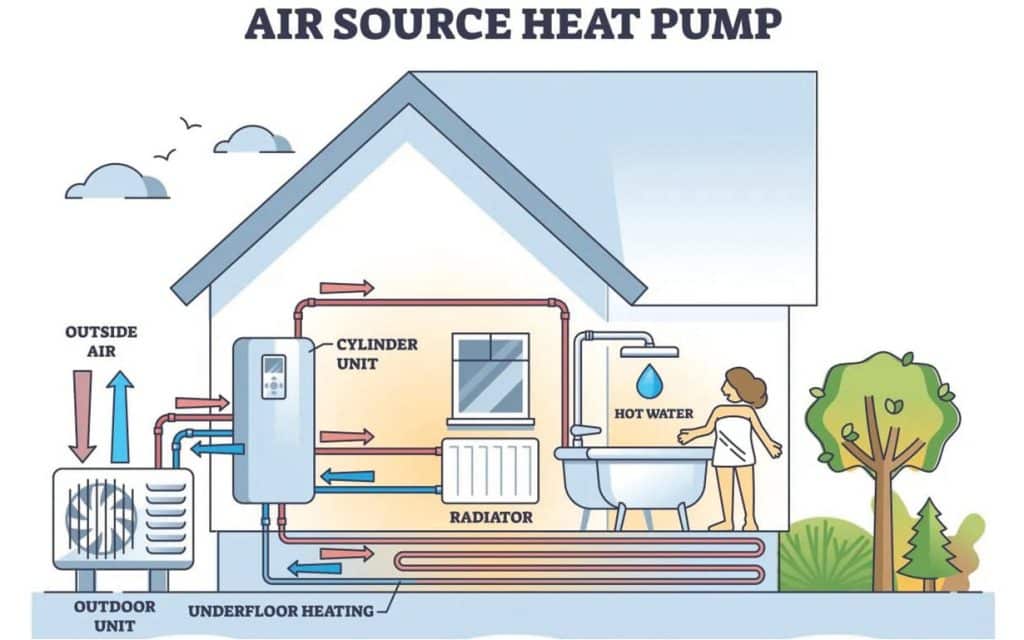
How is a high temperature heat pump different to a normal one? Standard heat pumps are incredibly efficient, but they prefer to provide a steady, low-temperature warmth over a long period, normally with a flow temperature of 35-50 degrees Celsius to underfloor heating or large radiators. Traditional oil or gas boilers, conversely, dump massive amounts of heat into small radiators at temperatures of 65 to 75 degrees Celsius. Try to put a standard heat pump into an uninsulated old farmhouse with small, traditional radiators, and you will probably be a bit chilly while your electricity bill shoots up!
Enter the R290 high temperature heat pump. By utilising R290 (propane) as a natural refrigerant, these next-generation units can absorb substantially more energy from the outside air and compress it more effectively than older synthetic refrigerants. This means they can deliver ‘boiler-like’ flow temperatures of up to 80 degrees Celsius, making them a straight swap for your old boiler.
The efficiency does suffer slightly at these higher settings though. With a flow temperature of 35-50 degrees Celsius, a standard heat pump runs at between 300 and 500 percent efficiency. When the flow temperature goes up to 65-80 degrees Celsius, that efficiency drops to around 200-300 percent – still better than a fossil fuel boiler, but higher on electricity usage.
The pilot offers the same robust level of financial support as other heat pump grants €6,500 for the heat pump itself; Up to €2,000 for central heating system upgrades (such as new radiators); A Renewable Heat Bonus of €4,000 (which I have heard referred to as the ‘boiler scrappage scheme’).
Furthermore, while you still need to publish a pre-works Building Energy Rating (BER) certificate, there is no specific minimum BER rating required to enter, nor is there a post-works BER target to hit. SEAI is actively seeking out properties built and occupied before 2011 that would have historically been rejected for standard heat pump funding.
However, there are a few caveats. The pilot is only accessible under the National Home Energy Upgrade Scheme via a One Stop Shop (OSS), so you cannot just go straight to your local independent SEAI-registered installer. Applications are being routed exclusively through these registered OSS companies.
Secondly, because this is a research focus, the pilot is strictly limited to just 100 homes across the entire country. The portal will only accept entries for a nine-month window to ensure data can be actively captured across the upcoming 2026/2027 winter heating season.
Because the heat pumps will be communicating performance data directly to SEAI via cloud-based platforms at 15-minute intervals, participating homes must have a reliable broadband connection. Homeowners must also consent to having this data gathered for a nine-month period so SEAI can evaluate how these R290 units handle actual Irish winters, tracking indoor comfort levels, running costs, and heating patterns.
So, is a high-temperature heat pump for you? My advice would still be to insulate your house properly first and then fit a heat pump that can work at maximum efficiency. However, there are cases where this pilot makes sense.
A few years back, our own oil boiler packed up. At the time, our house was not yet fully insulated (and still isn’t), so when we decided to fit a heat pump, we had to pay for it entirely out of our own pockets. This pilot would have been a lifesaver in a situation like that. Other great candidates would be homes where a full insulation upgrade is unaffordable, doesn’t make financial sense, or is impractical, as well as smaller or uniquely shaped homes that are unfairly penalised by the standard HLI rules.
As always, if you would like to get in touch about anything in this article or your own retrofit project, feel free to reach out to Ruairí at [email protected].