

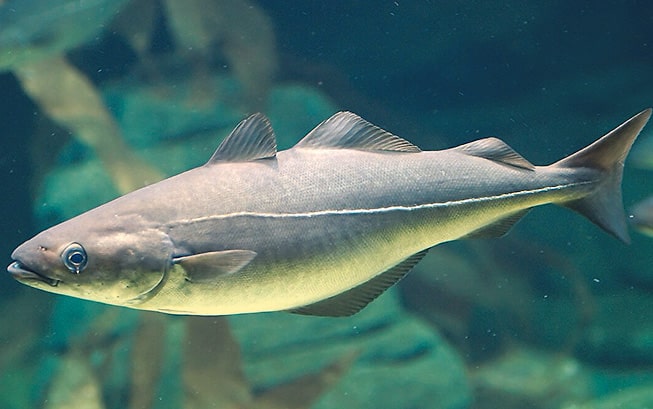
The pollack is probably the fish that sea anglers catch most often in Ireland; it is unusual to go out boat fishing and not get even one pollack. Perhaps because they are so common, they seem a little dull; even the name sounds unattractive (it is derived from the Scots Gaelic pollag). For those who take pleasure out of upsetting fish, big pollack offer relatively good sport, and although they are looked down upon by the discerning gastronome, a fresh pollack, filleted very quickly after capture then gently fried in garlic butter, is perfectly pleasant to eat. When I was skippering an angling boat, I could always be sure to sell pollack on a Thursday evening, because in old Catholic Ireland, people wanted it for their Friday lunch – and boiled day-old pollack is most definitely a penance, though my cat loved it.
Unfortunately, like almost everything else in the natural world, pollack populations are in decline, and so conservation rules have become necessary. In 2019, a ruling from the EU (Regulation (EU) 2019/1241) decided on minimum conservation reference sizes for marine species; for pollack this is 30 centimetres; charter skippers and angling clubs very admirably set a voluntary limit of 40 cm. Then, this year, a new law was introduced: The Pollack Fishing Conservation Bye-Law (No. 1028 of 2026), which allows an angler to keep only three pollack per day. This must have come as a shock to those used to filling boxes with pollack, as we did in the 1980s and 90s. There is bound to be the odd angler who will not obey these rules exactly, but it is hard to imagine anyone being so mindlessly greedy that they would regularly catch and keep very undersized pollack.
So I was enraged when, a few weeks ago, on the pier at Courtmacsherry, I saw two men, not from this part of the world, reeling in tiny fish; one already had several miniature mackerel in a bucket. I summoned what little of his language I could remember, and said that the fish were too small. He ignored me. I repeated it, and explained in English that what he was doing was wrong. But he just stared at the water as if I didn’t exist. I then approached his fellow countryman who had, in his bucket, not only a very small mackerel, but several undersized herrings and three pollack just a few inches long. He also ignored me, until I took a photo of his catch, then he shouted, angrily. Had I some assistance, I would have thrown the fish back in the water to feed the gulls, who needed them more.
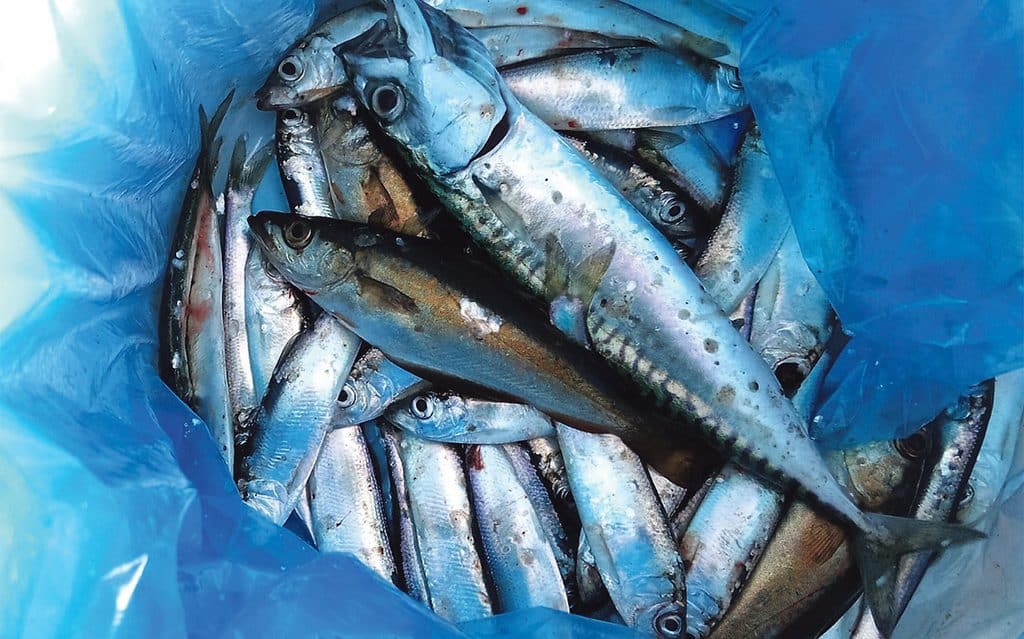
Last week, the same men were again fishing from the pier; one had caught about a dozen baby pollack. I threw one little fish, still moving, back into the water, and pointed to the sign in the fishing-tackle shop window, which informs anglers about the minimum size for keeping pollack. The man became very aggressive and, using a most unpleasant expression, he suggested that I go away.
I am told that these people fish every weekend. They are also often seen clambering over rocks with their buckets, stocking up on periwinkles and crabs and anything else they can stir-fry. Given the state of the shores and coastal waters of their country (I have lived there), they must think this is paradise.
When I was a child, we used to catch baby pollack off the pier – “curleens” we called them – but we always returned them alive; to eat a baby fish was unthinkable. Those young pollack growing up in the safety of the harbour are the adults of the future; kill them, and there will be none left for the sea anglers or the commercial men out in the bay. I don’t know how much damage a couple of anglers can do, but if it goes on regularly all around the country, then pollack stocks will suffer.
So I reported those men, twice, to the Sea Fisheries Protection Authority (whose headquarters are in Clonakilty). They weren’t much use: my first complaint didn’t even receive a reply. When I tried again, I was merely told to write to Inland Fisheries Ireland who, it seems, are responsible for pollack; the SFPA didn’t care about the undersized mackerel and herring. Inland Fisheries, in fairness, responded immediately, and one of their officers said he would see what could be done, which is probably very little.
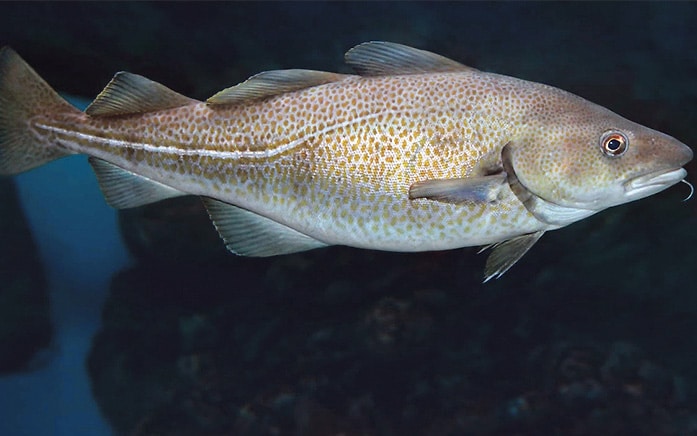
Pollack belong to the order Gadiformes, the cod fish. The order contains about 600 species in 18 families, only a few of which will be familiar: Gadidae is the family of cod, pollack and their relations; Lotidae, the ling; Gaidropsaridae, the rockling; and Merlucciidae, the hake. Others in the order include forkbeards, tadpole fish and rat-tails.
The closest relative of the pollack is the coalfish. Both are in the genus Pollachius; the pollack is P. pollachius, the coalfish P. virens. (The Alaskan pollock, Gadus chalcogrammus, is actually a species of cod). The coalfish has at least twenty-two other names, local or archaic; in Britain, it is called coley or saithe. Its Latin name means green pollack, but in West Cork, it is black pollack, to distinguish it from the better white pollack. Its flesh is a slightly greyish colour and often contains a few worms, which do rather put people off, but in the UK and Scandinavia, coalfish are far more important commercially. Most, however, are either dyed orange and smoked, or made into fish fingers. The word saithe, by the way, comes from its Norwegian name ‘seje’, which is also from where the sei whale gets its name.
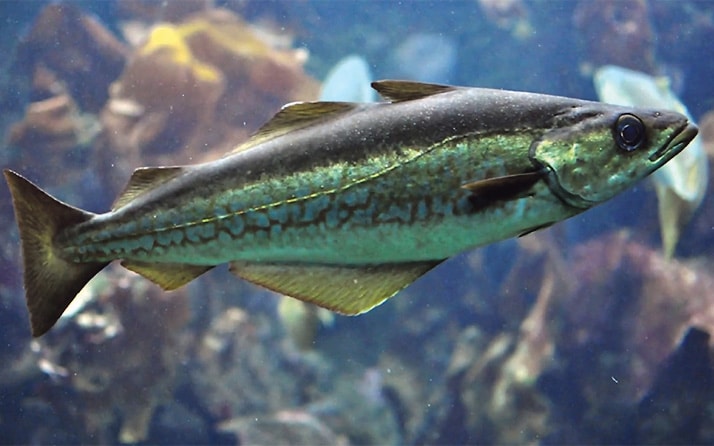
To the layman, pollack and coalfish might look similar, and no doubt an unscrupulous skipper has occasionally sold a coalfish on the pier to someone hoping for a white pollack, or even a cod. They are actually easy to distinguish; both have three dorsal fins, like all in the Gadidae, but lack the beard of the cod. The pollack has a bronze-coloured back, a protruding lower jaw and a bent lateral line, whereas the coalfish is dark green dorsally, its jaws are the same length and its lateral line is straight.
The Gadidae contains three of the most popular food fish in Ireland: cod, haddock and whiting. Then there are the less well-known blue whiting, pouting, Norway pout and poor cod, none of which are very good to eat, but blue whiting are caught in vast numbers to make fish meal to feed chickens.
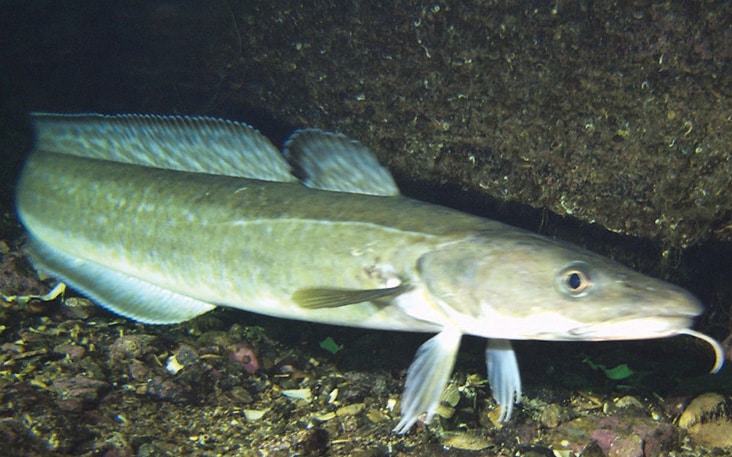
My favourite fish, in the days when I used to eat them, were ling, which look like greatly elongated cod, though they are now placed in a different family. The common ling is popular with anglers, being a strong fighting fish, and though it rarely appears in supermarkets, it is good to eat, its flesh being firm enough to make chowders and curries. Locals here used to salt and dry it for the winter.
The cod, Gadus morhua, is, after the herring, the most commercially important of all fish caught in the North Atlantic. Cod might have been the reason why Europeans first crossed the Atlantic – in the Middle Ages, probably before Columbus, Basque fishermen found the Grand Banks off Newfoundland, where the seas were said to be so thick with cod, one could simply scoop them up in a basket. The great zoologist T.H. Huxley said, in 1883, “I believe that the cod fishery, the herring fishery, the pilchard fishery, the mackerel fishery, and probably all the great sea-fisheries are inexhaustible.” But Huxley never imagined modern fishing vessels or human overpopulation, or greed. Cod once grew up to 200 pounds; a cod one tenth of that size would be considered big nowadays – a sure sign of overfishing. And inevitably, in 1992 , the Newfoundland fishery was closed – most of the cod were gone. It was thirty-two years before that fishery was opened again, but stocks have never fully recovered.
On this side of the Atlantic, cod stocks have been declining for years, and the International Council for the Exploration of the Sea has advised a zero catch quota for them for 2027 in most northern EU waters and around the British Isles. No doubt agreements will be made by politicians, and the cod will just keep being caught, until there are too few left to fish for. Then lesser species, like our pollack, will become more valuable. But unless we protect our juvenile fish, there might not be many pollack left either.
P.S. If you do see anyone catching undersized fish, or killing more than three pollack, don’t be afraid to report them. Fishery officers are few, and they can’t be everywhere. Contact: wwwfisheriesireland.ie.