


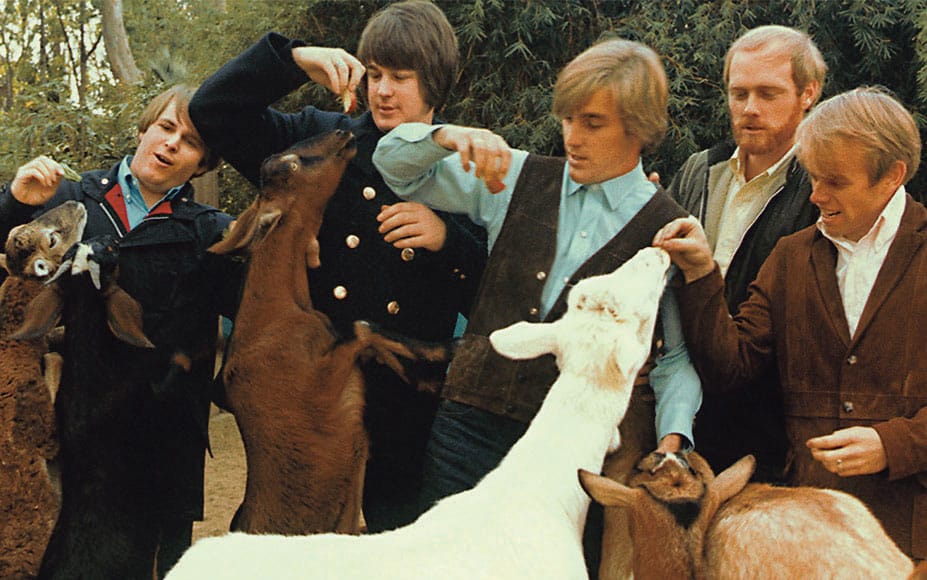
Summer’s here and it is festival time. It’s been sixty years now since the Beach Boys released the now legendary album ‘Pet Sounds’ in 1966. This album continues to inspire and enthral listeners, so much so that it remains a draw to modern arrangers and artists to this day. I was one of the lucky ones to hear the sumptuous fifty member RTE Concert Orchestra at Limerick University Concert hall in June, perform ‘Pet Sounds’ in its entirety, fronted by five harmonic singers reminiscent of the original band. Music, like books or food, is of course totally subjective to one’s own tastes. While one may or may not like the music of the Beach Boys, this album can still be admired for its revolutionary approach that changed album production and music making, forever.
Let’s take a step back in time, or perhaps a wave, if you’re a Beach Boy fan. Post World War Two, the United States was still a segregated society by law and by culture. Many African-Americans and people of colour had fought and died on the beaches and in the cities of Europe fighting for the USA. President Truman, in recognition of this, used an executive order to bypass (a racist) Congress in 1948, to desegregate the armed forces. Two more decades would pass until the Civil Rights Acts were enshrined into law, but the winds of change had shifted. One of those shifts was music, which had historically, been highly segregated, by audience, radio station, and of course the composition of the band themselves.
There were two massive cultural transformations that created a new sound that would change music forever. Firstly, black and white music started to cross over in this post war period. Elvis Presley’s style was shaped by Black gospel, blues and rhythm-and-blues traditions that he encountered growing up in Mississippi and later in Memphis. Black legends such as Chuck Berry, Sister Rosetta Tharpe and Nina Simone were beginning to transcend the colour bar. A more tolerant UK market had a huge appetite for black tunes that would soon inspire rock bands like the Rolling Stones and The Beatles, as well as the Beach Boys. The second phenomenon was the birth of the teenager and their access to disposable income. Postwar, adulthood pretty much began at age 14, when as many as 50 percent of Americans gave up school to enter the workforce. By the late 1950s, far more teenagers were remaining in education than in previous generations. The ‘Golden Age’ of wealth and consumerism had begun. American teens possessed more leisure time and much of the purchasing power and this would reshape the evolution of music.
Enter the Beach Boys. The Rock ‘n Roll craze was in full swing. What made them unique for that era for was that they wrote their own music. (This was nothing new of course in the blues and folk scenes). To put it in context, the king of Rock ‘n Roll, Elvis, had all his music written for him and never composed it himself nor did Frank Sinatra, amongst others. The Beach Boys’ early success owed a lot to their edgy guitar riffs, inspired by Chuck Berry, and their own blend of teen-centric lyrics that created a ‘California sound’. Together with a unique and sublime combination of angelic voices, which was arranged and guided by the tortured genius of Brian Wilson, cemented their identity as the new trend.
The Beach Boys were only teenagers, except for Mike Love who was just a tender 21-year-old. Not unlike any music era, trends and fads are part and parcel of the success, and the Beach Boys found an angle that captured the zeitgeist of that teen whirlwind that was taking over the west coast – surfing. Of the five original band members, none of them surfed or were interested in it except for 17-year-old Denis Wilson, who helped his brother Brian and cousin Mike with the surfing jargon and terminology, which they fashioned into lyrics over their catchy tunes and stunning harmonic arrangements. Harmonised singing wasn’t new, but Brian Wilson’s ability to arrange and blend the different voices into a mesmeric symphony of sound, was the essential tool. His own falsetto voice was unique, and initially it even embarrassed him, but it was an essential ingredient of their success.
For younger readers, it may be hard to imagine now, but it was commonplace for bands in that period to produce multiple albums in one year. The Beach Boys produced four studio albums in their debut year of 1961. Because singles, (45s) had only a very limited capacity, the three-minute pop song was the goal. And it was singles, not albums, that were the kingmakers of the day (They would release 75 singles and 29 studio albums in their career). The Beach Boys packed surf and car songs into all their early albums, Surfin’ Safari, Surfin’ USA, Surfer Girl with hip lyrics, mesmerising harmonies and catchy pop tunes. However, within a few years, Brian Wilson wanted more than just hit singles demanded by record companies. He was growing musically, creativity was expanding beyond mere popular music and The Beatles had already began their own journey away from the narrow confines of rock and roll. This was not an easy thing to do for Brian. He was faced with a domineering and bullying father, who was still their manager; a record company’s obsession with sales; and a resistant front man Mike Love, whose mantra was somewhere along the lines of ‘Don’t fuck with the formula Brian’. But Brain had his personal demons. Mental health issues, which were misunderstood and undiagnosed, and the influence of drugs on his thinking were the outside factors that would go on to torment him for the rest of his life.
Across the pond bands like The Beatles, The Rolling Stones, The Who and The Kinks were writing songs about youth, rebellion, mind-altering substances and revolution, while the Beach Boys were still trapped by surf, sunshine, cars and writing square songs like ‘Be True to your School’. This straightjacket that Wilson found himself in only got heavier with the release of ‘Rubber Soul’ by the Beatles in 1965, which at that stage was itself a groundbreaking album, with meaningful lyrics, wistful sounds and mature music that went beyond the teen market.
In fairness to the Beach Boys, their fan base was still huge and their fabric of harmonies were second-to-none, but Wilson wanted more. By ’64, this shy and retiring young man gave up touring to concentrate on writing and producing. The album in the meantime had surpassed the single as the main economic output, as well as a measure of a band’s growth. Wilson wanted to create a concept album like none before. He had his muses too. Phil Spector had pioneered a ‘wall of sound’ concept on albums, which filled the songs with music beyond a band’s guitars, drum and bass, adding scores of brass, percussion and strings sections. Wilson took this innovation and made it his own. He hired Spector’s session musicians, who were an experienced and talented bunch, yet he demanded sounds and arrangements they had never heard, yet alone imagined. Wilson was not classically trained, so much of his sound came from the kernel of his artistic mind. He could hear the sounds he wanted and sought niche instruments and created arrangements that were unheard of at the time. A good example to illustrate this was his use of an Electro-Theremin (more associated with sound effect in horrors) employed on his song ‘Good Vibrations’. He introduced rare sounds like a bass harmonica that fills the sound-waves in, ‘I Know There’s an Answer’ or how he insisted on his piano-player plucking the strings inside a grand piano on the track, ‘You Still Believe in me’. Paul McCartney is on record for saying ‘God Only Knows’ was his favourite song of all time. Wilson worked with lyricist Tony Asher to help him tease out the more introspective and deep feelings that Wilson was enduring, which were reflected in deep and mature songs like ’I Just Wasn’t Made For These Times’ and ‘Caroline No’, that delved into his personal torment and struggles, perhaps foreshadowing the mental disintegration that would plague him for the rest of his life.
When the Beach Boys returned from touring, they were invited into the studio to add their beautiful vocals, expertly arranged in a way only Wilson could do. Initially they were reticent, put off by sounds and lyrics that were alien to their beach vibes. However, once they got into the project, it dawned on them that they were part of an extraordinary album and a new style of music production. While a critical success, the album – with its new approach and deeper lyrics – initially alienated traditional Beach Boy fans who tended to be younger. Over in Britain, where tastes were eclectic and more accepting of innovation, the album reached number two (It still charted highly at number 10 in the US). It would go on to be their biggest selling album over time and be the catalyst for The Beatles equally mindbending album, ‘Sgt. Pepper’s Lonely Hearts Club Band’, which was a response to ‘Pet Sounds’. The Beatles would go on to become the most successful band ever, grossing the highest sales, even to this day. Wilson would spiral into a mental vortex that he would never fully emerge from, becoming coercively controlled by the therapist Eugene Landy for nearly a decade, resulting in him becoming a musical obscurity for a few years. The Beach Boys ‘stuck with the formula’ and the sun never set on the endless summer tours, becoming a nostalgia band before they got old. While their catchy sunshine hits and gorgeous blend of voices will always have a place in the music pantheon, for a short period it could be said that Wilson and the Beach Boys were the world’s greatest band. The greatest shame is that ‘Pet Sounds’ really was the end of their creative peak (not withstanding some great songs Wilson still would create). It inspired countless other bands, showing them that music and lyrics could be far more ambitious than the conventions of the era had allowed.