


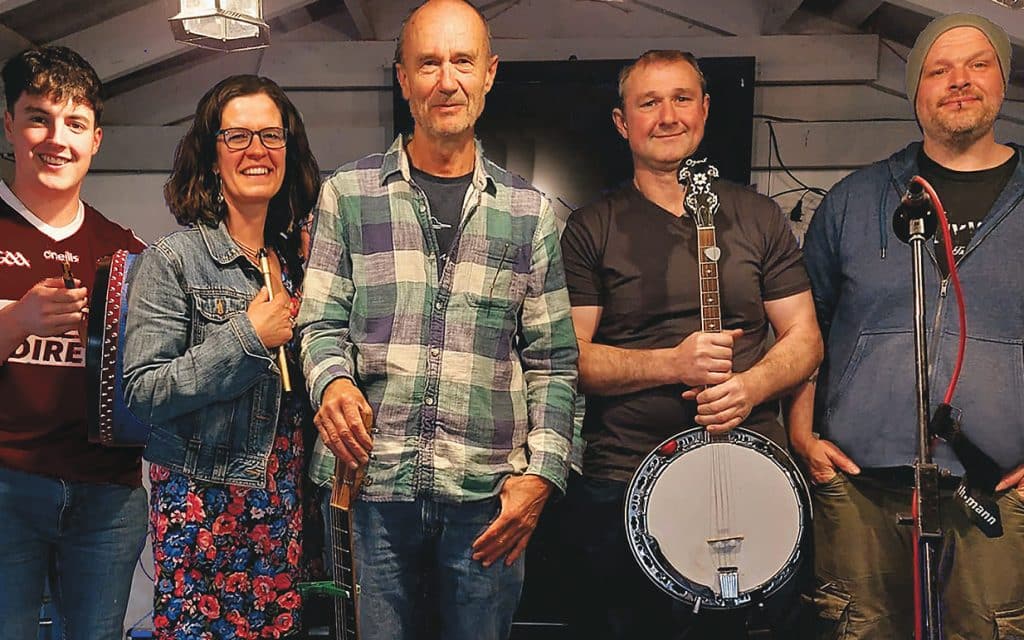
It is no secret that many people in Ireland like traditional Irish music. It’s also no surprise that most tourists do too. For, just like visits to stone circles, tombs, beehive huts and other Megalithic and Neolithic monuments, Irish trad offers a vivid, direct and immersive encounter with the roots of ancient language and culture in Ireland. A blast from the past, so to speak. And a pointer to the future. More and more Irish bands, famous and otherwise, writes Moze Jacobs, are inclined to weave a jig, a reel, a polka or an air through their music in some way or form. And/or sing ‘as Gaeilge’. Ballydehob-based band Rubicon has been described as ”pretty much the longest running trad band in West Cork”.
According to the band’s lead singer Francine Thurnheer “The music is going strong. It doesn’t seem to be stagnant.”
”Major bands such as Kingfisher and Amble or Kneecap make it trendier. Trad groups are now even performing at the big music festivals. And there is a large number of upcoming groups including 17-, 18-, 19-year-olds with brand-new bands. When I was growing up, you were nearly a nerd if you were learning Irish music.”
Originally from Castlehaven, Francine is also the virtuoso tin whistler player of the band. Her fingers deliver the melodies meticulously, clear, fast or slow. A feast of precision. No faltering. Which may have something to do with the fact that she immersed herself in music when she was young and stress-free.
“I was six when I started on the tin whistle. I also learned the accordion, guitar, piano. I just loved music and took to it naturally so my parents didn’t have to force me into it. On the contrary – I always absolutely loved singing and playing. And performing! My first band was with my music teacher and seven of her other students. We used to play a few nights per week over the summer.
“I had my first gig in a pub when I was 12 and I’m 45 this year, so it’s 33 years of playing in public. I’ve been in various bands before Rubicon, but this is the longest stint. 17 years!”
Although she feels very comfortable on stage in most situations, there is an exception. “I don’t have any problem with huge, anonymous audiences but I get very nervous when I have to play in front of people I know. And during the first year I was with Rubicon I wouldn’t talk into the microphone and address the crowd. I was so scared I’d freeze. But now they can’t shut me up.”
The person who invited her to join the band, and who has since become her husband, is called Haensel Thurnheer. On Rubicon’s website it says he is, “on guitar and backing vocals and makes sure we never get bored!” Like all the other members of the band, he is self-employed and has a day job.
Francine says she “didn’t know him as a musician.
“He’s an engineer, did some business with my dad’s company and was looking for a singer.”
On stage and on video, Francine is clearly the dynamic heart of the band. Whether she sings, plays, or steps off the stage to direct groups of dancers (small – in pubs – or large – at festivals), she’s very good at running the entire show, including the céilí. Microphone in one hand, tin whistle in the other, alternating seamlessly. But it wouldn’t all work so smoothly if it wasn’t for the other musicians. A deceptively simple line-up consisting of brothers Dorian (banjo, mandolin, backing vocals) and Finn Kelly (bass) with Thurnheer himself on guitar. Whereas Rubicon are still looking for a fiddle-player (apply via rubiconireland.com or ring 086 8430006) they have a ‘pool’ of five bodhrán players including Ivan Camiers and 22-year-old Daniel Coughlan, a former Senior Bodhrán Champion of the Munster Fleadh Cheoil. Plus, when they play in Austria or Germany, they are joined by either of two local bodhrán players.
As will happen on their upcoming tour, which will take them across West Cork, from May 17 (Courtmacsherry) through September 26 (Castletownbere) and on to Germany and Austria in October. The tour ends in Rosie’s Bar (Ballydehob) on January 1, 2027. Thirty gigs in all, so far. Not including functions (weddings, private parties, birthdays) where the band plays in-between. It will literally accommodate to any sort of audience.
“Our smallest gig was for six people: a couple, two friends, a chef and a waiter,” shares Francine. “The biggest was St. Patrick’s Festival in Munich for 80,000 people in March.”
Earlier this century, they played New York for six years in a row on St. Patrick’s Day. Until 2016, when Trump came in.
“They blocked us, sent us back to Dublin and said we are never allowed to return to America. Blacklisted. I went on Joe Duffy to complain and several bands contacted me to say they had similar experiences. When you’re being interrogated they say things like, we don’t need you in our country, we’ve plenty of people who can play Irish music, go home.”
We were entering America on tourist visas. A working visa would have cost us €3,000. That was completely unaffordable,” adds Haensel.
He founded Rubicon’s precursor under a different name in 2006, fifteen years after moving to Ireland from Switzerland where he was playing guitar in an Irish trad band. “I was immediately hooked.” But he’s also partial to rock. “I really like ACDC as well as trad. Our original idea was to play heavy rock albeit with Irish tunes. In the beginning we had an uilleann piper. Quite an aggressive sound but then we began to soften. Now we play not pure trad, but something close to it.”
Finn Kelly’s sturdy bass and the riffs he and Haensel play together, “give the music a real lift and facilitate the dancing.”
Rubicon play some original songs (including one called Ballydehob, by Haensel, “a comical song”) but their real focus is on existing Irish material. “Sometimes I hear a tune that gives me goose bumps,” says Francine. “Then I have to go home, find it, and learn it. Such as ‘Curlew’s Reel’.” The tune, (composed by Josephine Keegan), combined with a reel called ‘Moving Cloud’ (by Neillidh Boyle) is on their brand-new album, ‘20 Years A-Live’, released in March, available on CD during gigs and online. Somehow, the combination of Francine’s high-flying whistle and the solid trad band behind her continues to work like a train. Or, like clockwork.