
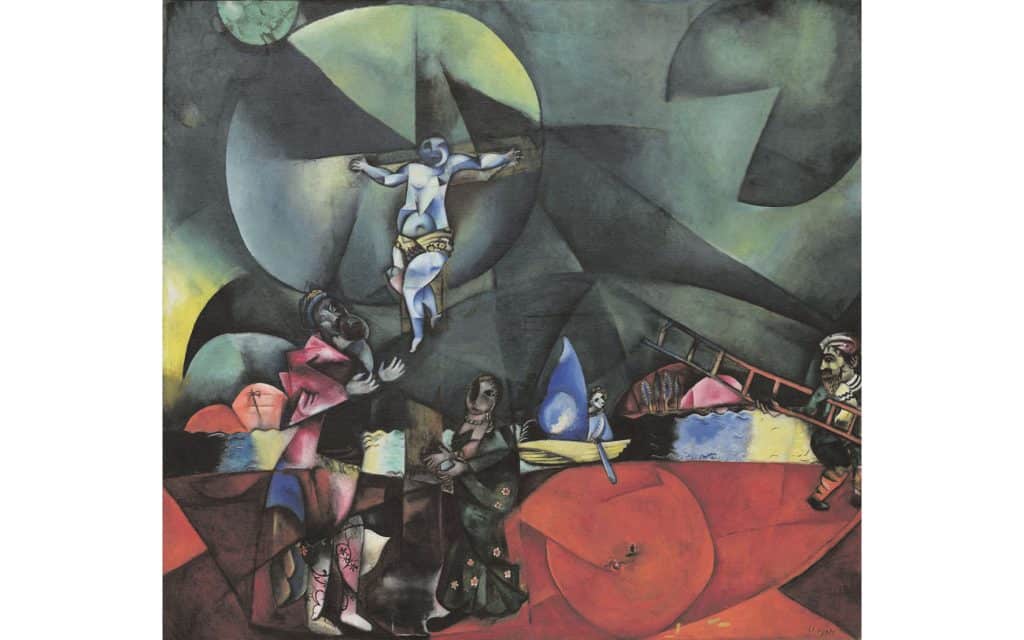
With Easter upon us it is perhaps timely to dwell on a painting, which not only resonates with the season, but also articulates the horror that continues to unfold in the Middle East and Ukraine. This is Marc Chagall’s ‘Golgotha’ of 1912, perhaps the most luminous, prismatic painting of the crucifixion in art history. It differs from all others in its non-literal transformation of the biblical scene: in place of an adult Christ is a blue child, ‘crucified’ on the arc of an emerald green sky. It is a deeply mysterious vision, one that speaks more, perhaps, of resurrection, rebirth and renewal, than death. And yet it also invites a darker interpretation, one more prescient to our times: that of the child of the Middle East, the child of Ukraine, crucified by war.
Chagall, a Russian Jew, was not one to be confined by conventions, whether they were pictorial, religious or otherwise. As a Jew, images were largely proscribed, and symbolic Christian images, unthinkable. In painting the crucifixion, the young artist from Vitebsk (Belarus) charted a course that broke completely with Jewish cultural norms. When, later in life, he was invited by the newly formed state of Israel to decorate the interior of the Knesset (the Israeli parliament), it came with a caveat: there was to be no Christian imagery, a condition Chagall quietly ignored. It wasn’t that he was pro-Christian, it was the fact that the figure of Christ was a part of his personal metaphoric language, a visual lexicon of images which sought to transcend politics and religion, in its depiction of love, suffering, beauty and eternity.
There is no doubt that his ‘Golgotha’ of 1912 is all four of these things. Chagall had a mysterious ability to evoke the eternal in everything he touched. The arc of the child’s open mouth is echoed by the large circle inscribed in the sky behind him, and by the prismatic arcs in the luminous red ground below. The line rhymes and echo shapes, employed throughout, enable everything to visually resound; nothing is static, everything is alive. In employing a programme of prismatic arcs and intersecting spheres, Chagall achieved a magical unity, at once terrifying in its imagery and beautiful in its manifestation. The result is an image which echoes forever in the mind.
In 2005, I wrote several poems which dreamt themselves, in part, out of Chagall’s painting. One of these was called ‘Blinded Lethe’ (Lethe was a river of the Greek underworld, which invited oblivion): “I am breathless with discovery / And wounded by the glare / Of the gored and shrapnelled child / Bronze fists of anger immeasurable / A wing of leaden death / You make me transparent / With your pain / Now I understand Christ / Whose limbs flared and shone / Like mirrors / Like glass / Which shattered and fell / In a rain of transcending passion / Upon the fields / Of blinded Lethe / Who, feeling glass soft as snow / Looked up in astonishment / At the son of man.”
The ‘child’ referenced in this poem occurs periodically in my work, and could be thought of as an archetype for the ‘wounded child.’ The poem itself is driven by an incandescent (and impotent) rage at the power-hungry architects of war, with the ‘wounded child’ being their ever-constant victim. The most recent atrocity – the bombing of a school in Iran – resonates Chagall’s ‘Golgotha’ one hundred times over. By saying this I do not mean to diminish such a heart-numbing loss of so many children to a neat line in an article, but to indicate that art is a quivering limb of life, that it is called to address the most urgent questions of our existence.
That is what archetypes are for, and his employment of them is partly why Chagall’s work is so enduring. His mysterious transformation of the archetype in ‘Golgotha,’ its resounding play of arcs and spheres, its deep, prismatic colour, is why I return to it again and again, every Easter; not as a window into a religious rite, but as a dark, pulsing emblem of suffering, as a reminder of art’s purpose, of its empathic power.
Chagall himself said of this painting, in a conversation with Franz Meyer: “Strictly speaking, there was only a blue child in the air. The Cross was of less interest to me.” The vision he had – palpable, non-verbal, mysterious – was everything. That is the truly creative space: the crucible in which spiritual treasures are born.