
Light, daylight, shadow; the richness of the hues, the softness of the shades. What, I often wonder, are we missing when we switch on an electric light, a screen? The microtones, the half-lights, what DaVinci called ‘earth light,’ the mysterious quality of sunlight falling upon a living thing, animating it, responding to its living pores, its pigmentation, the iridescence leant to it by its cells. Or the light of dawn streaming through frosted glass like silver filigreed with gold, imbuing everything it touches, like King Midas, with a mysterious golden hue. And then even the shadows come alive, their edges as soft as DaVinci’s sfumato, the smokey way he drew.
Electric light cuts, makes the shadows sharp, evens out the room.
Sunlight folds in like a sigh, rolls shadows out like living things, softens space.
I’m not a Luddite, I am not pining for a time before electricity. But as a painter, I’m now feeling a difference between the lights on in the studio and the natural grace of the skylight, between the electric bulb on in the bathroom in the morning, and the predawn glow filtering through the frosted glass.
There is poetry in fluctuation, in there being nothing else on but the play of the sun with the atmosphere, the dance of the light with the clouds. I am thinking now of Monet’s waterlilies in Musee de l’Orangerie, the magnificent semi-circular paintings only lit by skylights. You sit and watch as the light swells and fades and swells again, the colours in the paintings constantly changing, brightening and darkening like embers in a fire.
Sunlight is grace.
The nadir of our visual culture’s love affair with conceptualism is, for me, Martin Creed’s ‘Work No. 227 The Lights Going On and Off’ (2000). The ‘work’ consists of two electric lights going on and off every five seconds in a room. The regularity, the coldness, the poverty of vision and experience. The irony, of course, that there is no light in this ‘work,’ only darkness, emptiness, sterility. A statement? Please spare me such statements, I’m looking for transformation.
The opposite end of the scale, for me, is Odd Nerdrum’s painting, ‘Dawn,’ from 1989. Like in some surreal ballet, the four, near-identical seated figures have their faces raised to the sky, their mouths open, eyes closed, in a blind love song to the sun, which is breasting the mountains behind. They are at one with the mountain-scape, their bodies aglow with a sunlit radiance (a stage trick, as the dawn is behind them, not in front). The richness of this painting is something to behold, a testament to the truism that there are no new subjects, only fresh expressions of them.
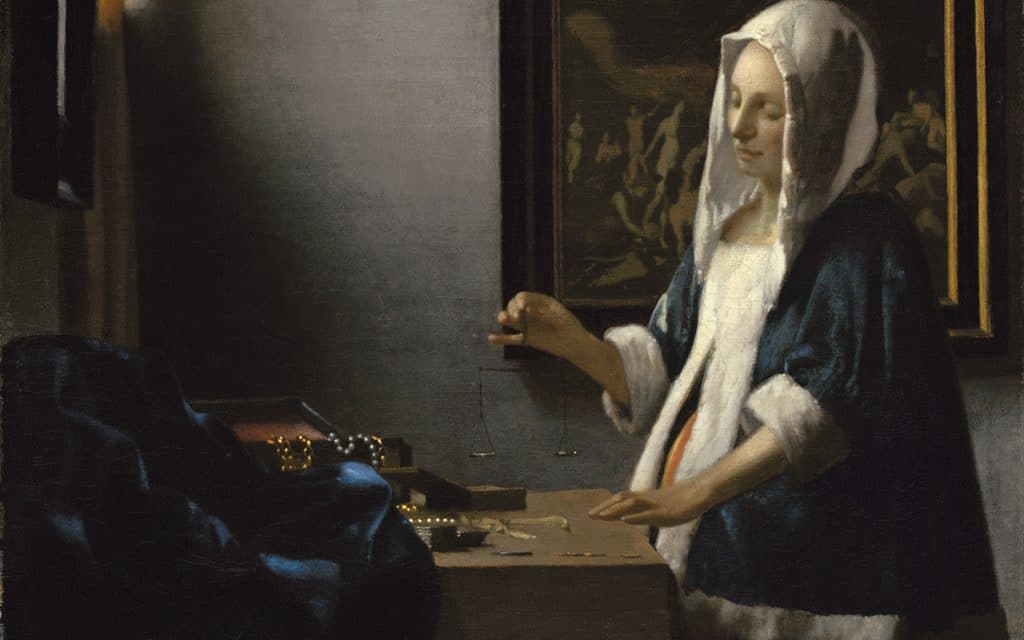
Another, perhaps more iconic example, is Vermeer’s ‘Woman Holding a Balance’ from 1662. Light pours in from a high window, delicately catching the gold of the balance, the paleness of the woman’s hand, her face and gown. This is why the world loves Vermeer: because he connects natural light to the figure in perfect, ordinary harmony, because he transforms oil into light. We feel the stillness of the moment, the silence of the transformation, and are more at peace for it.
I am writing this on a laptop, the screen radiating out at me. It is not, I know, good for the eyes, but I am grateful for it, writing is an addiction. At the same time I cannot help thinking of my childhood spent in an old farm house in the Australian bush. No computers or iPhones, of course, and for years we had no television. No screens at all. We rose with the dawn. At night we lit a fire, read books. You could hear the frogs croaking in the nearby dam, the wind rustling the trees, the wooden walls creaking. Outside the stars shone with a rare, diamond-studded brilliance. The cosmos was so vast, so mysterious, an intoxication of fire-laced distances beyond human measure.
Street lights cut out the beauty of the night sky.
But where would we be without street light? Our civilisation is founded on this electric pulse, this illumination, this connectivity of information and purpose. Somehow it keeps all the raw wildness at bay. For we are only one power outage away from the Middle Ages. This is our conundrum, a measure of our fragility.
How did I even begin thinking about this? For several years I have been imagining scenes in the 16th century studio of Pieter Bruegel, for a novel. Painters at that time were wholly dependent on natural light, could only really work in the spring and summer. Perhaps they could draw in the colder months, by the light of oil lamps and candelabra, but such light was hardly sufficient for painting. The studio was set up in such a way as to make the most of north-facing windows, north-facing, as it offered the most stable, unchanging illumination throughout the day.
Life had a different rhythm, a slower, softer vibration.
I am not pining for a time before electricity. I am a grumpy mess without a hot shower. But we have the luxury of choosing: to at times, turn things off, tune our eyes to the shadows, to a softer vibration, to a silence that truly connects.