


On what has become an annual odyssey to Greece, we spent ten days in Syros where we held a Greek cooking class. We shared this with a lovely group of people and it was great fun even if the weather did not always behave!
Syros is one of my favourite Cycladic islands – stylish, gracious and full of good food. However, beautiful as Syros is, we were keen to discover the other islands, of which there are many.
This year we travelled on to Chios, the main reason being curiosity. It is the only place in the world which produces mastica, an aromatic resin from the mastic trees that seems to be used in everything – food, drink, beauty products and medication. It means the island has a fulltime population and, as it’s a mission to get here, it isn’t dominated by tourism, so everything doesn’t close down at the end of the season.
We took the night ferry from Syros. It’s a ten-and-a-half hour journey, stopping at six other islands on the way. Each island is announced by a loud ‘Ta Ta Di Da’ and a lot of people moving on and off. Once the ferry continues on its journey the captain announces all the safety measures in Greek and English. This means that every time you doze off you arrive at another island and are awakened again. Pure torture. I was extremely grumpy by the time we arrived.
Like all the islands, Chios is very different, with its own personality and architecture. My first impression (perhaps due to grumpiness) was that the main town was, dare I say it, quite ugly.
Chios has been invaded and sacked over the centuries and a big earthquake in 1881 levelled a lot of the beautiful old Genoese and Venetian buildings. This means there’s a mish-mash of surviving old structures and random new ones.
It’s a big town – more than half of the population of 53,000 live here; the rest are scattered in villages north and south. Chios is also the fifth largest of the 119 inhabited Greek islands and at that it’s only 50kms long and 24kms across. It might sound small but due to Mount Pelinaith, which traverses the middle of the island, and the numerous valleys scattered between the interior and the coast, it’s certainly not fast to get anywhere. The roads switchback up and down and getting from one side to the other takes time. The mountain is quite high, 1297m., high enough to make our ears pop. Sections of it have obviously been ravaged by wild fires as the trees are blackened and skeletal in places.
The mastica trees are in the south of the island and the entire area is infused with the aroma of mastica, a fresh herbal sweetness with a resinous eucalyptus/pine fragrance. It’s quite unique.
Every spring the ground beneath the trees is cleaned and spread with a layer of fine limestone for the resin to fall on. In the summer the bark of the trees is scored with small incisions that allow the sap to emerge. The sap drips slowly over a number of days and hardens into translucent tears or pearls, which are then collected and cleaned by hand. The same method has been used for centuries. There is no mechanisation. This seasonal and painstaking process, which is unique to this island, is reflected in the price.
Mastica, is where the word masticate (meaning to chew) originates from. Mastica was the chewing gum of the ancient world.
This product made the island quite wealthy over the years and it also meant that the island was invaded by the Ottomans and Turks, all of whom wanted a slice of the pie. The mastica villages were like prisons in those times, as the mastic was so valued that noone was allowed in or out. Big iron gates that shut at night prevented anyone from leaving. Smuggling was a punishable offence. The villages – a maze of narrow alleyways, with very few windows and little light – are still inhabited today. I found them beautiful but rather oppressive.
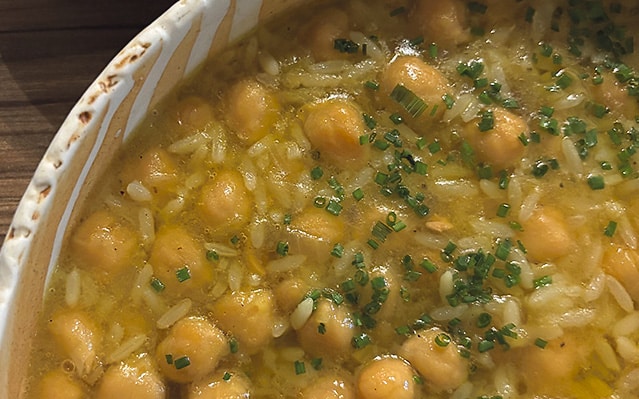
There are many culinary uses for mastica, but saying that, I can’t see everyone rushing out to find some, so I am sharing a recipe for a chickpea pilaf that I ate here, which I thought was delicious. It’s another one of those simple recipes that delivers more than the sum of its parts.
We enjoyed this dish at a small contemporary Greek restaurant where they generously shared the recipe. On the menu it was served with Aegean shrimps but as I am super sensitive to shellfish – after a food poisoning episode a long time ago – we had them on the side. Con thought they were a sweet addition.
Either way it’s worth making – fish or chicken could also work on the side if you fancy a little more protein.
The chickpeas can be cooked from dry, after soaking them but a more realistic way to make this recipe is to use a can or jar. Jars of chickpeas would be my favoured way – they are cooked to perfection and the broth in the jar can be used as part of the stock. Cans of chickpeas are best drained and rinsed.
As in all Greek recipes the addition of olive oil is generous – this forms part of the sauce.
Chickpea Pilaf
Ingredients
• 1 jar or can of chickpeas
• 200g short grain/arborio type rice.
• 1 large onion
• 75 -100 mls extra virgin
olive oil
• 2-3 cloves garlic
• 1 tbs mild yellow mustard
• 600mls vegetable stock
• 1 lemon, juiced – roughly 2tbs
• Salt and pepper.
• Chopped parsley to serve.
Method
Peel and finely chop the onion and the garlic.
Heat a medium sized pan then add enough olive oil to generously cover the bottom and the chopped onion. Cook on a medium heat until the onion softens, without browning, then add the garlic and cook for another couple of minutes. Stir in the mustard, followed by the rice. Cook gently until the rice is well coated with the onion mix then add the vegetable stock (and chickpea liquid if you are using a jar – make the amount of stock and chickpea juice up to 600mls). Bring to the boil then turn to simmer. The heat should be high enough to see some action but not have the rice belting around the pan. Cook uncovered for roughly sixteen to twenty minutes, stirring from time to time until the rice is tender and the stock has reduced. If it becomes too dry add more stock/water. Add the chickpeas, season with salt and pepper, then cook until warmed through. Stir in the lemon juice. If you want to add some freshly cooked shrimps or prawns stir them through now.
Serve garnished with a little chopped parsley.
It’s now time for us pack up and return home. See you soon.