

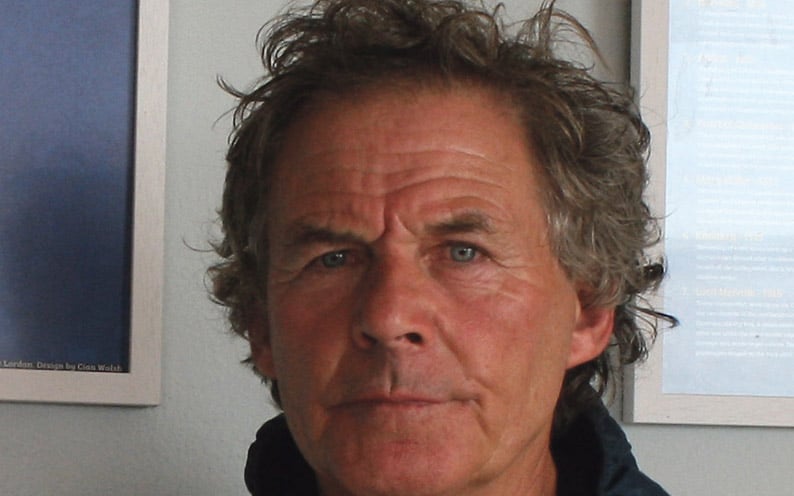
Jerome Lordan’s aunt used to say if you’re going fishing, keep me a ‘biardán’. She was referring to a small white pollock. Like so many other old Irish words, you won’t find ‘biardán’ in Dinnen’s ‘Foclóir Gaeilge agus Bearla’ dictionary. Sadly, with the decline of the Irish language, many of the old names traditionally handed down orally through the generations have long been forgotten. While he didn’t pay much heed to these colloquial words and phrases as a young boy, with age has come a deeper appreciation for lore and our connection to the land, and today, writes Mary O’Brien, the retired boatman and passionate local historian has turned his fascination with non-administrative or ‘minor’ placenames into a project dedicated to preserving the lost language of the Irish landscape along the southwest coast.
Over the past 30 years, Jerome has collected roughly 500 minor placenames drawn from his own recollections and through conversations with the older people still living on the Old Head of Kinsale and surrounding areas, opening a window into the social history of the area where he grew up. These have now been recorded along with archaeological features, historic timelines, parish and townland names and boundaries and shipwrecks in a series of maps covering the coastal area from Dunworley to Kinsale.
“Many of the older folklore collections never made maps, leaving names without locations,” says Jerome. The historian has taken on this challenge and, through careful detective work, has endeavoured to connect his collection of placenames and local landmarks to their exact locations. “Vincent Murphy gave me the locations for a stretch of coastline, specifically around Howe Strand, from memory, as he drank his pint at The Speckled Door,” he shares smiling. The late Francie Dempsey of Lispatrick also passed on his huge corpus of minor place names, which Jerome recorded, as he did with many more of the older generation, now passed on.
He drew on Brúnó O’Donoghue’s parish histories to complete townland maps for the intertwined parishes of Kilbrittain and Courceys.
“As you get older you realise the importance of recording things before they are forgotten and minor place names share the ‘greater story’ for that area,” he explains.
“In the past local people knew their own landscape intimately and had names for every field, rock and physical feature, as their world was an entirely local one and people moved little outside their own area.”
Unlike townland, parish or county names, minor placenames – many reoccurring around the coast of West Cork and Kerry like Cuas Buí, Tráigh Mór or Cuas a’Rón – were never anglicised.
Jerome’s fascination with folklore, archaeology and shipwrecks started during his master’s thesis at UCC in 2007. This developed into a passion for unearthing obscure Irish words.
On the advice of historian Dr. Éamon Lankford, he focuses on interpretation rather than translation.
“Sometimes literal translations can be incorrect or can strip away the nuance,” he explains. A ‘capall’ may not mean a ‘horse’ but instead can refer to a sharp submerged rock shaped like a horse’s back.
He references colour, as it can have a double meaning in Irish. Take the words ‘Cúis Buí’.
“Buí’ means yellow, but the name could mean a sandy yellow cove, a shallow cove, or reference yellow sedge growing on the banks,” he explains.
He interprets ‘Pointín na Rínce’ – a small rock point located between Garrylucas and Garretstown beaches – as meaning converging bodies of water making the waves dance.
‘Cúaisín na nDaoine Báite’ (Little cove of the Drowned People) in Dooneen downland (close to The Speckled Door), has been linked to the wreck of the ‘Stonewall Jackson’. “The entire crew were lost here in 1868,” says Jerome. A mound in the field adjoining the inlet is reputed to be the burial place of the sailors.
In ‘Poll na mBolg’, a sea cave at the Old Head, ‘bolg’ could mean ‘belly’. “But it could also imply ‘bellows’, describing how waves pump into the rock like a bellows,” adds Jerome.
He draws attention to Blanket Wood in the Bawnea townland of Kilbrittain. “It’s an interesting placename…so named because O’Sullivan Bere camped here on the way to the Battle of Kinsale in 1601.” Clashavanna, where the new GAA pitch in Kilbrittain is located, comes from ‘Clash a’ Bainne’ (the hollow of the milk).
He has also collected a number of Hiberno-English words used in everyday conversation to describe the landscape.
In the past when people spoke about a ‘wind dog’ they were referring to a low hanging, ragged, stormy-looking cloud. “It was looked on as a sign of ominous weather,” shares Jerome.
Seamen would have used the word ‘cottontail’ instead of ‘rabbit’ while offshore. “You would dare not mention the word fox, rabbit or donkey on a boat, as it was considered very bad luck.”
‘Bollán’, ‘Buillig’, ‘Rabha’, ‘Capall’, ‘Scoth’, ‘Droum’, ‘Mionnán’, ‘Stuicín’ and ‘Staca’ all referred to different types of rock formations both underwater and above water.
The phrase ‘fire in the water’ denoted phosphorescence. “If this was in the water it was seen as a sign that the conditions weren’t good for herring fishing,” says Jerome.
‘Crothóg’ was the name most commonly used throughout West Cork and Kerry to describe a small black pollock. Cailleach Breac was used for a bull huss or greater spotted dogfish and battle board or stock fish alluded to salt ling.
An otter was referred to as a ‘water dog and a seal was called a ‘rón’.
The word ‘gearcuach’ described little fledglings in a nest.
“These words were the cusp between the old linguistic world of Irish and the modern world of English,” says Jerome. Most have fallen into disuse today.
In the past fields were traditionally named in Ireland, a fact brought to the attention of the wider public in recent times by the late Manchán Magan. “‘Páirc/Gort/ na Horna’, ‘Páirc na mBó’, ‘Paircín Caol’ and many more descriptions were used,” shares Jerome. Once land ownership changed hands more often than not these names were unfortunately lost to memory.”
Jerome has also done a lot of research on local shipwrecks, referencing a number of notable ones and their legacies on the maps.
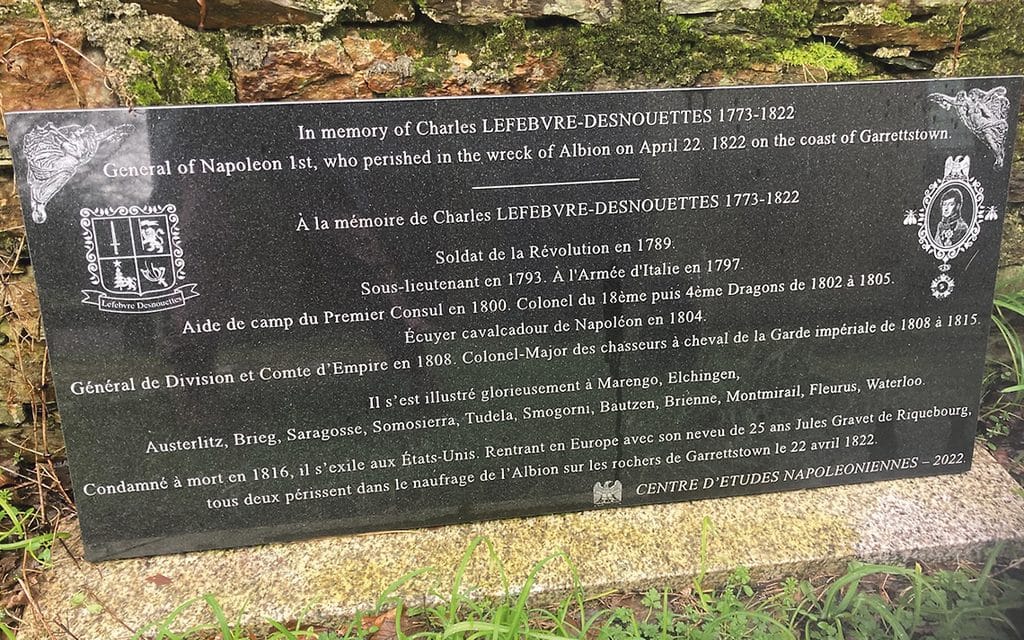
The distinguished victims of the Albion shipwreck lost west of Garretstown in 1822 – including Alexander Metcalfe (Yale physics professor), Anne Powell (daughter of the Governor of Upper Canada), and Charles Lefebure Desnouttes (a general in Napoleon’s army) – are interred in Templetrine graveyard, on the north side of the church. Other less distinguished victims are buried in an unmarked site in the same graveyard.
The deceased crew and passengers from the troopships ‘Lord Melville’ and ‘Boadecia’ – returning from the Napoleonic Wars – lost in 1816 were buried in a sand dune on White Strand. They were reinterred to Old Court graveyard in the early 1900s by Robert Buttimer on the instructions of Cork antiquarian Robert Day.
The victims of the Hercules, a German collier lost in 1874 at Hackettstown, are interred in an unmarked grave in the southeast corner of Currarane burial ground.
A number of dinner plates and other items from ‘The City of Chicago’ ended up in nearly every house on the Old Head. The ship was wrecked in 1892 at Ringagorteen with no loss of life.
Burial grounds for unbaptised infants, suicides, and unidentified sailors are documented on the maps. These ‘cillíns’ are typically found on townland boundaries. “Liminal places, neither here nor there, representing purgatory,” explains Jerome.
In places like Ardfield, the Seven Heads and the Old Head, the language survived well into the middle of the 20th century. This was one of the main reasons a record of minor place names survived. In other areas where the language disappeared at an earlier date there tends to be scant records. Jerome’s maps bring our attention back to the language of the land and the stories hidden beneath it.
The maps are available to purchase: €35 for A1 size and €45 for A0 size. Email:
[email protected].