


I feel that urine infections in women can be a condition that is put down to something we simply have to put up with. The reality is that many women do not ‘bother’ their GP every time they have a bout of cystitis; urine infections are not regarded as a serious illness in women under the age of 80.
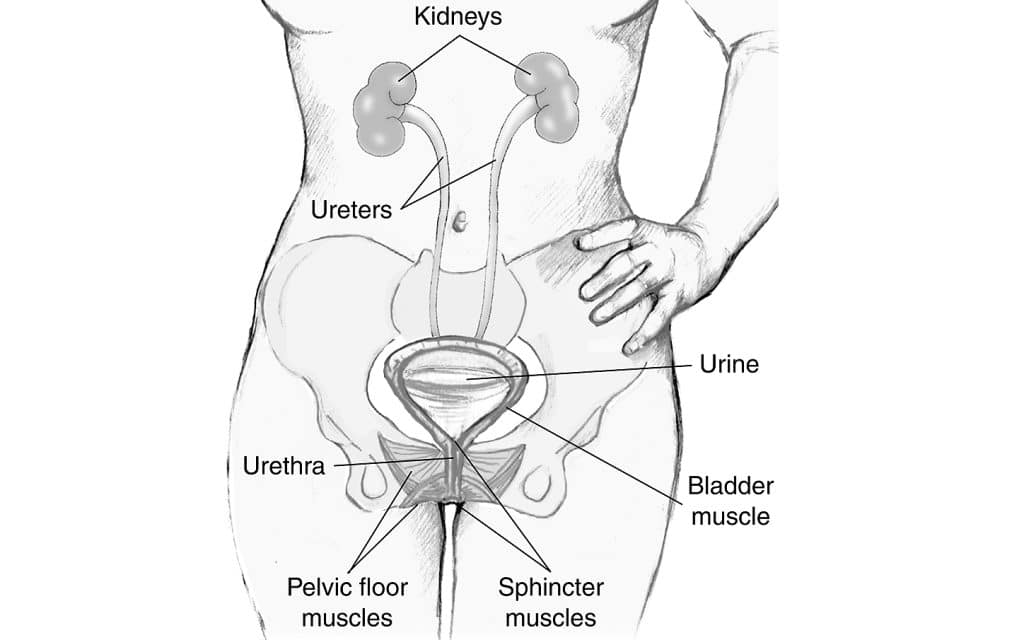
Let’s first talk anatomy. The urinary tract is a plumbing system made up of the kidneys, ureters, bladder and urethra. This system plays an important role in removing wastes from your body. The kidneys are a pair of bean-shaped organs that lie in the middle of the back, just below the rib cage. One of their functions is to filter waste from your blood. Tubes, called ureters, carry urine from your kidneys to your bladder, where it is stored until it exits the body through the urethra.
A urinary tract infection (UTI) is an infection that can occur anywhere along the plumbing system but most commonly involves the urethra and bladder, a so called lower UTI. Infection of the kidneys, an upper UTI, is a more serious condition called pyelonephritis.
Most UTIs are caused by the bacteria E.coli, that lives in the colon, especially the rectum.
Adult women are most commonly affected, as their urethra is shorter than men and opens nearer to the anus. This means it is easier for bacteria to enter the urinary system and cause an infection. About 40 per cent of women get at least one UTI in their lifetime. It is more common in sexually active women, during pregnancy, after surgery and menopause. It can also occur if the bladder does not completely empty or if catheters are used to empty the bladder.
How do I know if I have a urinary tract infection?
You will generally know! Your GP might ask about “tummy pain and burning or cystitis?”
When asked the question, can we be a little more honest about symptoms; lower abdominal pain on par with labour pains and peeing razorblades dipped in hydrochloric acid. That sounds about right, ladies?
We also tend to pee much more often than usual, sometimes needing to get up several times in the night. Urgency, a dire need to pee can be a feature, often with little or no urine being passed and, if you don’t get to a loo fast enough you might wet yourself. There can be blood in the urine. You may feel pressure in the lower pelvis or lower back ache. Urine may also become cloudy or smell unpleasant. These symptoms are seen with lower UTIs.
Symptoms and signs of more serious infection are fever, nausea, vomiting, chills and pain on one side in your lower back, indicating a kidney infection, called pyelonephritis.
Why do female UTIs matter?
A serious UTI can cause infection to spread to the bloodstream called sepsis. This can cause death if not recognised and treated on time. Even if sepsis does not occur, UTIs involving the kidney, pyelonephritis, require hospital admission for IV antibiotics. Recurrent UTIs can result in cumulative damage to the kidneys reducing their ability to function and filter our blood. So, yes; every episode of cystitis is important and potentially harmful.
Why do some women have recurring Urinary Tract Infections, (rUTIs)?
The definition of rUTIs is having two in six months or three over the last 12 months. There may be a structural issue in the plumbing, which may be related to menopause, and it is more common in pregnancy, when untreated UTIs are associated with increased risk of miscarriage. Post-op, they are more common, most likely related to needing catheterisation through the operation.
Often no specific cause is found. However, you still should not ignore return symptoms.
What can we do to prevent UTIs?
Number one – tell your GP! Every time you have symptoms!
As a GP for 30 years, I have come across patients self managing recurrent episodes of painful peeing many times. Cystitis or discomfort when we pee can happen without infection; this is very common from age 45 onwards when it is caused by oestrogen deficiency associated with menopause transition. Urine testing is usually negative for infection, and the symptom of recurrent cystitis resolves with vaginal oestrogen, either as a pessary or cream.
So cystitis does not always equal UTI. But the only way of knowing that is to see your GP or practice nurse for a urine sample – every time you have symptoms.
Urine dipstick is a very accurate, sensitive way of confirming UTI. If dipstick is positive, your GP practice should send a sample off to the lab for analysis. This is especially important if you are having recurrent symptoms. The clinical definition of rUTIs is based on laboratory confirmation of infections.
However, especially in West Cork and during a late evening GP surgery, it is not always possible to get a sample off to the lab. But you should have a sample dipstick as a minimum every time you have symptoms. Only by doing so, can your GP diagnose rUTIs. If confirmed, your GP needs to investigate why they are happening.
Investigations
As a minimum, you need a scan of your urinary tract, ideally first with a full bladder, and again after you pee, to check you are emptying your bladder completely. What we call a residual volume, over 50 mls in younger, and over 100 mls in older women, is significant and requires referral to a specialist; a urologist. A scan will also rule out structural abnormalities such as one kidney being smaller than the other or hydronephrosis, a condition characterised by swelling of the kidney collecting system, a marker of long standing back pressure. This might have been as a result of a childhood condition or obstruction of urine outflow by narrowing of the wee pipe called a urethral stricture.
If any abnormalities are found on scan or your recurrent UTIs are largely unexplained, your GP should refer you to see a urologist who may want to do an examination called a cystoscopy where they look up the urethra into the bladder.
You’ve had rUTIs confirmed, your scan is normal; what next?
Two treatments need to start, ideally in your GP surgery: The first is a course of preventative or prophylactic antibiotics. This is a very low dose, once at night mild antibiotic, usually for three to six months. Secondly, start vaginal oestrogen.
As a Menopause doctor, I, and readers of my articles, will be aware that oestrogen deficiency in perimenopause, menopause, and more so in the post menopause years, is the cause of many urinary symptoms including rUTIs.
Yes, we know that any woman, 45 and over, getting UTIs, should be started on vaginal oestrogen, as studies have repeatedly proven vaginal oestrogen prevents recurrent UTIs in this age group. Often oestrogen deficiency-related rUTIs start over the age of 65, many years after menopause transition, so both the woman and her GP may not realise that vaginal oestrogen is the cure, not repeated courses of oral antibiotics.
But that does not apply to women of all ages, or does it?
So what’s new?
I chose this topic after reading a US study published in Urology Journal June 2026. The study team examined US healthcare data base to identify women with rUTIs, defined as two separate coded UTIs within one to six months. Vaginal oestrogen prescription classification was either (1) never received or (2) received within two months of the second UTI. Outcomes of sepsis, hospital admission, and all-cause mortality were assessed within eight years of inclusion
The study group looked at the records 1.8 million women aged 20 to 99 years with r UTIs: five per cent were prescribed vaginal oestrogen, 95 per cent were not.
The study team then looked at the outcomes for those two groups: vaginal oestrogen prescription was associated with lower odds of sepsis, hospitalisation, and death across all age groups.
Even I was surprised; I expected that outcome for the perimenopause/ menopause and post-menopause age cohorts, ages 45 to 99, but not for the younger women.
I hope this has been helpful. I urge women of all ages having symptoms suggestive of recurring bladder infections to see their GP.
If you are having recurrent urinary symptoms, cystitis, leaking, frequency of urination, getting up at night to pee, then your GP can refer you to see Dr Aenne Helps, the gynaecologist who runs Bantry Hospital Gynaecology clinic once a month, where I work.