


Colours crisp as daylight, edges seamlessly rendered. The prints on show at the Blue House Gallery in August breathed out the colour mantras of 20th century modernism. Edges both hard and soft, prismatic primaries, diffused tertiaries, colour field teasing landscape, landscape teasing colour field. Through various media, including carborundum, screen print, aquatint and etching, the three printmakers in the exhibition both complemented and contrasted each other in a way that was pleasing and energising.
Shane O’Driscoll’s signature hard-edge shapes – printed typically on a light ground, were softened by Yoko Akino’s stylised aquatint-etchings, which render landscape with a beguiling simplicity and delicacy. O’Driscoll’s and Akino’s work stood in marked contrast to the soft, atmospheric carborundum prints of Elke Thonnes, and it is this contrast which gave the exhibition some charge.
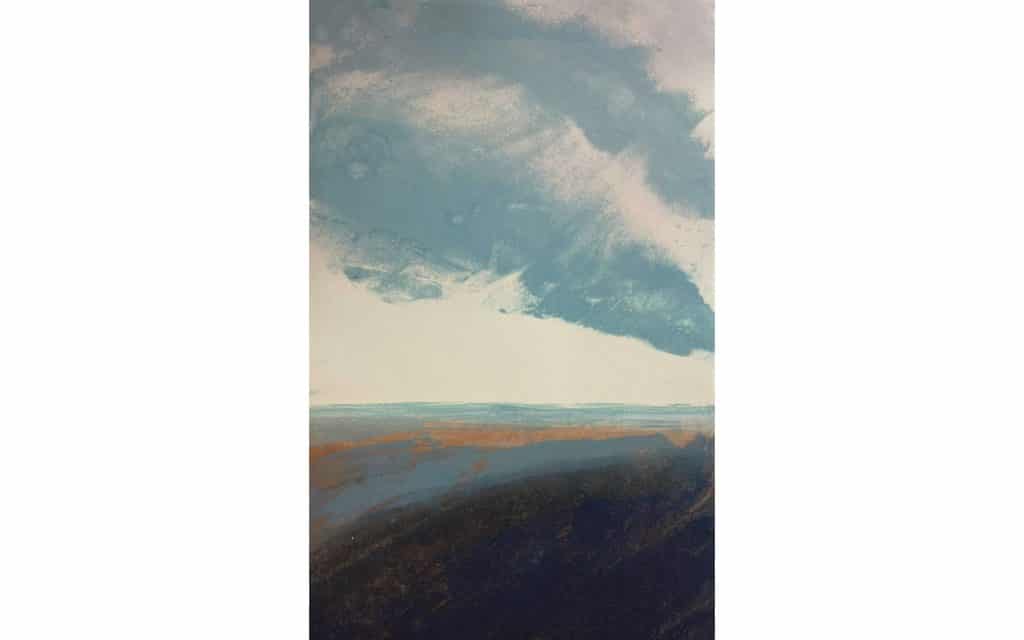
Thonnes achieves a remarkable degree of subtlety in carborundum, both in tone and texture, leaving the viewer feeling the presence of a moment, where the image is at once a simulacra of nature and not–a paradox that sings of multiple things at once, not unlike the work of that master of the post-expressionist sublime, Michael McSwiney. Her work titled ‘Soft Days II’ is a case in point: where the grey-blue of the clouds spray and drift, and the earthy oranges deckle and intermingle through the ground of the ultramarine, the sensation of earth and sky is effortless, loose and vivid. One delights in the feeling of the work as print, as much as in the evocation of the sublime vista.
Where Thonnes brings to mind McSwiney (who in turn riffs off Anselm Kiefer), O’Driscoll echoes a lineage that goes back to Henri Matisse, Piet Mondrian, Elsworth Kelly and Yaacov Agam, to name a few. With his preference for a pared back simplicity, O’Driscoll has more in common with Elsworth Kelly than the others, particularly with works such as Kelly’s ‘Blue and Orange and Green’ from 1964-65. O’Driscoll’s print ‘The Magician’ has something of this quality. It is a refreshing moment in his oeuvre, partly due to the use of an experimental, non-uniform ink, which softens the hardness of the shapes, and partly because the circle motifs, which often dominate, are absent. The colours are also more subdued, giving the work a tender feeling; it would be interesting to see more developed in this line.
The work of Kyoto-born Yoko Akino hovers somewhere between O’Driscoll’s and Thonnes’. It is both hard and soft, both geometric and organic. The use of aquatint generates gentle shifts in tone, whilst the hard ground etching leaves a trace of parallel linear rhythms, which appear to be Akino’s forte. Such rhythms sometimes evoke Akino’s Japanese heritage, recalling woodblock style renderings, such as in the clouds of her work, ‘Between Acts.’ Any stylisation or geometry is softened here by being hand drawn. ‘Even if Nobody Hears’ is, perhaps, the most successful of this grouping: a cerulean skellig rises out of an ultramarine sea, the stylised waves ascending with it, like so many eagle heads crowding around the peaks. Delineated in gold ink, the waves accentuate Akino’s predominately blue palette, which again contrasts with the high key colours of O’Driscoll and the wider range of Thonnes.
Colour. Colour freed from its mimetic restraints sings, and in print it sings so sweetly. Crisp and hallowed it conjures birdsong, crystal in its purity. It is energising to think of lineages, to see visual echoes, to sense the spirit of many artists through one. The Blue House Gallery has, here, staged a sensitive exhibition, highlighting the work of some outstanding practitioners. The variety of media, the dance between mimesis and abstraction, and the shifting colour temperatures, all served to deliver something both intimate and resonant. One left the gallery feeling, to paraphrase Thonnes, ‘softer,’ quieter, more gentle.