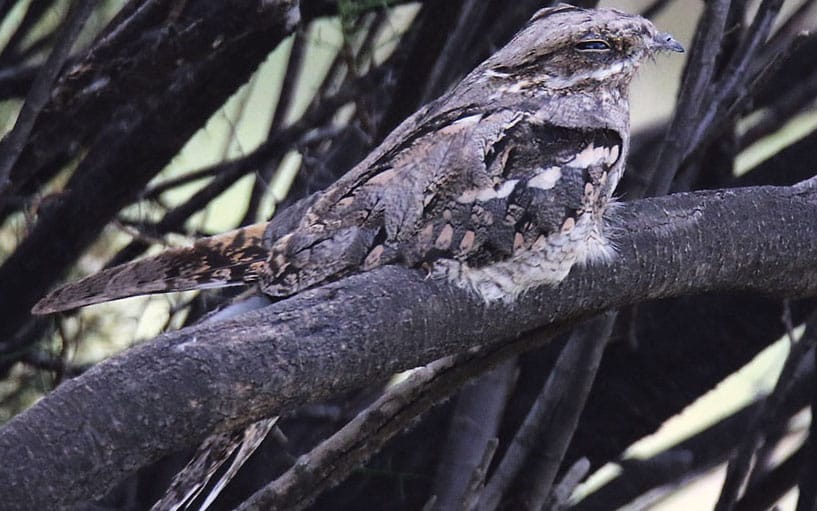


A woman in Donegal was recently stung by a weever fish. It happens occasionally in the summer when people are paddling in shallow water off sandy beaches. Weever fish lie hidden in the sand, often between tide marks, with just their head and black, spiny dorsal fin exposed, which, if stepped on, injects venom into one’s foot. The pain is quite severe, but rarely fatal. If you do get stung, immerse your foot in hot water; 40 degrees breaks down the toxin.
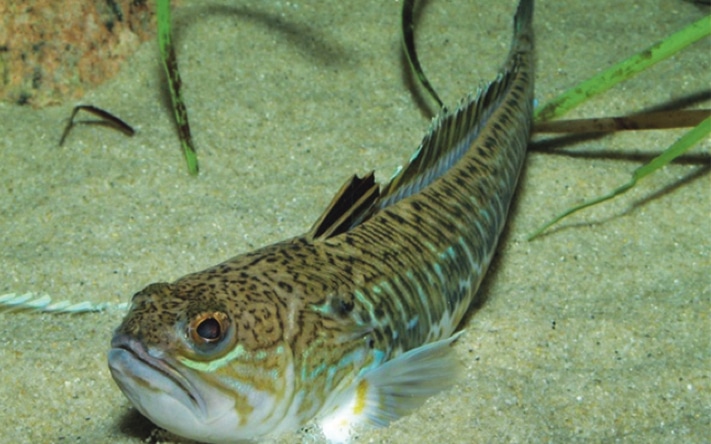
The name weever comes from the Old French word ‘wivre’, meaning viper. There are nine species, all but one live in the Atlantic; only two are found around these islands – the greater and lesser. It is the latter that bathers sometimes tread on. It is a small fish, mottled brown in colour, which grows to about 14 cm. The greater weever, up to 40 cm long, is more handsome, with blue, black and yellow markings. It can sting too, but it is less common inshore and is mostly a problem for fishermen. It is of no commercial value here, but much prized in France where it is an ingredient in bouillabaisse.
There are many dangerous fish in the sea, from man-eating sharks to man-stabbing garfish. An angler was badly bitten by a blue shark a few weeks ago off the Waterford coast, but then the shark didn’t ask to be hauled aboard his boat. There are other deadly marine animals, such as box jellyfish and blue-ringed octopuses, but fortunately none live around here. However, the oceans are warming up, and while heatwaves and wildfires are warning signs on land, the bleaching of coral reefs, the decline of kelp forests and the movement of marine creatures from tropical seas into more temperate waters are all further proof of climate change. In Courtmacsherry last summer, a moray eel was caught in a lobster pot. A flying fish turned up on a nearby beach last month. Local fishermen tell me that they are now catching the common octopus, a southern species, usually not as common here as the lesser octopus. Lobster fishermen in the south of England are losing their valuable crustaceans to this octopus invasion. Several species of squid are being captured in the North Sea where they were never found before.
About 1,000 species of sea creatures have migrated into the Mediterranean from the Red Sea via the Suez Canal since it was opened in 1869. But more species of fish have made the journey in the last twenty years than in the entire 20th century. Some of these new arrivals are fish we definitely do not want here.
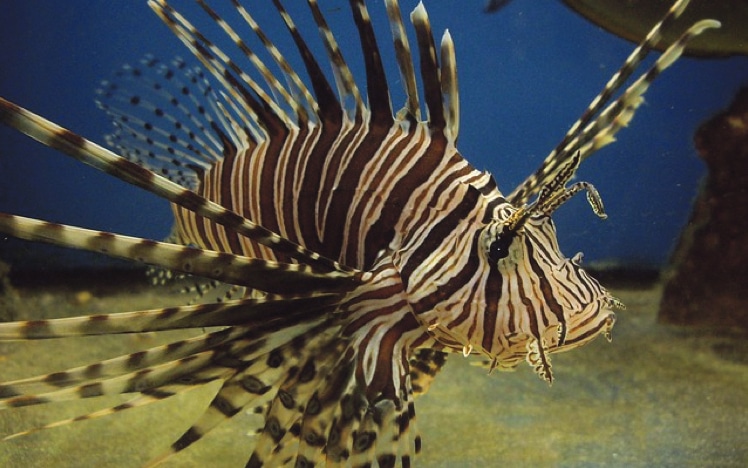
One such invader is the lionfish. There are five species, all native to the Indo-Pacific. They belong to the family Scorpaenidae, which also includes scorpionfish, redfish and Norway haddock, which can all be caught in our waters, and the deadly stonefish, which thankfully can’t. Lionfish are very attractive, striped in black, brown and red, with fan-like pectoral fins, long, separated dorsal fin rays and 18 venomous spines. A sting from a lionfish can cause severe pain, vomiting and breathing difficulties, and is occasionally fatal.
The common lionfish was first recorded in the Mediterranean in 1991. As well as being venomous, they are also gluttonous, eating vast numbers of commercial fish, and as they have no natural predators in the Mediterranean, and their females can lay over 30,000 eggs at a time, they are quickly taking over the territories and prey on indigenous fish. They are, however, good to eat and are starting to appear in Greek restaurants.
On the other side of the Atlantic, red lionfish have become a serious problem, the result of aquarists releasing them into the sea once they have discovered how difficult they are to keep – they eat everything else in the tank.
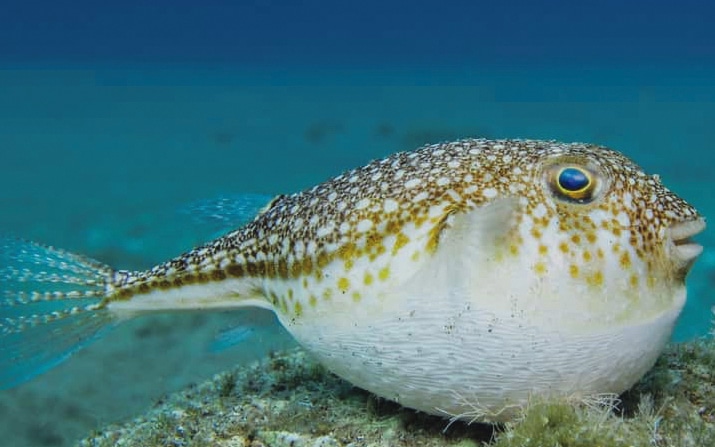
Even worse are puffer fish. There are about 200 species, in the family Tetraodontidae (part of the order Tetraodontiformes). They all puff themselves into ball shapes by sucking in water, to confuse predators, and all have large, incisor-like teeth. Their livers, gonads and skin contain tetrodotoxin, a deadly neurotoxin that causes heart and respiratory failure.
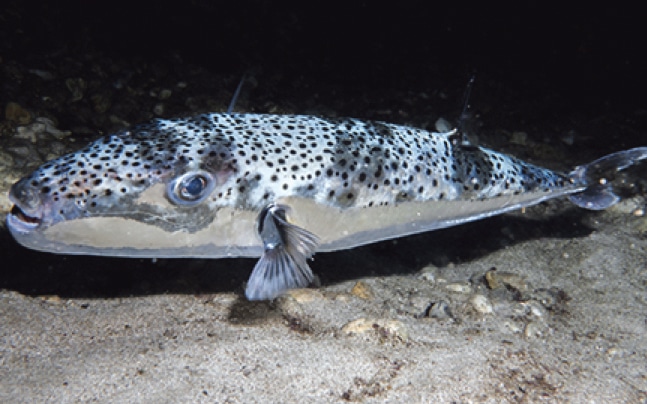
Two species, the diamondback puffer and the silver-cheeked toadfish, again both from the Indo-Pacific region, have invaded the Mediterranean and Atlantic. The former has been in the Med since the 1930s and remains restricted to the eastern part, but the silver-cheeked one which only arrived recently – it was first recorded off Greece in 2005 – has spread as far as the Straits of Gibraltar and south to Cape Verde. They are a menace to fishermen: their teeth are so strong they can bite off a finger, destroy nets and damage other more valuable fish in the nets, and, like the lionfish, they have no predators in their new habitats.
It is illegal to sell puffer fish in the EU, but in Japan, they are a delicacy. The Japanese enjoy what we would consider strange things, such as natto – fermented soy beans covered in slimy bacteria, and mochi – glutinous rice cakes that choke a few people to death every Japanese New Year. Puffer fish, fugu in Japanese, has to be prepared by specially trained chefs. Traditionally, if a chef lost a customer through fugu poisoning, he would have to kill himself. The ultimate gustatory experience when eating fugu is to get a slight tingling in the lips from the minutest quantity of tetrodotoxin.
The order Tetraodontiformes contains many strange fish. As well as the puffers, there are trigger fish, porcupine fish, cow fish and box fish. Trigger fish are so called because of the strong spine at the front of their dorsal fin that, when raised, locks into position so the fish can jam itself into a crevice and can’t be pulled out by a predator. Many are brightly coloured, such as the Picasso trigger fish, a bizarre creature with a long face and a body striped so madly in black, blue and yellow, it could have been designed by an eccentric artist. It has a wonderful name in Hawaiian Polynesian – humuhumunukunukuapua’a. One species of trigger fish appears in Irish waters occasionally in the summer months, but it is a dull greyish-brown fish – there is an example of this, stuffed, on the wall of the Anchor Bar in Courtmacsherry.
The sunfish, the largest of all bony fish, are also in this order. The ocean sunfish looks like a giant head without a body. It is occasionally sighted here, swimming slowly at the surface, tall dorsal fin flapping, like a drunken shark. Most of our sunfish are small, but the species can reach a weight of 1,000 kg. The southern sunfish is even bigger: one found dead off the Azores in 2021 was 11 feet long and weighed over 2,700 kg. Neither triggerfish or sunfish are dangerous, though the former can give a nasty bite.
Climate change will bring us new species, good and bad, but it might mean we lose others. Some planktonic crustaceans on which much of our marine fauna depend will move north, so will cold water fish such as cod. Of course, many people still don’t accept the whole idea of climate change. I was talking about this in the pub the other day with the crew of a large yacht. They insisted that global warming was not caused by humans, but was natural. They also said that world population was actually decreasing. Funny that, I replied – when I was born, there were about 3,500,000,000 people on the planet; now there are over 8,000,000,000. I hadn’t encountered such ignorance, delivered so vehemently, since I attempted to teach biological evolution to Born Again Christians in Zambia. People like that can’t accept that humans are ruining the planet, because to do so, they would have to think about their own excessively luxurious lifestyle.
There has always been natural climate change, but it happens slowly, over thousands of years, giving animals time to move to warmer or cooler places, grow or lose hair, learn to eat new prey. Man-made climate change, the result of almost everything that modern man does, is happening too quickly for animals to adapt. But those in charge, politicians, either don’t understand or don’t care. They only want ‘growth’, i.e. more cars, more houses, more industries, more people, which will all make things worse. Unless we go backwards, the environment will continue to suffer, and who in this rich, greedy society is ever going to return to a simpler, more environmentally-friendly way of life? And what will it take to get a government to make us do so? An invasion of lionfish near a TD’s favourite beach, perhaps.