

This month Andrea Reichstein, from the Save Murragh Action Group – a group dedicated to protecting the Bandon river valley – highlights the rare gem of ancient oaks found in Bandon woods.
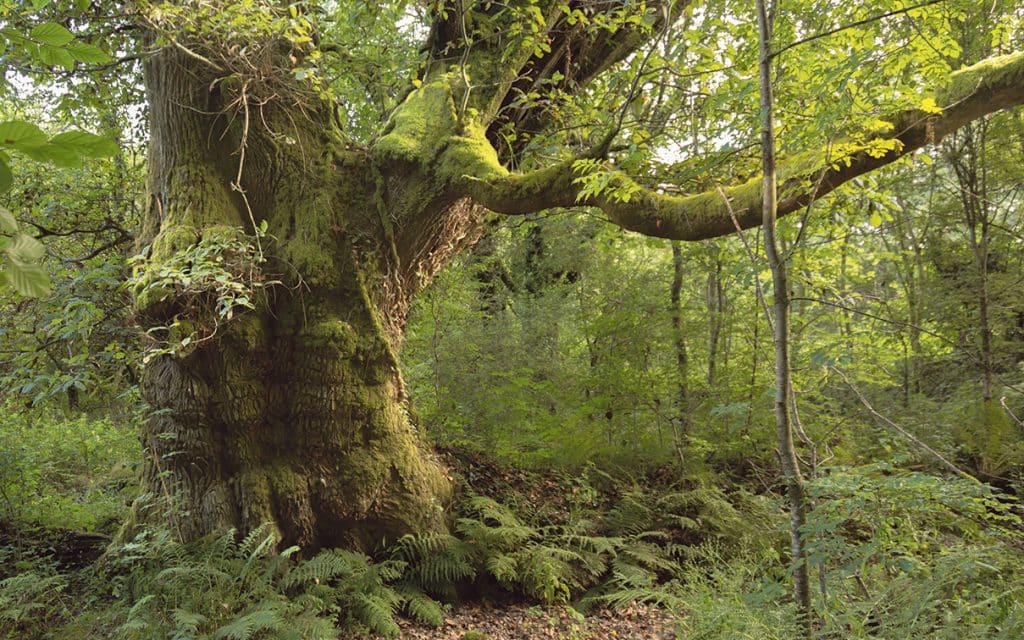
Bandon town, nestled into the beautiful Bandon River Valley has something very special right on its doorstep: probably some of the oldest and rarest oaks in Ireland. These are within a (possibly) ancient woodland forming part of the Castlebernard Demesne and they might even be a survivor of times when Ireland was still covered in woods.
But why are they referred to as ‘possibly’ ancient? This assessment is based on a desk-based survey on County Cork’s woodlands conducted as part of a report for the Heritage Council in 2010. The report consulted old maps to verify how long an area has been wooded. Castlebernard Woods appears on maps dating from around 1830. However, there is insufficient evidence to establish that the woods existed before 1660, a significant date as much of Ireland was surveyed during the Civil Survey and the Down Survey.
So, as Bandon was either not properly surveyed back then, or no convincing records could be found, it is listed as PAW (possibly ancient woodland).
Some PAWs got surveyed as part of the 2010 report, however, not Castlebernard.
Considering the impressive collection of massive oaks which, together with other woodland plants, indicate it being long-established, it is very likely an ancient woodland (AW).
However, while it may not yet be fully established that the woods themselves are ancient, some of the oaks within them are certainly ancient trees. An oak is generally considered ancient once it reaches 400 years of age, although this varies between species depending on factors such as growth rate. A fast-growing birch, for example, is considered ancient at around 150 years, while a yew needs to reach approximately 800 years.
But the woods are not the only habitat of note that the people of Bandon are fortunate to have. On the way to the park, which forms part of the Castlebernard demesne, one would cross what remains of the bog, an area of historic flood fields that, particularly during winter, once provided habitat for curlew, lapwing and, until recently, snipe. All three are red-listed birds, suffering significant declines as a result of habitat loss and deterioration, making the protection and restoration of suitable habitat a priority.
Unfortunately, part of the bog was built on some time ago and, more recently, the remaining bog has been drained.
This is happening at a time when the importance and value of protecting the floodplains and bogs we have left has never been greater – not only for flood protection, but also for carbon storage, river health and biodiversity.
The Bandon River, the bog and the possible ancient woodland form a unique, connected habitat of immense and irreplaceable value.
The bog and the woods help to hold water during periods of heavy rainfall. Together with the river, they provide habitat for species such as otter and kingfisher. The trees along the river help to stabilise its banks, reducing erosion, while their shade helps regulate water temperature, limiting excessive algae growth and helping to maintain conditions suitable for salmon and freshwater pearl mussel.
The latter was found in abundance along this stretch of river almost 50 years ago. Given that freshwater pearl mussels can live for more than 100 years, there is a possibility that some may still be present.
The area urgently needs to be properly surveyed.
But back to the woods.
I was lucky enough to get a tour of the bog and the park with Dan Holland from the ‘This is Bandon’ Facebook group, his partner Deirdre and Robert from BEAG.
Although I have lived in the area for more than 10 years, I had no idea what an extraordinary place this is.
The feeling of being in the presence of majestic ancient oak trees is difficult to describe. There is something humbling about seeing trees that have stood for hundreds of years, connected through an underground network of fungi, supporting each other and providing a home for thousands of woodland species.
Owls, woodpeckers, bats and squirrels all make use of the trees, nesting in the softer deadwood and cavities created as the wood decays. Some bats and small birds also roost or nest in the thick bark and its many creases and grooves. The acorns provide food for badgers, mice and birds such as jays, which bury surplus acorns for later. The oak flowers provide food for squirrels, insects and caterpillars of moths and butterflies, while the leaves also support countless caterpillars.
And then there are the fungi. One species, the extremely rare oak polypore, feeds only on the decaying heartwood – the inner part of the tree trunk – of oaks that are at least 250-years-old.
Altogether, more than 300 species are thought to depend solely on oak trees.
Some of these species are butterflies, many of which are so highly specialised to a particular tree that they cannot survive without it. The caterpillar of the purple hairstreak butterfly, for example, depends on the leaves and flower buds of oak. The striking adults are rarely seen because they spend most of their time high in the oak canopy. However, they have been identified in Castlebernard.
These trees are truly special. It is difficult not to be deeply moved and inspired by their presence, and to wonder what they have seen over the centuries, what they have lived through and what they may yet witness in the future.
Will they still be standing when we are gone? Will they continue to support their offspring – the young oak saplings patiently waiting for their opportunity to grow, reach the canopy and eventually become so-called mother trees themselves?
While the woods are within the proposed National Heritage Area, “Bandon Valley West of Bandon”, the bog lies outside its boundaries and therefore has little protection.
Even though the site synopsis states that the Bandon River (above Bandon) “floods occasionally in winter and at such times attracts birds such as Lapwing and Curlew as well as Mallard and Teal”, the pNHA is carefully mapped around the extent of the woods and along the old and new river channels, completely avoiding the bog and other flood fields.
To give the ancient oaks greater protection, an application for a Tree Preservation Order was submitted to Cork County Council for an area of Castlebernard Wood, or the park, containing a significant number of ancient and veteran oaks.
If successful, the order would provide this area of woodland with additional protection.
Keep an eye out on This is Bandon, Bandon Tidy Towns and Bandon Environmental Action Group’s social media channels for updates on the process and information on how you can help protect those ancient oaks and their forest.