


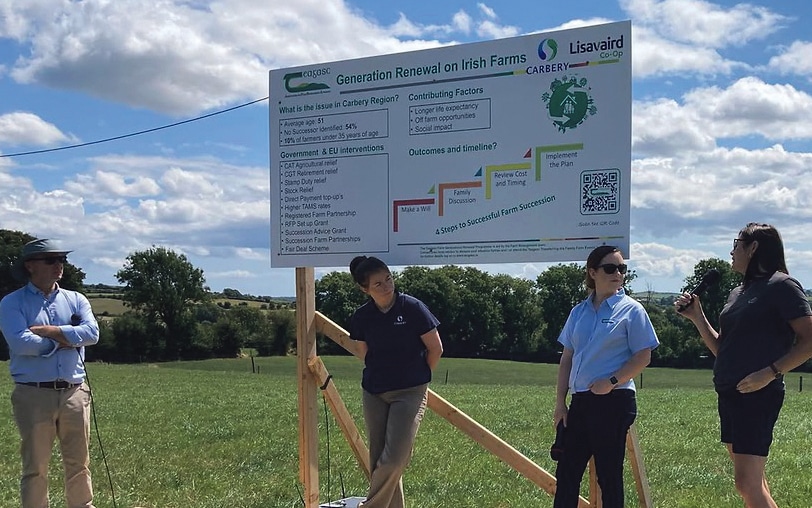
A great day was had recently on the award-winning Buttimer family farm at their farm walk. There was a massive turn out with very informative presentations by all speakers. The last stand was on succession and Caroline Buttimer brought up the subject of talking openly with family about the farm’s future.
At EU and National level, the buzz word is around generational renewal. At long last, the ‘powers that be’ have accepted that very few people now look to farming as a career option. There is, therefore, growing concern about how to attract young and new entrants to the sector, while also supporting older farmers in transferring their farms to the next generation.
With the average age of farmers in Ireland being 59.4, I wonder how many farm families are actually having a conversation about their farm’s future. Another startling fact is that 42 per cent of farmers haven’t made a will, which can lead to an awful mess for surviving family members.
On our family farm, we are almost certain that none of our children want to dairy farm, and that is ok! I think my generation is happy to see their children choosing a career they like without the burden that taking over the farm brings with it. They are both well grounded in dairy farming, so if they decide at some point that they want to return to farming, that option will still be open to them. However, we have said that both of them must complete the Green Cert, which would give them access to DAFM schemes and agricultural tax reliefs should they take over or inherit the farm at a later stage.
Personally, I like the idea of partnership or share farming with a young non-family member. I was very interested in hearing about the Gurteen farm model at an event hosted by Shinagh Estates and Teagasc last year. I am even more interested since a recent MRI informed me of severe deterioration of my spine in three places due to wear and tear over the past 30-plus years. I plan to make reducing the physical workload for the years ahead a priority, focusing instead on investing on improvements to farm facilities, as well as reassessing my own practices to keep me going as close to retirement as possible.
Whether it’s about planning a will or deciding on the future of the farm, the conversation is bound to be an emotion-evoking process for all farmers. Whether there is a successor or not, the tax implications surrounding farm transfers and inheritance can be a minefield. In many cases, the process needs to be carefully planned well in advance to achieve the best possible outcome for everyone involved.
On the farm walk, it was good to hear all the various options, supports and professional advice that are available to farm families to help them work through a bespoke plan.
If you are looking for a good guide to getting started, download the free online Teagasc Farm Succession and Inheritance Guide, which is an excellent publication (the paper version is available at local offices).
Teagasc recently ran their Family farm Succession event in Skibbereen where two local farm families discussed their generational renewal journey. The event also included case studies highlighting the challenges of succession, farm succession planning and collaborative farming options. The event was ably presented by Education Advisor Patrick Flannery, Financial Management Specialist Klara McGriskin and Livestock Advisor Aine O’Mahony.
Teagasc Generational Renewal week runs from Monday, September 7 to Friday, September 11 and will showcase opportunities and practical supports for the future of Irish farming.
Through a combination of webinars, farm walks, in-person engagement and new video content, the whole week will showcase real-life experiences and options available to farmers at different stages of their careers.
A new series of videos will be launched that week focusing on Education, Pension Planning, Business Planning and Access to Finance. The videos provide practical information to encourage farm families to consider the steps they can take now to strengthen the future of the farm business and support the next generation. So, if you cannot make any of the events or webinars, the videos will be a handy resource to click into on the Teagasc Youtube page, from the comfort of your living-room or tractor cab!
Carbery Group have announced the appointment of Ellen Hurley as a dedicated Farm Succession Officer to run their Shared Futures Programme.
Carbery surveyed milk suppliers through their Co-ops and, across the supply base, it was revealed that 54 per cent of farmers do not have a successor identified. It also found that 25 per cent of farmers shareholders plan to retire in the next five years. If no successor could be identified, 32 per cent of farmers said they would consider leasing the farm; 14 per cent said they would consider farm partnership and 10 per cent said they would consider a shared farming model.
The Shared futures Programme offers free and confidential one-on-one information sessions with Ellen to help farm families understand available options for independent professional services, including legal, accounting and agricultural supports. It will also support young farmers and new entrants seeking viable pathways into dairy farming.
There is plenty of support and advice available online and locally in West Cork for farmers, young trained farmers and farm managers.
What is needed now is new thinking around preserving meaningful tax incentives and a retirement scheme to assist families through the process of transferring the farm from one generation to the next and preserving the family farm into the future.
Interestingly, in 1991, Switzerland passed a federal Act on Rural Land Rights to preserve family farms, prevent over-indebtedness of farmers and stop land fragmentation.
The act made ownership of rural agricultural land regulated by guiding principles, such as a self-manager mandate, whereby if you buy or inherit agricultural land you must prove that you intend to personally farm it yourself and have the skills to do so. These applications to buy or inherit are overseen and approved by local authorities.
Price controls are in place to protect farmers from being outbid by wealthy speculators and agricultural land purchase price cannot exceed five per cent of the average comparative price for similar farmland over the previous five years. Also, if a farming heir is buying out siblings, they get to buy it at its agricultural yield value, which is calculated on what the farm can financially generate through agricultural production. However, if the farming successor sells the land or changes its use in the next 25 years all previous co-heirs can demand their portion of the financial gains.
The Swiss have a ban on dividing existing agricultural enterprises into parcels less than 25 acres and co-heirs inheriting farmland can’t force the division of a viable family farm if it destroys the economics basis of the farm business.
If there is a farmland sale, then preference is given to local active farmers, existing tenants and immediate relatives of the seller.
It is always interesting to look at how other countries view the importance of supporting agricultural families and the laws that protect them.
Is it time for our State to look at new laws like in Switzerland to preserve the Irish family farm for future generations?