


Polycycstic Ovary Syndrome (PCOS) has recently been renamed Polymetabolic Ovarian Syndrome (PMOS). So why the change?
For this article, I will continue to use PCOS, as it’s the name that most of us are familiar with. PCOS, now PMOS, is not simply an ovarian problem; it is a multi-system metabolic disorder with health implications that goes far beyond the effects on periods and fertility. The change in name was pushed for by health professionals and patient groups in order to highlight and recognise that. The metabolic disturbances that occur in PCOS have longterm health implications.
PCOS was first described in 1935 by gynaecologists Stein and Leventhal. In 2003 the Rotterdam diagnostic criteria were agreed upon. To diagnose PCOS there needs to be two out of three of the following present:
1) Irregular, infrequent or no periods: This is when a woman’s cycle is less than 21 or more than 35 days or if she has less than eight periods a year.
2) Clinical or biochemical hyperandrogenism: Clinical means that you have physical signs of excess testosterone activity such as bad acne, very oily skin, excess hair growth or hair loss. The hair loss can be diffuse on the scalp or more localised in the male baldness pattern; at the crown or on the forehead hairline. Biochemical means that your blood tests shows a high blood testosterone level. Some women with PCOS have a normal total testosterone blood level and the issue can be with excessive sensitivity to those normal testosterone levels.
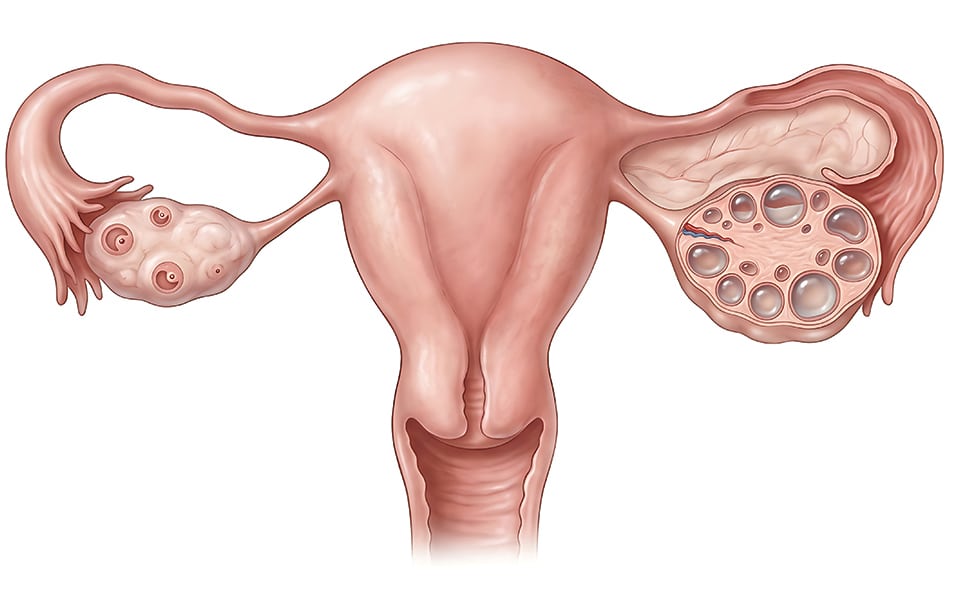
3) Polycystic appearance of the ovary on pelvic scan: This was defined in 2003 in Rotterdam criteria as a large ovary, more than 10ml in volume or more than 12 follicles or little cysts in the ovary.
This third criterion was amended in 2018 to 20 follicles per ovary when it became clear that many women have the ovarian morphology without the syndrome; in English; 30 per cent of women have 12 or more follicles on pelvic scan but do not have any of the metabolic issues, i.e. have polycystic ovaries but not polycystic ovary syndrome. Even with the amended criterion of 20 follicles, it is recognised that about 20 per cent of women will have 20 or more follicles on a scan but no syndrome.
It is important to clarify at this stage that irregular and infrequent periods is a normal phenomenon during the seven years after our very first period. In addition, in these teen years, symptoms of testosterone activity, such as oily skin and acne are common. It is therefore felt inappropriate to diagnoses PCOS under the age of 20. If a scan under age 20 reveals the ovaries have a polycystic appearance, this should be repeated in the early 20s, as often the appearance of ovaries revert to normal. This is thought to be because it takes seven or more years for the ovarian machinery to settle down into what will be their regular workings.
While your GP can reliably diagnose PCOS, it is vital that other causes of infrequent or no periods are ruled out.
Hyperprolactinaemia occurs when the pituitary gland in the brain develops a benign tumour that secretes excessive amounts of prolactin, the hormone usually produced when breastfeeding, which switches off periods. Other conditions that can affect periods are thyroid problems, adrenal hyperplasia, – when the adrenal glands that produce cortisol, testosterone and a little oestrogen are not working properly, – as well as more rare conditions such as tumours that secrete testosterone and syndromes of dysfunctional insulin resistance.
So, the baseline investigations should include thyroid and prolactin blood tests, as well as testosterone. Then, confusingly, there can be overlap or an element of PCOS and Hypothalamic dysfunction.
If it’s not completely straightforward, then your GP should refer you to an endocrinologist for an opinion as to whether this is simple PCOS or to determine if anything else is going on.
How does PCOS affect
my health?
Periods and fertility
What if I only get four periods a year? Not having a period every month means you are not ovulating every month. Infrequent ovulation makes it much more difficult to fall pregnant.
Endometrial cancer
During a cycle without ovulation the womb lining or endometrium encounters higher levels of oestrogen and lower levels of progesterone, our other female hormone. Net effect is overstimulation of the endometrium causing heavy periods. The serious longer-term effect of that over-stimulation is a two to six times increased risk of developing endometrial cancer.
Polycystic ovary syndrome (PCOS) is associated with dysfunctional metabolic activity across a number of body systems, increasing the risk of several long-term health conditions. Many women with PCOS have a higher body mass index (BMI), which is a key driver of many of these risks. A high BMI increases the likelihood of cardiovascular disease, including heart attacks and strokes later in life, while women with a BMI over 30 are also at greater risk of developing non-alcoholic fatty liver disease. PCOS is closely linked to insulin resistance, meaning women are more likely to develop gestational diabetes during pregnancy and have a significantly increased lifetime risk of type two diabetes. Cholesterol levels are also commonly affected, with lower levels of HDL (‘good’) cholesterol and higher total cholesterol and triglycerides. Hypertension is more prevalent in women with PCOS, further increasing cardiovascular risk. Sleep apnoea is also more common, largely due to a higher BMI, but it is an independent risk factor for heart attacks, compounding the overall risk. In addition to these physical health concerns, women with PCOS have higher rates of psychological conditions, including depression, mood disorders and eating disorders.
The metabolic bits
Women with polycystic ovary syndrome (PCOS) experience dysfunctional metabolic activity across a number of body systems, placing them at increased risk of several long-term health conditions. A high body mass index (BMI), which is common in PCOS, is a major driver of many of these risks. Women with PCOS have a greater likelihood of developing cardiovascular disease, including heart attacks and strokes later in life, while fatty liver disease is also more common, particularly in those with a BMI over 30. Insulin resistance is a key feature of PCOS, increasing the risk of gestational diabetes during pregnancy as well as type two diabetes both during and after pregnancy and throughout later life. Lipid abnormalities are also frequently seen, with lower levels of HDL (‘good’) cholesterol and higher levels of total cholesterol and triglycerides. Hypertension is more prevalent in women with PCOS, further contributing to cardiovascular risk. Sleep apnoea is also more common, largely due to higher BMI, but it independently increases the risk of heart attacks, compounding the overall cardiovascular burden. In addition to these physical health risks, women with PCOS are more likely to experience psychological difficulties, including depression, mood disorders and eating disorders.
So you can see, PCOS involves far more than infrequent periods and trouble getting pregnant. It is a multi-system chronic disease and needs to be recognised and more importantly treated as such: hence the change in nomenclature.
How useful is the testosteone blood test?
Androgen or testosterone activity is increased in the body but it is not a simple as having a high testosterone level in the blood. When looking at testosterone activity we do blood tests for total testosterone but also for sex hormone binding globulin (SHBG). This is a protein that binds to free testosterone, effectively mopping it up. Women with PCOS can have a normal total testosterone blood level but very low SHBG means that her normal testosterone level will have more effect on her organs. The most obvious place this is seen is on the skin, with oiliness, acne, excess hair growth and hair loss.
PCOS and menopause
transition
When seeing women during menopause transition, it is important to always ask about a history of PCOS. Ovulation can kick back in again, especially after significant weight loss and regular periods can resume, leading some to assume the PCOS is gone: not true: the metabolic issues persist. These women commonly experience more hyperandrogenism in perimenopause with hair thinning and loss, facial hair, severe acne or oily skin.
These women will be more sensitive to some of the older fashion of progestogens, either in the pill or in a HRT regime, and this needs to guide a doctor’s choice of hormone therapy.
Treatment
For women trying to conceive, ovarian stimulation is usually successful in inducing ovulation and improving fertility.
Hyperandrogenism, which can cause symptoms such as severe acne, excess facial or body hair, and hair loss, can be managed in several ways.
The combined oral contraceptive pill is often an effective treatment because the oestrogen it contains has anti-testosterone effects and also increases levels of sex hormone-binding globulin (SHBG), which binds to and reduces the amount of active testosterone in the body.
For women who prefer not to take hormonal treatment, metformin, a medication commonly used to treat diabetes, is a safe and effective alternative. In addition to improving insulin resistance, metformin has mild anti-testosterone effects and suppresses luteinising hormone (LH), which can help restore more regular ovulation and menstrual cycles in many women. Other medications with specific anti-testosterone effects, including finasteride and spironolactone, may also be prescribed, particularly for women experiencing hair loss or excess hair growth.
What is most important is that early on, as soon as PCOS is diagnosed, that a women is supported with issues of excess weight because high BMI is the main driver of her increased risk of heart attacks, stroke and lifelong hypertension. Phycological support and counselling may be needed, as prevalence of depression is high. Women with PCOS should see their GP once a year for blood pressure, BMI and blood tests for lipids and HbA1C to screen for diabetes or pre-diabetes.
I hope this has been useful and if you have any questions with regard to symptoms you are having or questions about PCOS if you are already diagnosed, please go see your GP.