

Would you buy a diamond ring if it meant you were contributing to the death of a frog? What a silly question, you will say. What if the diamond ring led to the extinction of an entire frog species? Most people probably wouldn’t care about that either. But a diamond is just a piece of carbon, chemically identical to the lead in a pencil; a frog is a fellow creature with as much right to a happy life as a human. Surely, that should be far more valuable.
Many species of frog are endangered. They suffer from a deadly infection, chytridiomycosis, caused by a fungus that invades their skin, reducing their ability to breathe, hydrate or control body temperature. The fungus has been spread by the pet trade and also by the use of the African clawed toad for medical research in laboratories all over the world. Climate change has probably made conditions more favourable for the fungus. Frogs are also killed by absorbing, through their skin, pesticides and other pollutants. Habitat loss, due to relentless human population increase, urbanisation and so-called ‘development’, is contributing to their decline, and millions of frogs get squashed on roads. Of the 7,600 or so known species of frog, 34 have become extinct in recent times, five in the last five years; 135 others haven’t been seen for decades and are possibly extinct too. Three more frog species are extinct in the wild and only survive in captivity.
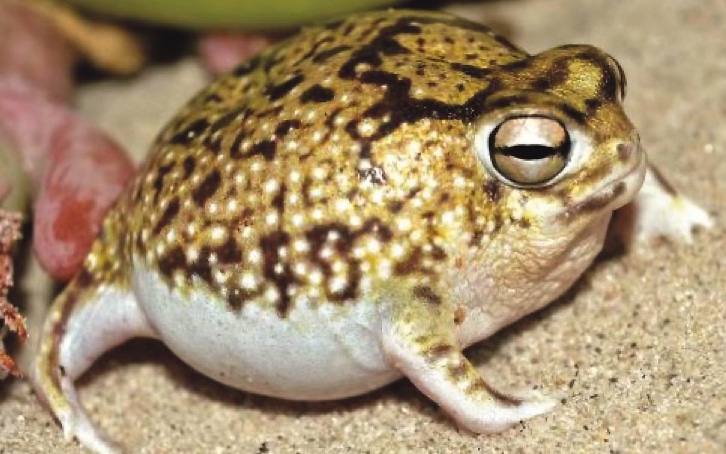
One species, the desert rain frog, was in the news recently, having just been classified as vulnerable by the International Union for the Conservation of Nature. It is an enchanting little creature, found only in a small strip of sand dunes on the coast of southern Namibia and northern South Africa. It is one of 15 species of rain frogs, all globular and only a few inches across. Their legs are so short they are unable to hop, and the males can’t even clasp their females during mating, but have to produce a sort of glue to stick them together. They have bulging eyes and down-curving mouths, giving them the most mournful expressions. And well might they look mournful – several are endangered.
The desert rain frog is a very specialised animal, which is not a good thing to be when faced with man-made environmental changes. Living in an arid place is difficult for a frog. The only moisture this one ever gets comes from sea fogs, which dampen the sand enough for the frog to survive. It spends most of its life underground, buried deeply where the sand is still damp and where it can escape the heat of the day, only emerging at night to feed on insects. It lays its eggs in a burrow and, as there is no water around, has no tadpole stage, the eggs hatching directly into froglets.
Unfortunately, there are diamonds under the frogs’ desert home, and I can’t imagine any diamond miner, trader or jeweller, or African politician, being worried about a frog (they don’t always worry about humans – have you seen the film ‘Blood Diamond’?). All diamond mines damage the environment and threaten wildlife, and are quite unnecessary because diamonds can now be made synthetically. To mine for them in the only place where the desert rain frog can exist is just criminal.
The poor desert rain frog has other threats to face: industrial development, climate change, again, (causing even drier conditions) and something really preposterous: videos on the internet. These have been put there by people, probably not herpetologists, who think that the little frogs are “cute”, in the American sense of that word. Their appearance is extraordinarily endearing, but even better (for fools), if you make them angry, they squeak, just like a dog’s toy. What these morons don’t know is that the frog is angry for a very good reason, not just because it doesn’t like humans (perfectly understandable), but because if it is picked up, it will quite possibly die a horrible death. To help absorb as much moisture as it can, the belly of the desert rain frog is paper-thin, and so transparent its internal organs are visible. If it is handled roughly, the skin will rupture and its insides fall out. When it squeaks, it is actually screaming “Please, don’t touch me”. There might soon be queues of idiotic “influencers” filming themselves with these poor little amphibians, and huge demand for them as pets. Until their insides fall out.
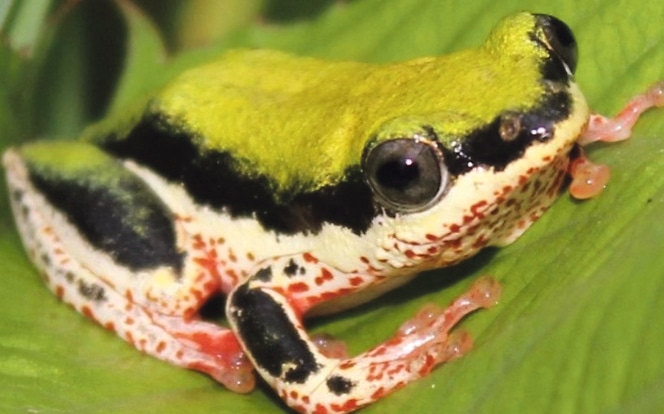
One of the joys of an African night is the sound of frogs. There are 146 species in southern Africa alone, each with a distinctive call, made by the males to attract females. Three species lived in my garden in Zambia: fat, knobbly guttural toads, with creaking woody voices; red toads, dark, brick-red, with low, booming calls; and tiny painted reed frogs, yellow with irregular black and white stripes and blotches, which sang all night in a high-pitched, slightly metallic squeak, like an orchestra of tiny, tinkling bells.
I once took a year off teaching and went to work, voluntarily, in a nature reserve in Malawi (I would be there still if I had the money). There was a pond outside my wooden hut, home to two species of the totally aquatic clawed toads (one species – Xenopus laevis, was used in pregnancy tests – if a female frog was injected with the urine of a pregnant woman, it would produce eggs). There were also sharp-nosed grass frogs, a species that holds the world record for frog-jumping (10.3 metres in three jumps), and foam-nest frogs, which turn white in the heat of the day, and lay their eggs in nests of bubbles that they build on tree branches above ponds and pools; the tadpoles hatch out in this foam and drop into the water.
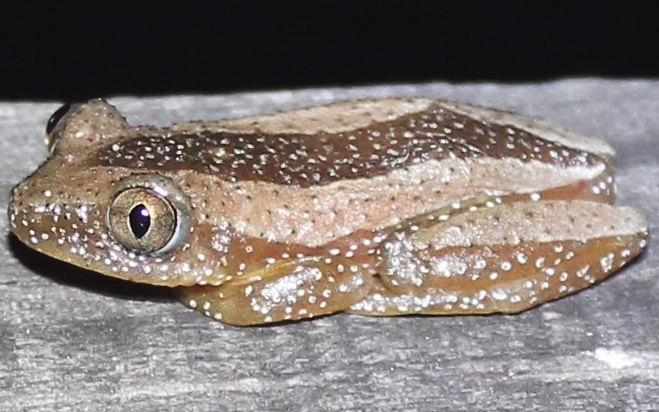
To see other species, I had to trudge around the wetlands after sunset, with torch, camera and sound-recorder, often accompanied by a friendly ostrich. Greater leaf-folding frogs lived in the reeds by the edge of a large lake; they lay their eggs on reed leaves, which they then fold over and glue together into an envelope. There were many types of reed frog, one of which I couldn’t find in my frog book and hoped for a few weeks that it might be a new species. It wasn’t. There were other types of grass frog, and shovel-nosed frogs, bull frogs, rubber frogs and ornate frogs too. But the frog I most wanted to see was the bubbling kassina, a handsome yellow and brown striped amphibian whose strange call, like a stone plopping into water, can be heard all over southern Africa. I waited every night by the lake’s margin and listened to its call, but as soon as I got near, the noise would stop, and the frog would creep silently away. I never did see one.
Ireland is not a great place for frog-lovers: there are just two species here – the common frog and the natterjack toad, and few people will ever see either. (The word toad is not scientifically specific; the true toads belong to one particular family of frogs but, confusingly, many other frogs are called toads). When I was in college, my only encounters with frogs were ones I would rather forget – dissections. Undergraduates at Trinity always dissected the frog, after the dogfish and before the rat. And at the College of Surgeons, research students used to give dissection courses every year to the pre-meds before their summer exams. We would buy the frogs from a frog farm somewhere down in the country – they arrived by train, in boxes of damp grass, and I would collect them from Heuston Station.
Many people consider frogs ugly, slimy, even poisonous (some are, but can’t harm you if you leave them alone). But frogs are not only amusing and attractive, they eat slugs and insect pests, so should be our friends. They are also good indicators of the state of our planet, and their decline should be a serious cause for concern. One way to help frogs is to build a pond. It need not be anything fancy. When I lived in Zambia, I dug a hole in the garden big enough for a washing basin with a few rocks and weeds, and soon a gravid female guttural toad moved in. She would have spawned had she not been eaten by a mongoose. We don’t have mongooses in Ireland, only fanatical grass cutters, and there is no point making a pond, attracting frogs, and then spraying weed-killer and smashing them apart with a strimmer. The choice is yours – wildlife or useless lawns. And before you buy any diamond jewellery, please think about the desert rain frog.