

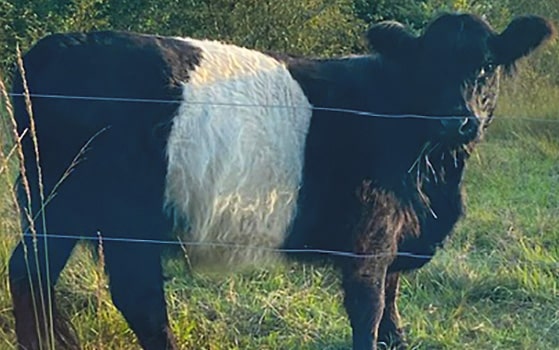
What does organic beef farming and homeopathy have in common: Claire Hurley, the force of nature who returned to her West Cork roots in 2009 to take over the 55-acre family farm, despite its uphill challenges. Claire farms an upland hilly farm in the townland of Gortnaclohy (field of the stones) near Skibbereen. “That should tell you everything,” she tells Mary O’Brien, laughing. Determined to bypass the Industrial Revolution altogether, by pairing the hardy, ancient genetics of Belted Galloway cattle with holistic animal health principles and organic standards, Claire has built a ‘birth-to-burger’ enterprise that prioritises animal welfare and soil health above all else.
Before becoming a farmer, Claire studied and worked in horticulture before going on to study and qualify as a homeopath.
She has fond memories of a childhood with her grandfather, when they “tilled small fields of fodder beet, potato’s and mangles with a single draft horse”. Mainstream methods of farming felt unsuited to her, as she had “neither the capital or motivation to intensively reclaim or fertilise such a rough landscape or to erect a large slatted shed that would never seen a return of my investment”.
Initially Claire bought four heifers from County Clare, “raising more than a few eyebrows as the breed was a rare and peculiar sight at the time.” In 2011 she acquired a bull, and in 2013 she slaughtered her first animal and sold weanlings. The frozen meat proved a difficult sell at the time. In 2015 she completed a diploma in Speciality Food production at UCC to better familiarise herself with food legislation, labelling, safety and training. Through this course she many gained friends but also confidence in what she was producing – a quality and ethical product.
In 2017 her friend Andy was selling his small food trailer and, as she puts it, “the rest as they say is history”.
Her hot food stall is now a regular sight at the Skibbereen Farmers’ Market every Saturday, and from Easter Sunday and every Sunday until the end of September at Schull Country Market. The main attraction is the Belted Galloway organic Beef Burger on a choice of bread roll – sourdough, ancient grain or brioche – with cheddar or Gubbeen cheese, and homegrown organic onions, tomatoes, gerkins and salad. They also serve a breakfast with the same choice of bread, an organic egg, Baltimore Pig (nitrite free) bacon and homegrown organic onions, salad and tomatoes. Claire says it’s “a great sense of satisfaction when you serve the beef burger, salad, tomatoes, onions and lettuce that you have grown and cooked yourself!” A selection of frozen meat is always available at the stall.
Claire began her conversion to organic farming in 2010, “sure of the fact that I would continue to farm the land in the way it had always been done”. Having sold the remaining animals, she researched what sort of animal would best fit the habitat, and “landed on the Belted Galloway”, a breed that thrives on a grass-based diet and natural grazing. “They have a longer gastro-intestinal tract, which gives them the pot-bellied appearance, better to extract nutrients from rough grazing and convert into a nutrient dense meat. The breed has the rare ability to marble first and then put on backfat, they do not develop much fat under their hides; instead have a double coat of hair which provides excellent protection in cold, wet and windy weather, perfect for out wintering. They are naturally polled so no requirement for dehorning.” Excess grass in summertime is baled as haylage and supplementary fed so the herd can maintain a natural life as possible. “They are easy calving and excellent mothers so need minimal intervention.”
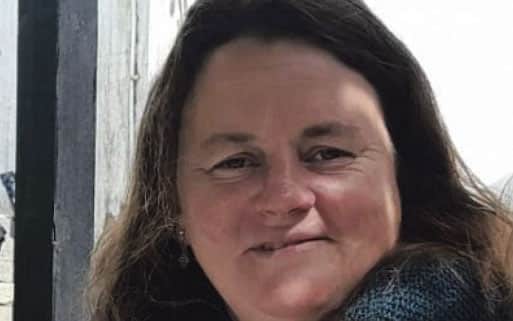
Claire believes that it has never been more important than now to move away from large-scale, long chain food production to more local agriculture. “Where food production systems rely upon a network of small, usually sustainably-run, family farms, which takes into consideration; the soil type and climate lending to the type of crop or animal to be grown there,” she explains. In her opinion, “Organic farming has not got the dependency on artificial fertilisers, vaccines, antibiotics, vaccines or petrochemicals.”
Homeopathy – a system of medicine that uses highly diluted substances to trigger the body’s natural healing – plays a significant role in her farming practice. “A key principle would be the observation of signs and symptoms indicating the nature of the imbalance, be that plant or animal or human,” shares Claire, who has used homeopathy in a variety of cases such as calf scour, retained cleaning and a horse with an eye injury. In 2019 she did some training with Homeopathy at Wellie Level to teach the responsible use of homeopathy on the farm, though “Covid brought this to a halt”.
Farming has not been without its challenges. Beginning in September 2024, her herd succumbed to TB. “I ended up losing just under half my herd which included my in-calf cows and heifers, along with the genetics built up over the years.” In 2025, with much reduced stock, she wasn’t sure she would continue, but in November she purchased six organic Belted Galloways from Brennus on Cape Clear. “As the seasons have rolled around new calves have arrived from the remaining herd and life on the farm has returned to normal.”
Looking back, Claire reflects that “things have progressed so far, I never set out to be producing and cooking all my own produce at the Farmers’ markets but I suppose each step borrowed another and as you try to hone and perfect each stage you realise you’re halfway through something else!”
Her philosophy on animal welfare is clear: “An animal that is reared on a natural diet, with its mother, in its family grouping – free of pain and unnecessary intervention – gives it the best chance to be as healthy as possible and without vaccines and antibiotics; and when the time comes – to be transported and handled and slaughtered humanely. I think the consumer appreciates the fact that the animal, which is consumed, is well-looked-after from birth to death, lives a relatively free and good life. As humans, if we are choosing to eat meat, that is the least we can do for the animal who gives his or her life. That every step in that journey is carried out in the best interest of that animal.”
Each stage of the process has been a huge learning curve, from the animal rearing to handling and cooking the end product. The slaughtering process, meat hanging and cutting is carried out by MJ O’Neills in Clonakilty, “whose expertise is vital and without whose help none of it would be possible”.
Farmers’ markets provide more than just income. “Farmers markets are a huge social hub and have a huge sense of community so I do look forward to starting back after a long winter just feeding and talking to cows!” She still keeps horses and enjoys regular lessons, having purchased a young Irish Draught mare which she’s breaking in at the moment. “Of course the horses give the benefit of a mixed grazing system which is very important in organic farming as it interrupts the parasite life cycle. As if I need an excuse!”
Recently Claire has joined the pop up shop at Levis’ in Ballydehob to sell a selection of frozen organic meat. It is a one stop shop for tasty local ingredients in an iconic setting from 9:30am to 12:30pm each Wednesday.