


Farming in West Cork by Cadhla Ó Conchobhair
I’m writing this in the final throes of March heading into April and down to the last five cows left to calve: The cows are out day and night. With no vet calls all season, the relief of not having to clean cow cubicles morning and evening was a pure joy.
Unfortunately, the joy was short-lived: I had a cow that was behaving unusually while trying to calve and, after putting on my midwife gloves to investigate dilation, I soon realised a professional was needed. To cut a long story short, the cow ended up having three vets (not at the same time) and I had to make the gut-wrenching decision to have her put to sleep due to complications. The circle of life can be heartbreaking. When the vet went out to their van to get the medicine, I knelt down beside my lovely cow in the same shed where I welcomed her to life seven years earlier – now to say goodbye – and gave her a last rub behind the ears. I’m still not the better for it but, after having experienced giving birth myself, I am only too well aware of how things don’t always go to plan, despite everyone’s best efforts.
Nobody can truly prepare you for the kind of emotional decisions that have to be made in farming. They are incredibly difficult. However, being part of a farming community – one that understands the reality of losing an animal and the weight of that loss – offers a level of emotional support that often goes unrecognised and deserves far more credit.
Our farming neighbour called in the next morning to drop back a piece of borrowed farm equipment and ended up hearing my sorrowful tale. We probably stayed talking for the best part of an hour about how scenarios like this is one of the hardest parts of farming. Even though I’m sure he had plenty of work waiting for him on his own farm, he instinctively knew that giving me his time that morning would help. I think that no matter what walk of life you come from, we all need a community that understands what we need – and is there for us when we need it.
This brings me to the success of farm discussion groups. While they were originally intended as peer-to-peer learning networks for sharing technical knowledge, for many they have also become an important source of social support and a way to reduce isolation.
While the majority of farmers are male, thanks to mechanisation and technology, one doesn’t have to be built like an ironman to farm today and all systems of farming are seeing more women taking part.
When it comes to farm succession, the main consideration is now which offspring – male or female –has the strongest interest in farming, rather than their gender. Not so long ago, it was typically the eldest son who was expected to take over the farm and carry the family into the next generation, sometimes whether he wanted to or not. In the past, preserving the family name was a top priority. Now, with many farms restructuring as companies and adopting business-style names with ‘Ltd’, the focus seems to have shifted – placing more importance on the farm’s viability than on maintaining the family name as a requirement.
I chatted with Mona Concannon, the Chairperson of the Women in Agriculture Stakeholder Group (WASG), about a recent event held by the group at Bandon Mart. WASG are not a pink balloon and photo opportunity type of group. They have had their sleeves rolled up since 2021 representing the voice of female farmers at policy level and holding the state to task on farming issues like pensions, TAMs grants, education access and the lack of state recognition for work done by the thousands of ‘invisible’ women who work full- or part-time on the family farm.
Last year WASG and DAFM co-funded three regional National Dialogues Events for women in agriculture to give these women young and old an opportunity to voice their challenges and their successes in the Agri-sector.
One of the recurring themes at these events was that attending marts can be daunting. Many women said they felt out of place or lacked confidence in their buying and selling skills in that environment. The group decided to do a pilot run of a mart event that would be practical, educational and confidence building.
Bandon Mart manager, Sean Dennehy, was approached to see If he would host the trial event for WASG; and Teagasc West Cork, which runs a female discussion group, were asked to partake. Invitations were also extended to Bandon Secondary School students studying Ag Science in order to collect feedback on the experience before similar mart events are rolled out throughout the country in 2026.
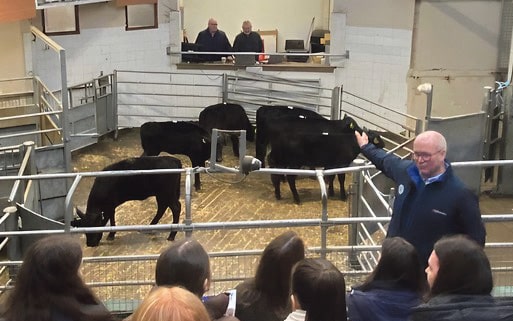
That Monday, mart day in Bandon caught the usual clientele by surprise with women landing in from all angles. Mart manager Sean welcomed the ladies, giving a brief history of the mart and the services provided and ICBF’s Christopher Daly and Aoife Downes gave an excellent presentation on understanding CBV’s, DBI, and utilising the ICBF web-portal, as well as talking about apps for checking stock and assessing traits.
Seán then brought the ladies on a tour of the mart. He explained the mart process, starting with calf intake and finishing up at the sales ring, where the last few sales of the day were being completed. Sean explained the buying and sell procedure and how to use the Mart-Eye app and the ladies got an opportunity to test their bidding skills with a mock-up sale ringside on a Lot of four Angus calves. Some ladies used the app to bid while others raised their hands. The lively bidding created much banter with the auctioneer and a lot of laughs from the crowd. With the fall of the hammer, a student from Bandon’s Coláiste na Toirbhirte came out as the highest bidder. There was plenty of opportunity throughout the event for Q&A and WASG was delighted with the feedback received.
Attendee Jean O’Suillivan (a full-time farmer in partnership with her parents) and Chairperson of the Teagasc Ladies Discussion Group, said the informative and confidence-building event was enjoyed by the group. She highlighted the lack of exposure to marts from an early age, which has an impact on confidence levels, and she gave credit to parents who bring their children, particularly daughters, to the mart.
The event was a resounding success and WASG received great feedback from all involved. As a result the group is now in the process of rolling out these events all over the country this year, which also happens to coincide with the UN International Year of the Woman Farmer.
It is wonderful to see groups of farmers, be it males, females or mixed groups, coming together, combining the educational and social aspects of farming.
I hope this month’s farming article highlights the importance of finding a network that offers ongoing learning opportunities – connecting you with farm friends who support your journey. Whether you’re facing challenges and hardships or celebrating the good times, having that support makes all the difference.
Email me at [email protected] if there are any farming events happening in your area so I can share them here.