

Think Business by Naomi Fein
Growing up, I was part of an orienteering youth group, where I learned that when you’re unsure if you’re on the right track, the first thing to do is stop. Look around, identify landmarks, and climb the nearest hill to get a better viewpoint. Find yourself on the map and make sure you’re facing the right direction. Learning to read the map can make the difference between being lost and finding your way to the hot meal waiting at camp.
The same approach can help when navigating turbulent times as a business owner.
Many of us think of our businesses as machines. We expect them to follow a linear path from A to B to C. When progress stalls, we add more – more time, more resources, more software, more marketing – assuming more input will create more output. This way of thinking, rooted in the industrial revolution, has shaped how we understand and do business.
But what happens when, despite your best efforts, results don’t come? When long hours lead to stagnation or decline?
It may be time to pause and ask: Is there another way to understand change?
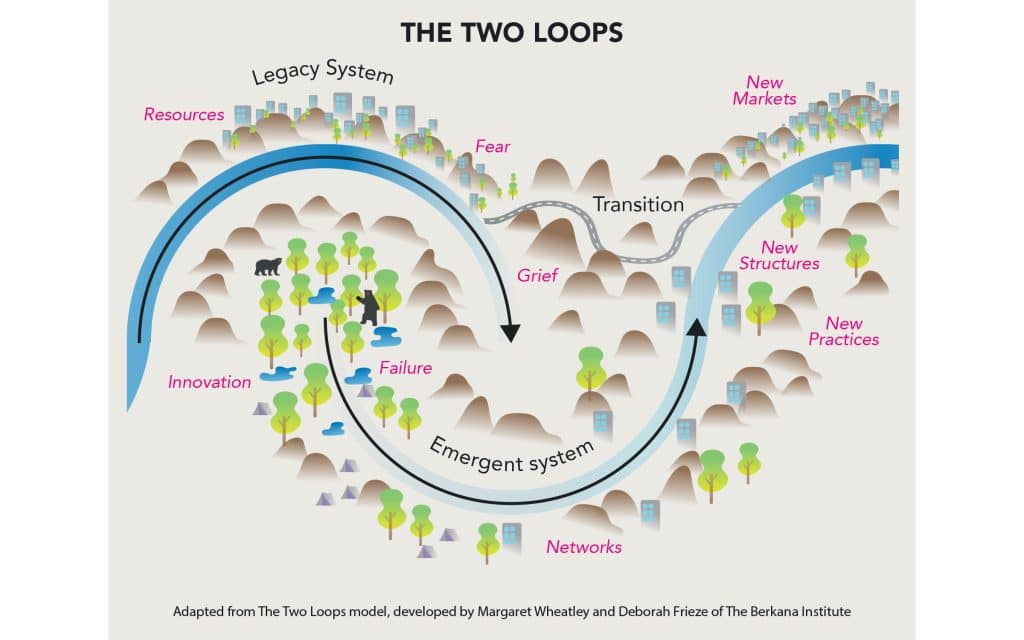
The Two Loops model, developed by Margaret Wheatley and Deborah Frieze of The Berkana Institute, is based on the idea that human systems – businesses, industries, ways of working – behave like living systems. They grow, peak, and eventually decline.
Unlike machines, living systems are not linear. As one system declines, another begins to emerge. As one way of working reaches its limits, new possibilities open elsewhere.
If you’re not seeing the results you want, it might be time to stop and ask questions like: Am I holding on to a mindset or practice that no longer serves me?; What else is happening in my field?; Are there new ways of thinking or new markets I could explore?; What can I learn from innovation outside the mainstream?; Are there tools or approaches that could save time or energy?; Where else might my expertise fit?
To bring this to life, here’s Rachel of Mix Coworking’s story.
Rachel of Mix Coworking in Clonakilty came to me feeling that, although things were progressing well, she was in the dark about managing seasonality spikes. Pleasing the customers, creating bespoke offers to fit every need, did not result in the level of commitment and monthly recurring revenue she hoped for. Instead, she was stretched and unsure which products were working. Rachel was wondering: “if I’m offering so much, why isn’t there more commitment?”
With my help, Rachel followed the steps, using the Two Loops Model as our guide,
Stop: Rachel stopped and reflected. While the business was progressing well overall, seasonality spikes meant financial instability, managing many offers left her confused and tracking what works was difficult.
Look back: Mapping her business onto the Two Loops Model, she considered what old beliefs and mindsets were guiding her. Like many business owners, she was focused on meeting every client’s need – giving more in the hope of stability. Rachel realised that she was paying a high price for trying to offer everything to everyone. She was ready for a change.
Ask: where am I hoping to get to? To answer this, Rachel reconnected with why she first created Mix Coworking: “I wanted to create a place that helps people create and do their best work, build meaningful connections, and support their well-being”. Rachel also wanted to be more intentional with her own capacity and balance.
Look around: Together, we explored alternative operational approaches taking inspiration from the different places on the Two Loops Map. We found examples of businesses moving from a ‘buffet’ of options to a more focused offering – shifting from “what do you want?” to “what do you choose?” We also looked beyond business, exploring community-based practices that foster deeper connection and commitment.
Find your own path forward: Equipped with fresh clarity, Rachel engaged Mix’s Regulars, and guided by their input, she created three simple subscription plans that offered great value and prioritised her customers’ core needs. Rachel moved the sign-up process from email to the website, inviting her clients to show their commitment through a self-managed, direct debit subscription.
Stay tuned: For Rachel, results came quickly. Her core members were happy to commit, and the Mix community feels energised. The self-managed subscription model led to more stability, predictability, and less admin. Rachel now feels more able to track what is working and better equipped to navigate the unknowns of business life.
This is the kind of work I do with clients – stepping back, making sense of what’s happening, and finding a way forward that fits both your business and your life. If that sounds useful, you’re welcome to book a free discovery call. In the coming months, I will also be running a leadership workshop, applying the Two Loops Model to your business. Email me to book your discovery call or to register your interest in the workshop [email protected].
And if you’re curious about Mix Coworking, why not drop by next time you’re in Clonakilty or visit their website www.mixcoworking.ie.