

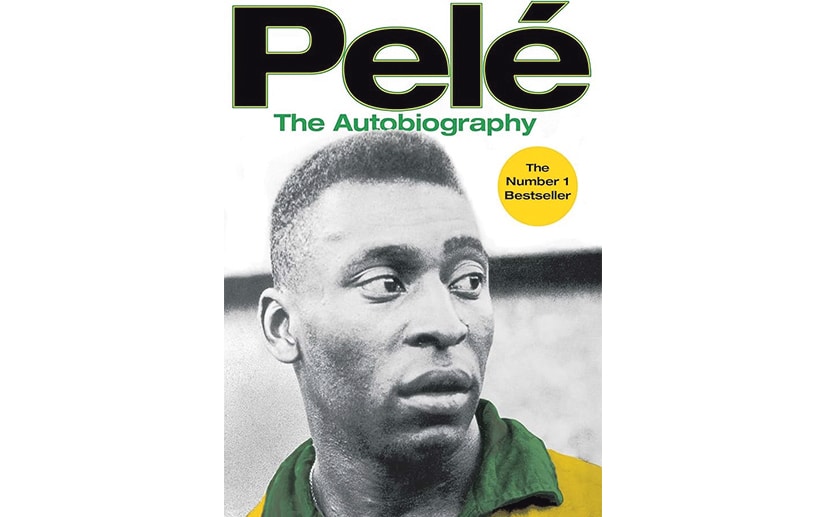
John Coughlan finds the autobiography of the world’s greatest footballer a boring read.
In our two years of reading football books on the Dynamo Football Bookclub, we have observed a consistent pattern – the world’s most eminent players often seem to be among its most captivating characters.
Maradona and Cruyff would be on football’s Mount Rushmore, and both were totally captivating characters. Garrincha too; a legend who lived an enthralling and ultimately tragic life. Even the likes of Gazza and Ibrahimovic; they didn’t reach the heights of the others but were among the top players of their generations and are both notably quirky characters in their own suitably enigmatic ways.
The fact that Messi is an Argentinian dribbler means he is always compared to Maradona. But in some ways, it makes more sense to compare him to Pelé.
Pelé and Maradona were before my time, but for all Maradona’s genius, it always seemed that Pelé was considered the greater – if not necessarily better – player. There seems to be a consensus now that Messi is the best of all, or at least the best since Pelé. In terms of style, Messi is akin to Maradona but in terms of success – and ultimately greatest – it is Pelé who is his peer.
There is one other way that the two make good bedfellows, Messi and Pelé. For all their sporting successes and the incredible lives they have led, they have remained steadfastly boring throughout.
Reading Pelé’s autography – with its aptly uninteresting title ‘My Autobiography’ – one can’t help but be struck by the odd boring-ness of the man. He is not dull, as such, indeed he seems a very genial fellow with nothing bad to say about anyone, but there remains something very boring about him.
Why is this? It must be partly timing. Pelé was great, the greatest, everyone agreed. But he came to fame in 1958 when, as he points out in the book, there were no mobile phones. More significantly, there isn’t much footage.
That in itself may be partly down to geography.
Pelé famously played most of his career in Brazil, where he was deemed ‘unexportable’ by an act of Parliament. Had he scored 569 goals for Real Madrid rather than Santos, there would probably be more film of him. Even the high points of his part in the 1970 World Cup win – all of which was caught on camera – focus less on the goals he scored than the ones he didn’t – a near miss from halfway against Czechoslovakia, rounding the keeper and putting it wide against Uruguay, and that save by Gordon Banks.
As there is no way to go back and change this, all of us who arrived after Pelé, just have to take it as given. Pelé was the best. Maybe Messi is better but really, who knows?
All the greats mentioned above were eminently more interesting than Pelé but that’s because they were eminently more flawed. Maradona like drugs and controversy, Cruyff was some kind of footballing megalomaniac, Gazza was Gazza.
What makes Pelé boring ultimately is that he seems to have been a pretty happy and stable individual. He played guitar, acted in films, and generally said the right thing in any given moment. But none of this made him interesting. He was nice. And nice is boring.
His autobiography is not particularly interesting. I knew the broad outlines of the Pelé story going in and that’s all that’s there really. I finished the book thinking that it’s a shame that there isn’t a more interesting book about him. But then, it might not be possible to write an interesting book about Pelé. In a strange way that says something very good about the man.