


This month Niamh O’Leary, a member of the Save Murragh Action Group committed to protecting the environment of the Bandon River Valley, discusses the elusive otter and the importance of protecting its presence along the Bandon River.
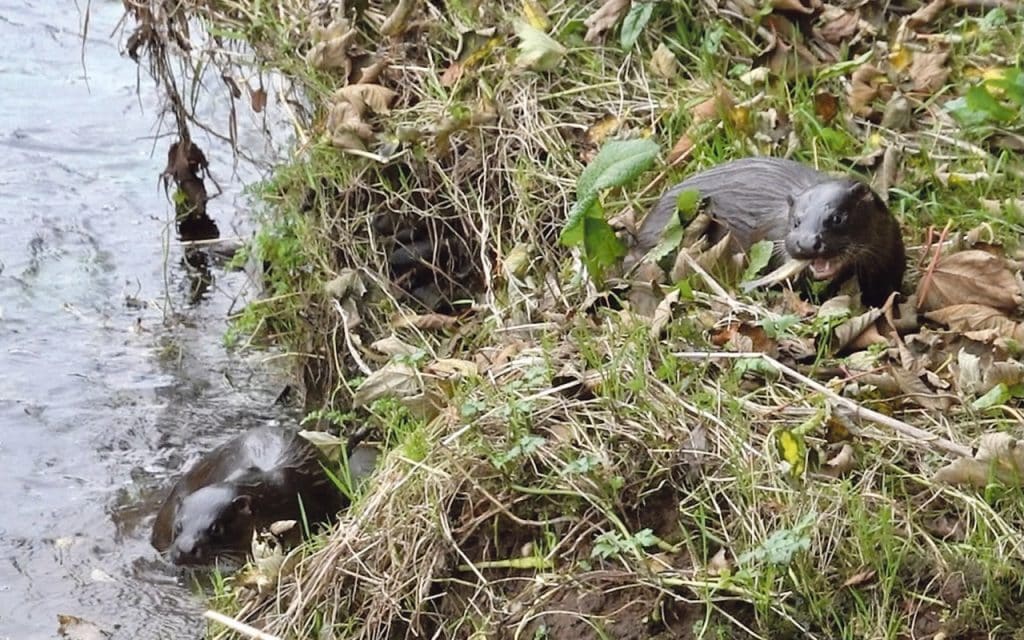
Otters are special little characters, they are one of Ireland’s most charismatic wild mammals, thriving quietly along rivers, lakes, and coastlines across the country. The Eurasian Otter (Lutra lutra) is one of the island’s most elusive residents, at home in freshwater and along the wild Atlantic coast alike. Though rarely glimpsed, its presence is written in subtle signs: a trail in the mud, a smooth slide into dark water, otters slip through the landscape almost unseen. In a Europe where otters once vanished from many waterways, Ireland remains a refuge, offering clean rivers, rugged shores, and space enough for this secretive mammal to endure.
Otters have long held a place in Irish folklore and tradition. Often portrayed as clever or otherworldly creatures, they appear in stories as shapeshifters or enchanted beings. In some traditions, harming an otter was believed to bring bad luck.
Otters are highly territorial, with individuals ranging over many kilometres of waterway, marking their routes with spraint (otter poo) to signal ownership. They are agile swimmers and skilled hunters, feeding mainly on fish but also taking amphibians, crustaceans and occasionally even small mammals or birds. Otters usually rest in hidden shelters known as holts, often among tree roots, dense bankside vegetation or natural cavities. Females raise their young alone, giving birth to one to three cubs in natal dens, which can be up to 1km away from water. The cubs are born blind and helpless and remain dependent on their mother for several months. During this time, she teaches them to swim, hunt and navigate the river network before they disperse to establish territories of their own.
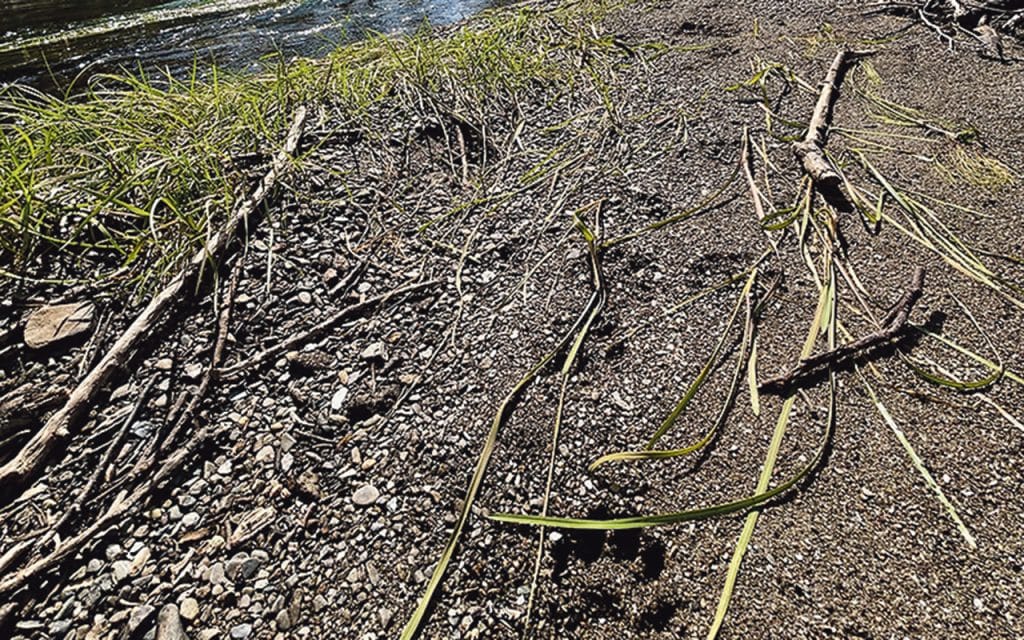
In Ireland, otters are not counted directly. Instead, their presence is measured by signs they leave behind — footprints in soft mud, or spraint deposited on rocks and bridge footings. These signs are searched for along stretches of river, lakeshore and coast, using methods that have remained broadly similar since the first national otter surveys in the early 1980s. This consistency allows comparisons across decades, but it also introduces uncertainty. Otter signs can be washed away by heavy rain, missed by inexperienced observers, or concentrated in places where animals prefer to mark. As a result, surveys can tell us a lot about ‘where’ otters are, but less about how many there are, or whether small changes reflect real population shifts.
The most recent NPWS Otter Survey of Ireland 2023-24 confirms that otters remain widespread. Signs were found at about two-thirds of surveyed sites, and when all available records were combined, otters had been recorded in almost every part of the country where land and water meet. At the same time, the survey suggests that otter presence has declined since the 1980s, particularly between the early 1990s and mid-2000s. The authors are careful not to present this as a dramatic collapse. They point out that survey conditions vary enormously, and that once allowance is made for factors like rainfall and surveyor experience, the scale of decline becomes much smaller and more uncertain. What does emerge clearly, however, is that pressures on rivers have increased steadily over the same period — more sediment washing into channels, more pollution, more abstraction, and more physical modification of riverbanks and beds.
County Cork stands out in this national picture. The southwest has some of the highest levels of otter occurrence recorded anywhere in Ireland, reflecting its dense river network, long coastline and generally complex waterways. This is not just a matter of geography, but of how rivers function. Otters are most often found where water is moving, banks are vegetated, and riverbeds remain rough and varied rather than engineered smooth.
This is where local studies become invaluable. A detailed survey of the River Bandon catchment, carried out by Patrick Smiddy and published in 2019, showed otters present across almost the entire river system — from the tidal estuary at Kinsale to small upland streams. Otters were not confined to the main channel. They were found regularly in narrow feeder streams, sometimes little more than a metre wide, demonstrating that healthy otter populations depend on whole catchments, not just headline rivers.
The Bandon study also highlights an important point often missed in national summaries: otters are resilient, but their resilience is rooted in intact river processes. Where tributaries remain connected, banks retain trees and scrub, and water quality is good enough to support fish and invertebrates, otters persist quietly in the background.
When the two studies are read together, a clearer picture emerges. Cork, and the southwest more generally, shows some of the highest otter occurrence nationally, making it a contemporary stronghold. Yet the NPWS survey also documents rising pressures even in these better-performing regions: siltation, pollution, water abstraction and river modification are now recorded at their highest levels since monitoring began. The otter’s continued presence should therefore not be read as proof that river systems are healthy, but as evidence that they have not yet crossed a critical threshold.
The River Bandon exemplifies this balance. Smiddy’s findings show a catchment still capable of supporting otters throughout its length, but the national context warns that such systems are increasingly fragile. Otters are tolerant animals, but their tolerance is not limitless. They disappear not when a single insult occurs, but when cumulative changes simplify river structure, reduce prey availability and erode water quality over time.
Nationally, otters are a protected species under the EU Habitats Directive. Protecting otters in Cork is inseparable from protecting river processes: maintaining natural banks, preserving riparian trees and scrub, limiting sediment runoff, and safeguarding flow regimes. Otters may be elusive, but the message they carry is direct. Where they still thrive, rivers are still doing enough things right. The task now is to ensure that remains true – not just for otters, but for the freshwater systems on which so much else depends.