

This month, branch committee member Karl Woods provides an overview of gull species in Ireland and gives tips on how to begin gull-watching.
The word ‘Seagull’ is a generally well-known and used name, but is it really a suitable term? The image that generally springs to mind would be of the white and grey birds you see at the beach, that shout a lot, and steal your chips or ice cream. Hence where the ‘sea’ part comes into it. Technically though, there is no such bird with this name. It is a generalised term given to an entire group of birds – gulls, which includes many different species. While many of these can be found in greater numbers near the coast, they are by no means restricted to it, with most Irish species found well inland feeding in farm fields or on lakes/rivers and so on.
So far, twenty-three species of gull have been recorded in Ireland, with seven of these resident and breeding here. A similar number are regular visitors, recorded in small numbers annually, usually during the winter months. The rest are classed as vagrants, with some species turning up every few years, while a couple have only been seen once or twice.
Of these, only two species tend to be found exclusively off the coast or at sea – Kittiwake and Sabine’s Gull. Kittiwakes breed around the coast in Ireland, usually on cliffs or sea stacks, and can be seen feeding in bays or out from the coast. The Sabine’s Gull migrates past Ireland and can sometimes be seen passing coastal headlands while sea-watching during summer and autumn. While the term ‘Seagull’ could be more fitting for these species, they are unlikely to be encountered much by the general public.
If you would like to open up a new avenue of birdwatching, head down to your local beach or estuary in the winter and take a good look at any flocks of gulls that you can find. You will start to notice the differences between them and learn to pick out some of the different species. Be aware that while adults become a little easier to spot and separate with practice, younger birds can be a lot more challenging. Larger species of gulls take approximately four years to reach their full adult plumage, with younger birds showing a mix of brown speckling with features slowly changing over each year. Being able to age the bird from these combinations of features is vital to helping decide on what features to use for identification. This challenge has been taken on by a subset of birders known as Larophiles, who enjoy sifting through the finer details of gull plumage trying to find a rarer species.
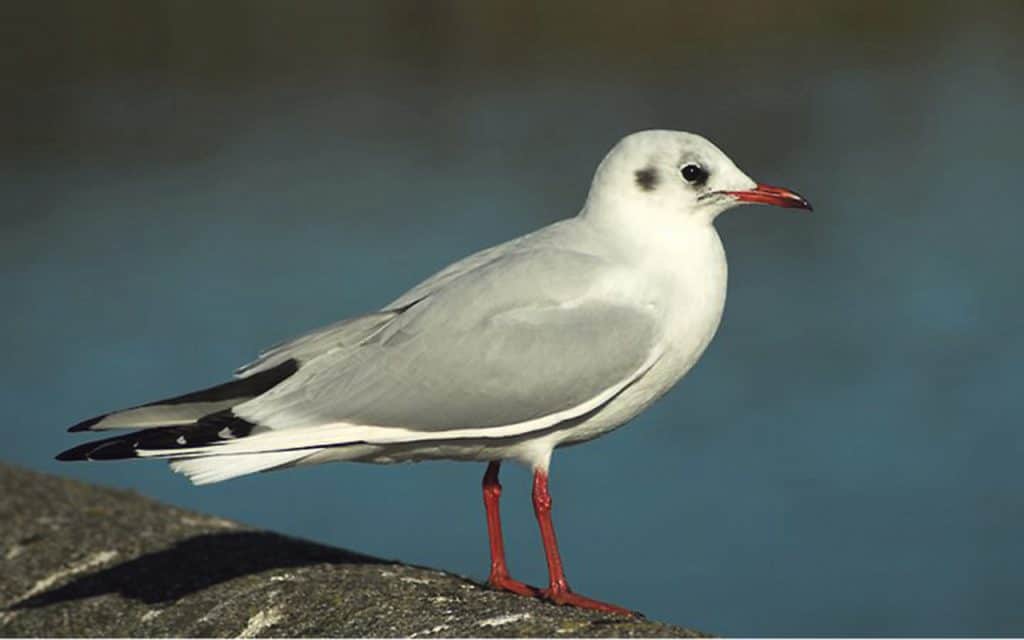
How to identify different species? A good field guide is a major help with this group. Size is a big factor, and is the easiest to start with. There is a huge difference between our smallest gull, the aptly named Little Gull with about a 65cm wingspan, and our largest (also the largest in the world) the Great Black-backed Gull which can have a wingspan of up to 165cm. While there is a range of sizes within each species and a bit of overlap, you can split them into three different size groups – small, medium, and large. There are five species that are likely to make up the bulk of what you see with size alone helping to separate some of these – Black-headed Gull (S), Common Gull (M), Herring Gull (L), Lesser Black-backed Gull (L) and Great Black-backed Gull (L). While the last three all come under large gulls, the Great Black-backed is noticeably larger than the other two. In adults, the colour of the back is another identification point that people will first notice, with the two Black-backed species having very dark grey colouring (almost black on the Great), compared to a paler grey on the other three species. Other features can also help with identification such as leg colour, bill shape/colour, head markings, wing tip colour/pattern, and the colour of the orbital eye ring. A number of these features become heavily involved when you start to look at the other less common species.
Once familiar with our regular species, you can start to keep an eye out for anything a bit different where you could get lucky at spotting some of our rarer visitors such as Iceland or Glaucous Gulls. These birds are termed white wingers because they have all white wing tips, whereas most of our resident gulls have black tips to the wings. These birds also have very pale grey backs as adults, and when young can look almost completely white all over. These very striking birds show up in small numbers every winter.
Feel free to message the BWI West Cork branch with any identification queries or share your photos on our Facebook page. All are very welcome.
BirdWatch Ireland West Cork Branch News
Our next events are:
Early February, date TBD: See the Whooper Swans in the morning at Ballinacarriga.Sunday, February 22: Gulls and Divers at Bantry.
Visit our website www.birdwatchirelandwestcork.ie for more information about these events. To receive news and reminders about our events join our mailing list by sending an email to [email protected].
Facebook @BirdWatchIrelandWestCork
Instagram @ birdwatch_ireland_west_cork