


Jessie Buckley has recently entered the hallowed pantheon of great Irish actors. Victory in the 2026 Oscars, in one of the blue ribbon events that is best leading actress, was achieved by her empathetic performance as Shakespeare’s wife, in the movie ‘Hamnet’. She is now occupying that rarefied place, up amongst the greats of Irish entertainers such as Cillian Murphy, Brenda Fricker, Daniel Day-Lewis, Neil Jordan, George Bernard Shaw, and Cedric Gibbons who, incidentally, is also credited with conceiving the design of the Oscar statute.
Aside from being just old-fashioned good entertainment, are movies and books that have a historical backdrop, a help or a hindrance? Jessie Buckley’s victory has drawn even greater attention to the book ‘Hamnet’, written by Maggie O’Farrell in 2020. It has already made its way onto the English Leaving Cert curriculum, which of course is a tribute to the work’s literary value and popularity. But how true to life is it and should that matter? In this article, I want to explore a number of texts that are grounded in historical events or based upon a historical person and explore the positive and negative aspects upon their readerships.
Let’s start with the novel ‘Hamnet’. Little is known about Shakespeare’s family life aside from a few basic facts. He got married at 18 to an older woman, Anne Hathaway, and had a number of children, including twins, one which was christened Hamnet. Shakespeare was the son of a glover who struggled financially and his son Hamnet did die during the time of the plague. A few years later he wrote, ‘The Tragedy of Hamlet, Prince of Denmark.’ It may surprise you that, in terms of biographical accuracy, we don’t know much more about his family life. O’Farrell is particularly effective in how she fuses her understanding of Elizabethan society to enrich the backdrop of the book, enabling the reader to form a picture of how people lived and toiled in daily life. Her understanding of the horrors of the plague are well-researched and no doubt one of her main attributes was leaning into some Shakespeare’s very own narratives. O’Farrell imagines that William and Anne planned to get pregnant to force their marriage against the will of their unsupportive parents, which mirrors the storyline of a courting couple in a Shakespearean play called ‘Measure for Measure’. O’ Farrell also reimagines their youthful courtship along the lines of another of his better known plays, ‘The Taming of the Shrew’. The difficulty now, is that many readers/viewers are already forming the idea that this is how it actually happened.
On a positive note, any ‘historical’ book (or movie) that inspires someone to read, can only be a good thing. Perhaps many a generation, who were scarred from studying Shakespeare to simply pass an exam, may feel inspired to pick up Hamlet. Outside the cauldron of an exam, it remains a most wondrous and beautifully-penned play. Those who only watched the movie Hamnet, may well decide to take a chance with O’Farrell’s book, and enjoy engaging with the novel. The problem for some historians arises when fiction is conflated with truth. A good friend of mine was surprised that during a discussion of ‘Hamnet’ at her book club, some readers took umbrage with how horrid Shakespeare’s father was and wondered how on earth he went on to become a writer, forgetting that the depiction of his father is purely fictional. I have heard others profess the theory that the death of his son, Hamnet, inspired the great bard to write the play Hamlet – beautifully romantic, but a wholly invented narrative. It illustrates how the fiction can obscure the fact. We know nothing of their relationship and, by the time Shakespeare was writing Hamlet, his star had risen and he was writing commercially successful plays for the Globe Theatre. The novel/movie hinges greatly on a romantic ideal, of a grieving Shakespeare using his pain to exercise his own loss, by exploring the father-son relationship in his play Hamlet (and also the fact that the names are so similar has added fuel to the speculative fire). It’s a frivolous theory but, will probably seep into people’s take on Hamlet. To further puncture this romantic bubble (sorry), King Hamlet and father of prince Hamlet is a self-confessed sinner who, when appearing to his son as a ghost, briefly recounts the horrors he endures in purgatory, paying for the horrid sins he committed in his life, before weighing down his intellectual but ill-equipped son, with the burden of revenging his murder. For all that we admire about young Prince Hamlet, he also shows himself to be a heartless brute to his ex-girlfriend Ophelia and mother, a coward, a procrastinator, and ultimately a murderer of innocent men. Is all this inspired by the memory of his eleven-year-old son? Closer to the truth is that Shakespeare – buoyed by the success of plays like ‘Romeo and Juliet’ – knew how to conjure up a great tragedy and was astute enough to give Elizabethan audiences what they held dearly: a good old supernatural plot, that would draw audiences into the Globe theatre and money into his pocket. He repeated the trick with more zest in the play ‘Macbeth’, not just with ghosts, but adding witches, continuing a winning formula. What O’Farrell has shown is how research and imaginative writing can transport people back to a bygone world.
Perhaps the queen of this style of historical fiction was Hilary Mantel with her ‘Wolf Hall’ trilogy, also based in Tudor times. Her novels revolve around the relationship between King Henry VIII, and his chief minister Thomas Cromwell [not to be confused with Ireland’s nemesis Oliver Cromwell], during that tenacious reign where Henry moved heaven and hell to get his way and remarry, brutally disposing of wives like confetti, all in pursuit of an heir. This novel also leans into imagined fictions and invented conversations that bring the work alive. However, Mantel’s history is a lot more solid, as she works within the court politics, religious animosity between Catholicism and the emerging Protestantism and the well-documented annulments, executions and deaths that the helpless queens had to endure at Henry’s hands. Mantel [who almost bought a house in Ardfield, now occupied by a friend of mine, who never tires of telling me this] was of course a master of historical fiction and, in my opinion, a more nuanced and able writer than O’Farrell. Although she has a lot more material to work with than O’Farrell had, boy does she weave a most believable world of Tudor sexual morasses, politics and power plays. Like any historical fiction, no doubt people will quote her book, saying Thomas Cromwell said ‘this’ or ‘that’, without considering the dialogue is a figment of her well-researched imagination.
Irish great, Colm Tóbín, is famously known for his historical fiction which he would claim is ‘inspired’ by the writings of those he depicts, such as the great German writer Thomas Mann in the novel ‘The Magician’ and American writer Henry James in ‘The Master’. Similar to Mantel, his research is extensive and he ‘finds’ the voice of both protagonists in his stories, sticking closely to real life narratives of events in their lives but finding that Midas touch, that breathes life into his characters and narrates them in a way that invites us to become a voyeur into their private world. That’s the real power of historic fiction and, in this case, Tóbín may well lead his reader to the actual novels written by Mann and James, once their interest is tickled by the power of his storytelling.
Another novel that has the perfect pitch between historic fact and imagination is the novel ‘HHhH’ by Laurent Binet, who brilliantly captures the days running up to the assassination of SS commander, Reinhard Heydrich, the Butcher of Prague, in 1942. That for me is the closest anyone has gotten to the perfect blend of history and narrative, capturing real events, the real time line and real people into a storytelling thrilling novel style, as opposed to a standard biography or history. I would totally recommend it for those interested in the mind-set of the Nazi regime and how it was controlling many parts of Europe.
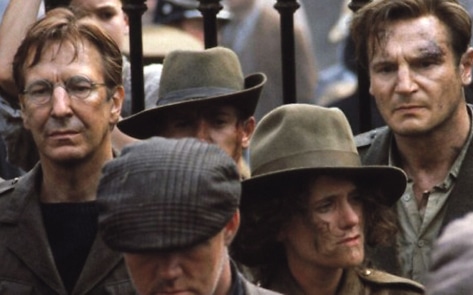
Closer to home and more problematic in my opinion is the Michael Collins movie directed by Neil Jordan. We are used to movies taking some liberties but the Collins movie goes to town. If it was just any movie, one might just accept that’s part of Hollywood playbook, but given that Collins is such an important historical figure and studied in schools, the movie has led to misleading information in the public discourse. There are more holes in it than Swiss cheese and, perhaps the most dangerous one connects De Valera’s appearance in Béal na Bláth with giving the order to assassinate Collins. For the record, while Dev was in West Cork on that day, it was Liam Lynch who was in charge of the anti- treaty IRA and their military strategy, as well as local commanders on the ground. Dev was not consulted or listened to on military matters, most certainly not at Béal na Bláth. The 1970s-style car bombs blowing up agents at Dublin Castle, while cinematically spectacular, was historically cringe worthy nor was Collins in the GPO during the 1916 Rising. The movie has had such a misleading impact that recently, while on a school tour of Glasnevin Cemetery, the tour guide, standing at Collins’ grave, told us that an American woman had recently arrived with flowers for the grave of Liam Neeson. I carefully reminded the group not to include that in their Leaving Cert answers!
Ultimately anything that gets you reading fiction or interested in history is a good thing in my opinion, as long as you do a little bit of your own research and discover what is real and what is entertainment.