

There was much discussion in the pub last week about the weather, as usual, particularly the flooding in Co. Wexford. Some suggested that pearl mussels and slugs were to blame, a view also expressed in the newspapers by an Enniscorthy town councillor, though he talked about “pearls and snails”. So I thought it time for a small lesson in malacology – the study of molluscs.
The phylum Mollusca is one of the great divisions of the Animal Kingdom. It is made up of seven classes. Four of these will be unfamiliar to most: Monoplacophora, Polyplacophora (chitons), Aplacophora and Scaphopoda. The other three classes are well-known: Cephalopoda, Gastropoda and Bivalvia. I have written before about cephalopods and gastropods; the former are cuttlefish, squids and octopuses, the most advanced of the molluscs, and indeed, of all invertebrates. Gastropods are the snails and slugs. Bivalves are those molluscs with two shells, such as mussels and clams. A mussel is no more closely related to a slug than a fish is to an elephant.
Bivalves are probably the least charismatic of the molluscs. You can look an octopus in the eye, and recognise a fellow being. You can do much the same with a snail, though they are not so bright. But most bivalves don’t have eyes, or even heads. Cooking bivalves might not engender the same degree of guilt as, say, watching a lobster struggling in a pan of boiling water, and when served up in a shellfish risotto or as moules marinière, it is easy to forget that they were once living animals. But they were.
There are over 9,000 species of bivalves; most are marine, but a few families have species that live in freshwater. I always found their classification rather difficult and sometimes illogical, based as it was upon internal structures such as gills, muscles and hinges, and before writing this, I had to get out my old invertebrate zoology book and see what I had forgotten. Then, knowing that zoologists (and botanists) keep re-naming and re-classifying things, I looked them up on the internet. Unfortunately, Wikipedia doesn’t seem to have mastered bivalve taxonomy either so, for simplicity, I will divide the bivalves into four categories.
Firstly, there are those with muscular feet, two siphons and two identical shells. These are the cockles and clams. We are all familiar with cockles; they live in shallow sand, are easily collected and good to eat. Clams are more variable, and the word can refer to many quite different types of bivalve. There are thousands of species, from tiny ones less than a centimetre wide, living unnoticed in littoral mud, to the giant clams of the Pacific, the largest of all bivalves, which can reach 120 centimetres in width and weigh 200 kilograms. Clams have always been commercially important: the hard-shelled clam, Mercenaria mercenaria, known as the quahog in America, is the main ingredient in clam chowder, and was one of the species used by indigenous Americans to make wampum – ceremonial beads which later became a currency for trade with the Europeans, hence its Latin name.
My second category is made up of bivalves with reduced feet and siphons and sometimes non-identical shells; they usually live on top of the sediments or anchored to rocks. Many are also commercially important. The common mussel grows on every rocky shore around our coasts; thousands of tons of farmed mussels are exported from Ireland every year. The great scallop has many rudimentary eyes and swims by jet propulsion; it is mostly captured by dredging, which is very destructive. The European flat oyster used to be poor man’s food; now it is an expensive treat. Most bivalves can produce pearls of some sort; the best come from Indo-Pacific pearl oysters.
The third group are the burrowing and boring clams. These have very long siphons and much stronger feet that allow them to borrow deeply into sand, wood or rock. Razor shells are so named because they look rather like old fashioned cut-throat razors; try to catch one and its long, muscular foot will pull it downwards at great speed. Then there are the soft-shelled clams or sand gapers; they are large and meaty, and though common on our beaches, are rarely eaten here, but in America are a main ingredient of the New England clam-bake. Their cousin, the geoduck from the Pacific coast of North America, can live for more than 150 years, and has siphons so long, up to a metre, they cannot be retracted into the shell.
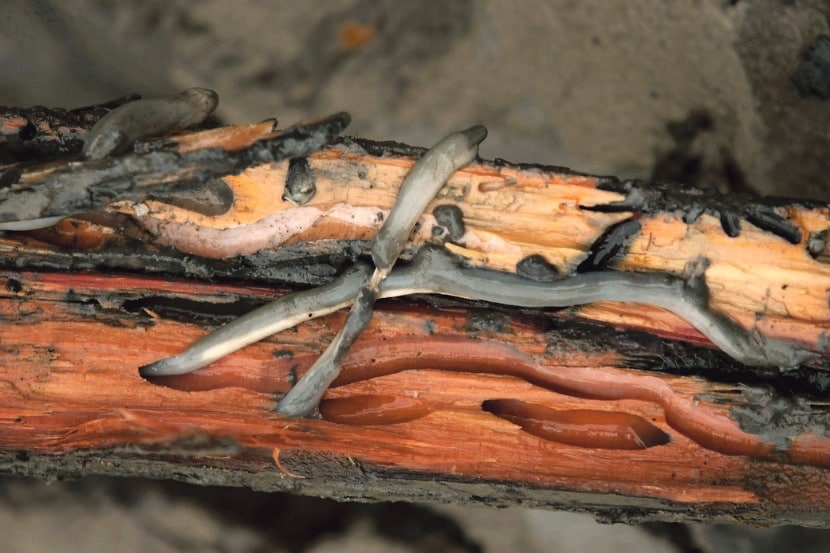
The related piddocks use their shells as rasps to make holes in rocks in which they live. They still look like bivalves, but the shipworms, Teredo, don’t. These have become so modified for boring, they resemble worms, and their greatly reduced shells are used not for protection, but as tools for chiselling away at timber. Unappealing as they look, shipworms are a delicacy in some south-east Asian countries.
Before the invention of antifouling paints and steel ships, Teredo was a menace that destroyed many large vessels. One famous example was HMS ‘Roebuck’, commanded by the explorer, naturalist and pirate William Dampier. Having written a best-selling book about his first circumnavigation of the world, Dampier was commissioned by William lll in 1699 to explore the east coast of New Holland (now Australia). He surveyed western Australia and parts of New Guinea and collected many specimens new to science, but by then the ‘Roebuck’ was so riddled with shipworm the expedition had to be abandoned and the ship sailed homeward. They got as far as Ascension Island, where she sank. So from the mid-18th century, Royal Navy ships had their bottoms sheathed with copper, which kept the shipworms out.
Back in the 1990s, I had my own experience with Teredo. My old wooden boat developed a serious leak, which was eventually tracked down to three shipworms. Their larvae are microscopic and can get into any tiny crack; perhaps my antifouling was insufficient, perhaps they got in before I bought the boat and the surveyor never noticed. Either way, I had to replace three planks.
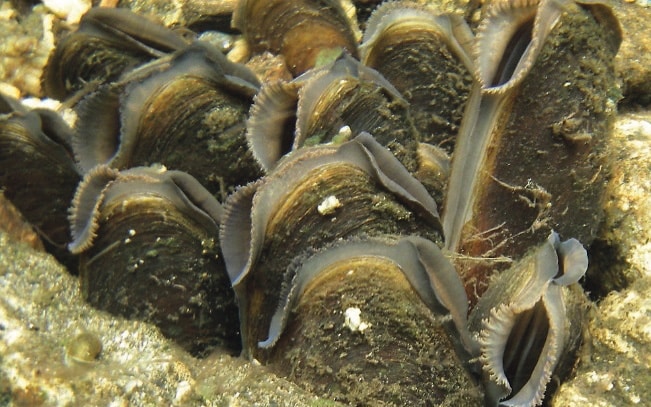
The last of my four categories contains exclusively freshwater bivalves with parasitic larvae. They all have very short siphons, so can’t live in deep sediments. In Ireland, we have three species: swan and duck mussels which are found in lakes and ponds, and the pearl mussel, Margaritifera margaritifera, which needs clean, fast flowing rivers.
Most bivalves release eggs and sperm into the water; these mix together to produce planktonic larvae which eventually settle back onto the sea or river bed where they grow into adults. Pearl mussels do it a bit differently. The female’s eggs stay inside her and are only fertilised if she inhales sperm from an upstream male. The larvae, up to four million of them, spend two months developing in a brood pouch before being expelled. To continue their development, they have to meet a salmon or a trout. Most don’t, and are simply washed away down river and eaten by something. A lucky one will find its way into a salmonid’s gills, using its tiny shells as a sort of clamp. There it stays and grows for about eight months, after which it drops off and sinks to the bottom. If it lands in a muddy area, it will die; it has to settle on a gravelly river bed. There it might live for over 200 years, growing to a length of 15 centimetres, while feeding on organic matter filtered from the water.
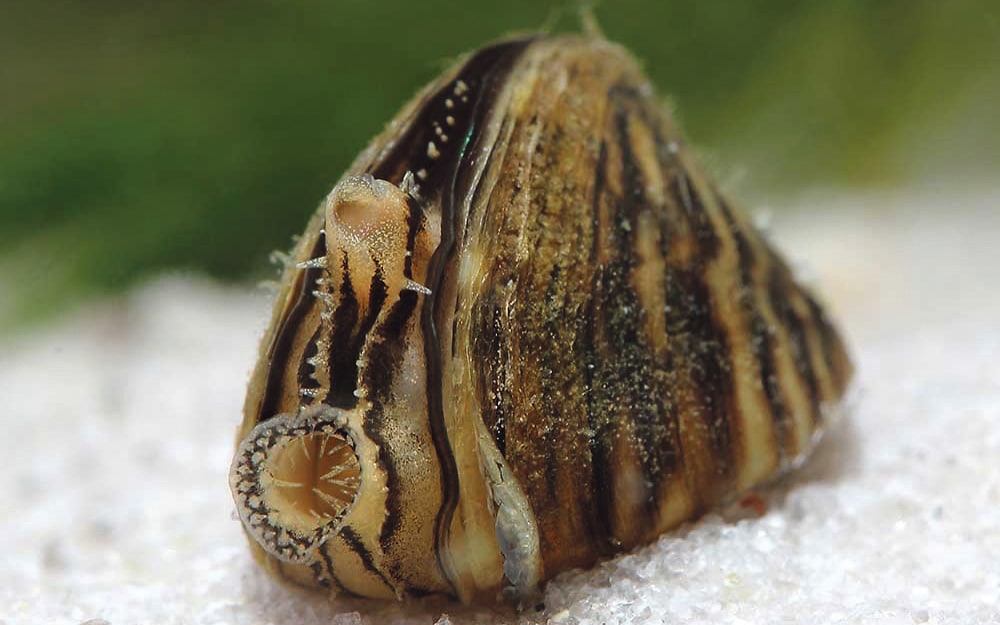
M. margaritifera is now endangered or extinct in most of Europe, where it was once exploited for its pearls, though it is still fairly common in Ireland and Scotland. But the alarming thing is that few young pearl mussels have settled and survived since the 1960s – most are killed off by pollution, siltation, the dredging and tidying up of rivers, reduction of salmonid numbers (by pollution and overfishing) and smothering by the invasive and unrelated zebra mussels. A subspecies, M. margaritifera durrovensis, evolved to live in the calcareous waters of the Nore, Barrow and Suir; only about a hundred individuals are still alive, all in the Nore.
Pearl mussels might not look very exciting, but I think any creature that lives so long, has such a precarious life cycle, and actually cleans river water (the opposite of what humans do) deserves to be respected and looked after. If humans are affected by flooding, it is because their ever-increasing populations, mindless materialism and ignorance of the natural world – the real world – are destroying ecosystems and changing climates; and, rather obviously, because they build houses in areas prone to flooding. It is humans that are ruining the lives of pearl mussels (and most wild animals), not the other way around.