

What binds all the great philosophers from Aristotle to Peter Singer is a voyage of self-discovery. Despite the many centuries and cultural nuances that separate them, time and time again, a common theme that emerges from so many of them, is to be virtuous and selfless. Aristotle believed that happiness comes from service to the community. Christian philosopher Thomas Aquinas, said the key energiser is love and thus acts of love towards humankind. The great fifth century Chinese philosopher Confucius preached that a person becomes whole when they fulfil responsible roles in society in a selfless way. Twenty-first century sage Peter Singer puts it that basically one wants to feel there is more to life than just consuming products and generating garbage. He asks what greater motivation can there be than doing whatever one possibly can to reduce suffering and pain?
The recent pairing of the Republic of Ireland soccer team and Israel in the same group has, once again, highlighted the tensions between the two nations that has developed since Israel’s military incursions into Gaza. It’s probably not a bad thing, since it has turned the spotlight back on the conflict that a UN report has called genocide, seeing that it has dropped out of the media cycle. Yet there have been 600 deaths and counting since Israel agreed to stop the bombing and a ceasefire. So what’s this got to do with a bunch of philosophers?
Prior to the draw, League of Ireland clubs such as Saint Patrick’s Athletic have bravely brought a case to UEFA against Israel’s continued participation in both international and club football. The case is black and white. In summary, the argument revolves around the fact that Israel’s continued participation is a direct breach of article three and four of UEFA’s statutes. By allowing Israeli clubs in occupied Palestinian territory, to participate in European competitions, UEFA are in breach of these statutes and indeed international law. By coincidence the recent draw has escalated this case further but so far both the Irish Government and the FAI have decided not to take a stand. Supporters of the boycott favour UEFA taking the lead on this with a ban – like they did previously with Russia and Yugoslavia – but Israel seems exempt from these rules. So what happens next? The Irish woman’s basketball team, when faced with this uncomfortable fixture, fulfilled it, in spite of many of the young women speaking out against it. Basketball Ireland said it would “damage the sport” and thus the game went ahead. Will our government take action? Mary Lou has said we should give Israel “the red card”, whereas Simon Harris said, “Ireland would miss out” The FAI likewise have said they “have no choice”. Will individual players take it upon themselves to take a stand? It’s difficult on one level given many may feel it could damage their career, but should we listen to the great men and women who believe that virtue and selflessness will lead to a fulfilled life above everything else?
This article will look at some sportspeople who made the decision to do what they felt was right, even if it could have led to their own personal ruin. History has been kind to them for their brave actions and, in times of great moral ambiguity, we need more of our heroes to stand up.
Muhammad Ali
By 1967 there were almost half a million soldiers fighting in Vietnam. Black people were drafted in disproportionate numbers, something that Martin Luther King Jr highlighted in a famous speech he gave at the Riverside church in New York in April 1967. Always conscious of keeping the white political elite on board, he risked sanction with his direct confrontation; “We were taking the black young men who had been crippled by our society and sending them eight thousand miles away to guarantee liberties in Southeast Asia which they had not found in southwest Georgia and East Harlem.”
Muhammad Ali would take it further, which ultimately led to the loss of his boxing world title and his arrest and deny this brilliant and charismatic athlete from performing in a boxing arena for a further three-and-a-half years. Just a few short weeks after King’s speech, he refused to be drafted, as it went against his religious beliefs and, like King, his moral outlook. On April 28, he declared to the world “The real enemy of my people is right here (USA). I will not disgrace my religion, my people or myself by becoming a tool to enslave those who are fighting for their own justice, freedom and equality.”
Tommie Smith and John Carlos
Mexico City 1968. America marvels at the performances of their 200-metre sprint team. Carlos claims the bronze and Smith the gold, breaking the world record in the process. Since then there have been thousands of American medal winners that most people have forgotten, but these two athletes will be remembered forever for their brave stance. They walked into the area, shoeless, as a symbol of the poverty that had engulfed their communities. (Vietnam was costing the state 30 billion dollars a year and LBL’s ‘great society’ project was bankrupt). Carlos wore a necklace to symbolise lynching. More symbolically, they raised their clenched fists in the manner of the civil rights group, the Black Panthers, after they received their medals and during the national anthem. Afterwards they were sent home in disgrace, received death threats and endured financial hardship. When Smith was asked if he regretted that salute, he replied, “The only regret was that it had to be done.”
Tony Ward
In 2026, Irish rugby has been obsessing about who should be the Irish number 10 for the national team – Jack Crowley or Sam Prendergast. There was a similar conversation in the early eighties, when Tony Ward and Ollie Campbell were the darlings of that era. They were both so good that they were selected for the Lions tour to apartheid South Africa in 1980. Both men jumped at the highest accolade in rugby, but it would have a negative effect on Ward. The reality of the situation appalled the young man: “When we arrived in Johannesburg airport I came face to face with the reality of apartheid when I went to the toilet and saw the sign ‘Whites only toilet – No Blacks’.” The following year, trade unions, the government and the Catholic church called on the IRFU not to tour South Africa. It fell on deaf ears and unbelievably they still went. Not Tony Ward (and a dozen others). After what he had seen firsthand, he refused to travel and his international rugby career was never the same again after.
Naomi Osaka 2020
Osaka is one of the highest profile players in the women’s tennis circuit, winning four grand slam titles. During the US open of 2020, she wore seven masks bearing the name of black victims shot dead by police, to shine a light on the continued police violence in the USA that has been particularly hard on immigrants and the black community. In an interview she said, “For me it’s just spreading awareness. I feel like the more people know the story, then the more interesting or interested they’ll become in it. It’s quite sad that seven masks aren’t enough for the amount of names.” That was the same year the high profile case of George Floyd was choked by police officer Derek Chauvin in May 2020 on the streets of Minneapolis, where this last month Alex Pretti and Renee Nicole Good were killed by federal agents. Has anything changed? Thankfully Osaka’s career was not negatively affected for her brave stance.
Vladyslav Heraskevych 2026
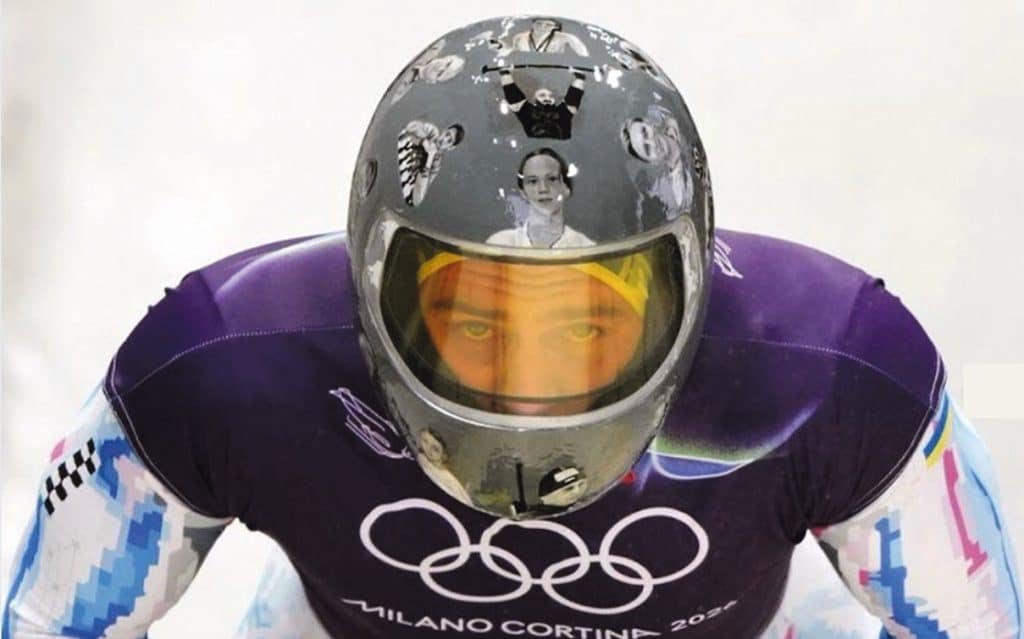
Heraskevych, a Ukrainian Winter Olympic athlete engaged in a similar protest as Osaka’s. On his helmet, he wore what he called a ‘helmet of remembrance’ depicting twenty-four of his friends that have been killed by Russia in the war on Ukraine. He was disqualified from the competition on the grounds that the Olympic committee does not allow signs of political, religious or racial propaganda to be displayed. Heraskevych said it was to honour his dead friends and refused to back down. The IOC disagreed and he lost his Olympic dream because of his moral stance.
It’s an eternal question that never goes away. Should sport and politics mix? Perhaps instead we should ask the question: Is every platform a legitimate one to voice concerns, raise awareness and shed light on injustice? Sadly, for many who have used their fame for such things – be it writers, sports people or musicians – the consequences have been negative. One thing is for sure, the aforementioned examples have lived up to the ideology of some of the greatest philosophers. What is it all about – love, selflessness, the service of your community and the betterment of all our lives. That is true happiness.