


I often talk to cows; where I live, there isn’t much else to talk to. They can look so miserable, standing in muddy fields, soaked by the pouring rain and battered by the wind. But then, on a sunny day, chewing the cud, they seem quite content. They stare back at me with those great big eyes and inscrutable expressions while I assure them that I’m not a carnivore. But I do drink milk, and life without cheese would be unthinkable, so in a small way, I contribute to their misery.
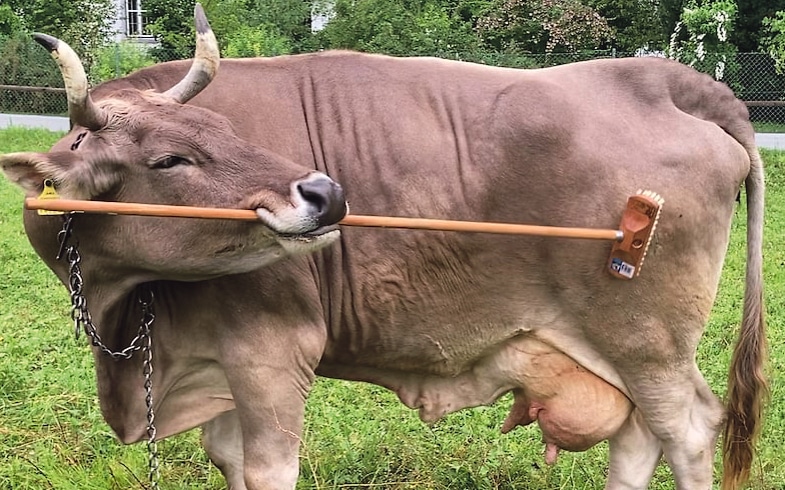
What cows don’t ever appear to be is intelligent, so the title of this article must seem an oxymoron (which itself could be a bovine pun). But recently, it has been discovered that one cow has learned to use tools. Veronika, a Brown Swiss living in Austria, uses a broom to scratch her back. She picks up the handle with her mouth and manoeuvres it with her tongue towards wherever needs scratching. She even knows which parts of the brush to use for which jobs – the bristles for a general back scratch, the handle for getting at itches in difficult places underneath.
Many animals can use tools. In 1960, the great Jane Goodall, who died last year, first observed a chimpanzee using a grass stem to collect termites. Chimps can also scoop honey out of wild beehives with thick sticks, and use leaves as spoons. Orangutans construct nests from leaves and branches, use a variety of twigs for food gathering tasks, and know that poking a catfish with a stick will make the fish jump out of the water where it can be easily grabbed. Elephants break off branches to swat flies and scratch itches, and some dolphins protect their noses with sponges when they are foraging for fish hidden in the sea bed. Egyptian vultures use stones to break ostrich eggs, and New Caledonian crows modify sticks and leaves, just like apes, to get food. Even some invertebrates use tools: the Indo-Pacific veined octopus makes shelters out of discarded coconut shells, bottles or other litter, while the Hawaiian boxer crab faces any threat with a sea anemone in each claw, like a Wild West outlaw with two guns. So perhaps a brush-wielding cow is not so strange.
Cows are ungulates, i.e. mammals with hooves. There are two types of ungulate: the odd-toed ones in the order Perissodactyla (horses, rhinos and tapirs); and those with an even number of toes in the order Artiodactyla – the camels, pigs, hippos and ruminants. (Some zoologists, controversially, place whales in the latter order too, but that is another story). There are six families of ruminants, including the deer, the giraffes and the bovids. The bovid family is further divided into three sub-families: antelopes, goats and sheep, and buffaloes and cattle.
Ruminants all have four-chambered stomachs. A cow eats grass and swallows it quickly. The grass passes into the first and largest chamber, the rumen, where bacteria and protists start to break it down and produce various nutrients. When the rumen is full, the partly digested grass is regurgitated and chewed; the cow is literally ruminating, perhaps having profound bovine thoughts. When the cud is broken down sufficiently, it is swallowed again, and this time passes into the second chamber, the reticulum, where any alien objects (like plastic) gather. Next, food goes to the omasum, which absorbs water and fatty acids, and finally into the abomasum, where further digestion takes place.
There are two reasons for all this: firstly, grass is very difficult to digest; and secondly, ruminants are, in the wild, constantly under threat from predators such as lions and tigers, so it is vital to get as much food inside as quickly as possible, then digest it at leisure in a safe place.
The domestic cow’s closest relatives are the six species of buffalo (five Asian and one African); two species of bison (American and European); and three species of wild cattle – gaur, bentang and yak (which have each been domesticated too). The gaur comes from India and SE Asia; the bentang, which is critically endangered, survives only in a few places in SE Asia and northern Australia; and yaks are the extraordinarily hairy cattle from Tibet and other remote parts of western China. (I tried yak once, about twenty years ago in Yunnan Province, fried with Szechuan peppercorns and pak choi; it was the just about last mammal meat I ever ate).
There are two more notable bovines: the kouprey and the aurochs. The kouprey, Bos sauveli, is the national animal of Cambodia, not that many people inside or outside Cambodia know this. The concept of a national animal is meaningless anyway (we don’t have one here), especially in Cambodia, because the kouprey is extinct – the Cambodians ate them all. Koupreys once lived in areas of mixed grassland and forest from Thailand to Vietnam. Habitat loss, as well as hunting, contributed to their demise – much of Cambodia’s forests were lost during the Vietnamese War and the insane rule of the Khmer Rouge; commercial, often illegal, logging since has done even more harm. The last sighting of a live kouprey was in 1983. There are none in captivity; only one was ever kept in a foreign zoo, in Paris; it died during World War Two. The nearest I came to a kouprey was the statue of two bulls in the town of Sen Monoron, in the north-east of Cambodia.
The aurochs, Bos primigenius, was the ancestor of modern domestic cattle. It was a massive animal, the bulls nearly six feet at the shoulder, and each horn nearly three feet long. It once lived all over Europe, Asia and North Africa, grazing alongside Irish elk, straight-tusked elephants and narrow-nosed rhinoceros. Neanderthals and early Homo sapiens hunted the aurochs, and painted pictures of it, along with other animals, on the walls of their caves. The giant bulls of Greek mythology, symbols of power and sexual potency, were aurochs. But by the end of the 17th century, they had all been exterminated. (The word ‘aurochs’, by the way, is from Old German, and is related to ‘ox’; it can be singular or plural; an alternative plural is ‘aurochsen’.)
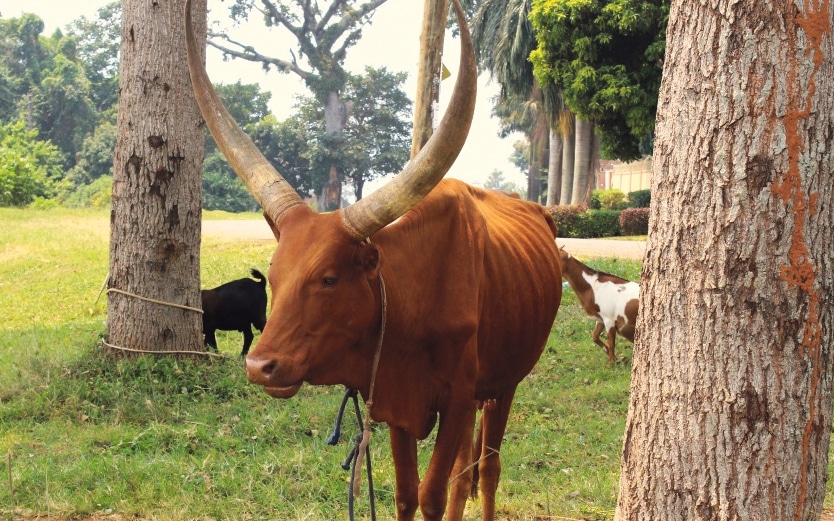
Domestication of the aurochs occurred twice: in the Middle East, about 10,000 years ago, this produced our beef and dairy cattle, Bos taurus; and in India, about the same time, gave rise to Bos indicus, the humped cattle or zebu. These were introduced into Africa about 3,000 years ago and hybridised with African aurochs, which resulted in breeds such as the enormously-horned Ankole.
While cattle here are just agricultural commodities, to the Hindus they are sacred and often lead pampered lives; an estimated five million cows roam freely in Indian cities. Unfortunately, there is little for a cow to eat in a big city, except human rubbish; according to a 2017 article in the Times of India, nearly 1,000 cows die a painful death each year in the city of Lucknow alone, due to feeding on plastic. In a 2021 report in the same newspaper, one cow was found to have 77 kilograms of plastic in its stomach. So much for being sacred.
Cattle kill, on average, twenty-five people every year in the UK and USA, and probably many more worldwide – some are in farmyard accidents, others involve stupid people walking across fields where cows are grazing. In Spain, where bull-fighting (a relic of Roman barbarity) is still considered a sport, matadors and those idiots running through the streets of Pamplona during the Fiesta de San Fermin, sometimes get gored by the horns of the animals they are tormenting; that seems fair enough to me.
Cattle cause more harm by the production of methane, mostly by eructation resulting from their digestion. Methane makes up 19 per cent of greenhouse gas emissions, 21 per cent of it coming from cattle. Certain food additives can limit this, such as rapeseed or seaweed – particularly the red alga Asparagopsis, an invasive species from warm waters. Research in California found feeding a seaweed supplement to grazing beef cattle cut methane production by nearly 40 per cent.
I don’t want to upset farmers – theirs is one of the few jobs that is truly essential; they should be appreciated, and paid, much more. But there are an awful lot of domestic cattle on the planet; the current world population is about 1,500,000,000 – one third of all mammalian biomass. That could be reduced. Apart from the methane they produce, such a huge number needs an equally huge amount of grazing land, much of which was once natural habitat for wildlife – whether rainforests in South America, or gorse-covered hillsides in West Cork. Perhaps now, with the knowledge that cows are not stupid, but are capable of deliberate thought and decision making, people might stop eating them.