

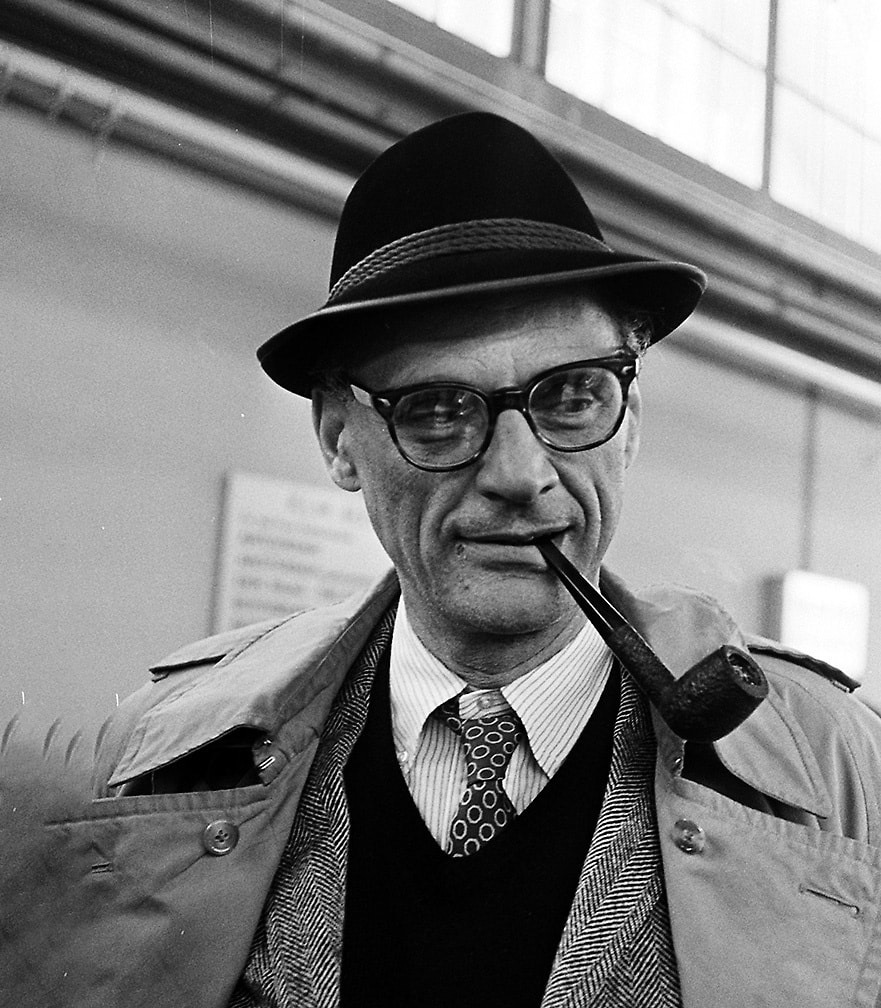
Arthus Miller in 1966.
Arthur Miller is one of America’s greatest playwrights. Some of his dramas are household names; ‘Death of a Salesman’, ‘A View from a Bridge’, ‘All my Sons’. His story lines are suspenseful, his themes tackle morally ambiguous scenarios, his characters depict ordinary, relatable people like you and I, faced with awful decisions. Arguably however, Miller’s greatest play is ‘The Crucible’. Not only is it an enthralling historical dramatisation of the Salem witch trials of 1692 – a masterly-crafted story that lays bare the human condition; love, power, jealousy, hypocrisy, injustice and redemption – but it is also an iconic political statement.
Its allegorical connection to what was happening in 1950s America elevated its status. Written in 1952, amidst the hysteria of the Red Scare that enveloped American society, Miller was influenced by the great paranoia shaking the nation – the perceived communist penetration into the USA. He sought to use his art to draw a poignant and dangerous parallel to the Salem witch trials. Let me build you a picture of those times to clarify the context in which Miller was writing.
After entering World War II in December 1941, the Americans tipped the balance in favour of the Allies. Out of the ruins of fascism would emerge a far greater perceived threat than the one they had vanquished: the communist Soviet Union. Even before the war had ended, both nations were carving out spheres of influence. Whether it was squeezing the Nazis in Europe or chasing the Japanese from their colonial territories, red Russia and democratic America both liberated and occupied in equal measure. Churchill famously coined the term ‘the Iron Curtain’ in 1946 to describe the division of Europe into two camps. Within a short time, the Soviets tried to wrap a stranglehold around Berlin. While West Berlin barely survived a blockade, communism was also creeping into China, North Korea, Yugoslavia and nearly into Greece. Could it ever infiltrate America?
Several factors contributed to the belief that America was contaminated with communist sympathisers and agents. In the 1930s, communism and socialism were more ‘fashionable’ in America. Trade unions had become the weapon of the working man and woman. Many in that generation had been imbued with socialist ideology when confronted with the growth of fascism in Franco’s Spain, Hitler’s Germany, Mussolini’s Italy and Salazar’s Portugal. It was therefore not uncommon to find ordinary people and left-leaning celebrities supporting the anti-fascist cause, joining foreign brigades, or supporting trade unions and collective ownership. But this past would come back to haunt many. Miller, though never a communist, had expressed socialist sympathies and spoken at pro-communist events, and by the 1950s this had become a dangerous legacy. Red Russia, it seemed, had arrived at the gates of Troy and the House Un-American Activities Committee (HCUA) believed there were American citizens waiting in the wooden horse.
The game-changer was the discovery of atomic espionage. The Manhattan Project in the deserts of New Mexico had brought together the greatest scientific and technological minds to create the world’s first atomic bomb. Klaus Fuchs, one of those scientists, was arrested in London in 1950. He not only admitted his role in passing secrets to the Soviets but gave up the names of a ‘spy ring’ of scientists centred around Julius and Ethel Rosenberg. The Rosenbergs contended that they were motivated by a sense of duty to protect global destruction; if the Soviets had the bomb, they argued, it would act as a counterweight to America’s potential unchecked use of atomic warfare in future conflicts. This laid the groundwork for a period of hysteria, accusation and paranoia throughout the 1950s. Senator Joseph McCarthy led the charge – this vehicle being the aptly named House Un-American Activities Committee. It comprised bipartisan members of the House of Representatives. Shockingly, McCarthy accused the State Department of harbouring 200 communist members. This accusation ushered in what was to become known as the ‘Red Scare’. Over the next several years, civil servants, unions, teachers, librarians and – most famously – Hollywood stars were hauled in front of the committee to lay bare any ‘associations’, however insignificant, with labour unions or left-wing organisations. The hysterics had begun.
With television becoming a mainstay of the American public, watching Hollywood stars grilled in front of the committee was better than…well, watching Hollywood. It was infused with a catch-22. Thousands were subpoenaed, often simply because they were named by others who often were attempting to save their own careers. Some were co-coerced outright. Refusing to answer could lead to imprisonment for contempt. People with even the smallest connections could be crucified. One must remember that this was happening in a country that had pioneered free speech and freedom of association. Not at this time. As many as 320 Hollywood actors, directors, and writers were blacklisted and never worked again for major studios. It was amidst this madness that Miller bravely penned ‘The Crucible’.
In Salem in 1692, a number of young girls claimed that the devil was working through them because witches were pulling the strings. Just as 1950s America wanted to purify the nation of communists (prompting the line ‘Better dead than red’), the Puritan community of 1692 saw itself as pure and Christian. Incredibly, the girls were believed based solely on their testimony, with no corroborating evidence, resulting in many innocent people being hanged and 200 more languishing in jail. It was a mirror image of was unfolding in Miller’s America.
Miller does a superb job of dramatising the human condition, capturing the mania and paranoia, but also the frustration and disbelief of innocent people being named as witches or devil’s agents. John Proctor is the play’s flawed protagonist. He is far from perfect but this adds a layer of the everyman in us all. His wife Elizabeth, perhaps the play’s purest character, is accused by Abigail , who is infatuated with Proctor after their affair. In her frenzy, Abigail and her accomplices, begin to name names to the court with impunity. Her daring and power grow exponentially, to the point where she threatens the authority of the court when she is questioned too closely, declaring, ‘think you so mighty that the power of hell may not turn your wits?’ Many characters are presented with a bleak ultimatum – confess or be hanged. It’s the classic ‘damned if you do or damned if you don’t scenario’, one that would be mimicked in the 1950s McCarthy hearings. False confessions were extracted, just as in Salem. Refusing to answer meant jail.
Miller could have been named when his long-time friend and director, Elia Kazan was called before the HCUA. Kazan was a massive name and it suited the HCUA for him to declare himself pure while simultaneously condemning others. To his credit, in his first appearance he refused to name anyone, but in his second, public appearance, he found himself in the unenviable position of ‘if you’re not with us, then you are against us’. Names were named, and with the utterance of those words, people’s lives crumbled, careers were finished, some even took their own lives. He never did mention Miller, who would be questioned himself years later for his left-leaning ideas and appearance at communist-linked events. Miller, like Kazan, faced the same ordeal, but refused to crumble. He was cited for contempt of Congress and blacklisted, but fortunately for him and us, this verdict was later overturned in a court of appeal.
Even before ‘The Crucible’, Miller’s plays were known for their introspective examination of America’s moral fibre, which he often found lacking in its care for the common man and woman. Miller would survive and thrive. After marrying Marlin Monroe, he wrote the screenplay for the famous 1961 movie ‘The Misfits’, and continued writing until his death in 2005. He fell out with Kazan, as did many others who had the moral fortitude to resist the advances of the HCUA, even if it hurt their career and life.
Kazan’s informing haunted him for the rest of his life. In 1999, he received a lifetime achievement, which was met with a lukewarm to outright hostile reception. Yet he is probably best known for his Oscar-winning picture ‘On the Waterfront’ in 1954, released two years after his HUAC testimony. The film, a brilliant piece of cinema, tells of the struggles of New York longshoremen under the control of the mafia. Kazan clearly sends his critics a message by making it a movie about one’s duty to inform. In this case, it’s to the Waterfront Crime Commission, who are investigating corruption and are depicted as the ones that can save the workers from the clutches of the mafia. One of the film’s main heroes is Father Barry, a straight-talking local priest who tries to help the dockworkers. He says ‘Now what’s ratting to them, is telling the truth for you. Now can’t you see that?’. If ever a line expressed a director’s personal justification, it was that. But perhaps Miller’s voice will always be louder and more significant. In the climax of ‘The Crucible’ his main character, Proctor, declares – before he is hanged for defying the court: ‘I am John Proctor – you will not use my name’.