


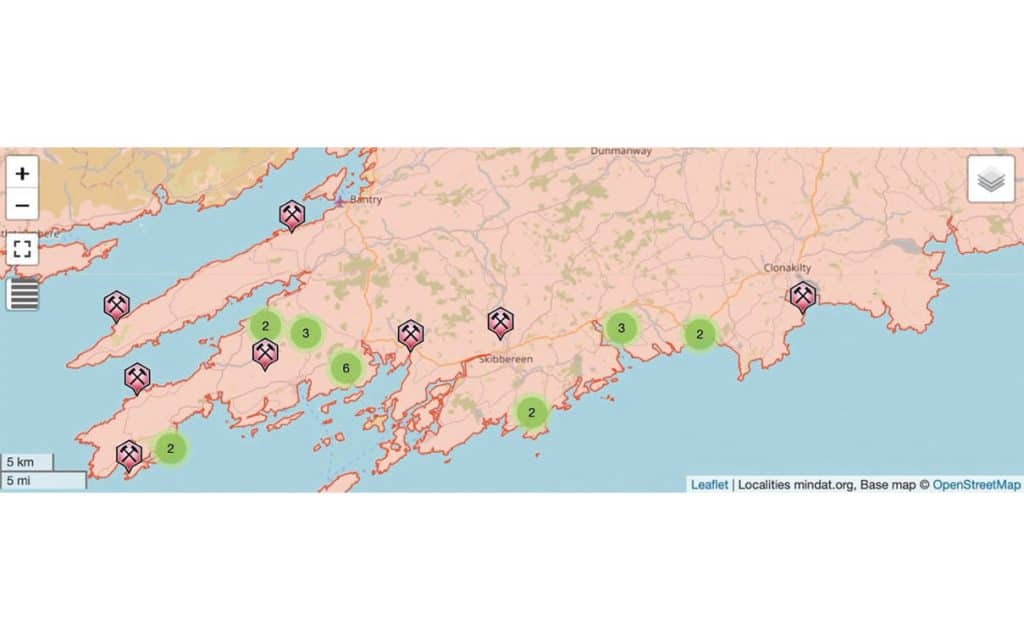
Map of mines across West Cork in 19th Century from www.mindat.org/loc-14239.html
In the early 19th century copper mining was prevalent across West Cork with miners brought in from Cornwall in the early part of the century to supplement the workforce. While back then landowners owned the mineral rights below the surface of their land and no government licence was needed to mine copper, today a government licence issued by The Geoscience Regulation Office (GSRO) is needed to even prospect for minerals. At the end of 2025, a total of 18 Prospecting Licences (PLs) were issued in West Cork – to ‘Aurum Discovery Ltd’. These licenses each relate to a portion of land outlined and mapped in the GSRO document. While copper is one of the most useful metals in the push for clean energy, mining it can cause tremendous destruction of the environment, therefore Innovative solutions are needed and are being developed writes Fiona Hayes.
Copper increased in industrial importance in the 19th century with the invention of the electric battery in 1800 and electromagnets two-and-a-half decades later. Commercial telegraph introduced in 1837 further increased reliance on copper as a conductor and traditional telephone landlines continue to be made of copper wires today. Indeed, a single iPhone contains around 6gms of copper.
In West Cork, copper mining started in Allihies in 1813, Ballycumisk and Horse Island in 1814, then opened in Balllydehob, Cappagh, Gortavallig, Kilrohane, Bantry, Scart, Derryinagh, Dereenlomane, Mount Gabriel, Dunbeacon, Gortycloona and Skeagh.
With ‘Aurum Discovery Ltd’ was granted a licence in 2025 to prospect in West Cork, it’s important to note that this doesn’t imply a licence to mine for minerals. Such a licence would require a comprehensive Environmental Impact Statement (EIS) to support applications to the Local Authority for Planning Permission and to the Environmental Protection Agency for an Integrated Pollution Control or Industrial Emissions Licence. A period of time would then be allowed for statutory consultation with a wide range of Government bodies and public scrutiny of the EIS along with public comment.
There have been prospecting licences continuously covering these geographical areas for at least the past decade. Prior to Aurum being granted licence on these particular land blocks, they were held by ‘Adventous Exploration Limited’ (AEL), who engaged Aurum to manage exploration projects and provide technical expertise. In fact (AEL) held 100 per cent of the 114,000 hectares West Cork licence block.
AEL have a Joint Venture Agreement with the Canadian-based mining company ‘First Quantum Minerals’ and have identified areas for secondary follow up prior to potential drill testing of targets and exploration of base metals. First Quantum Minerals specialise in copper mining.
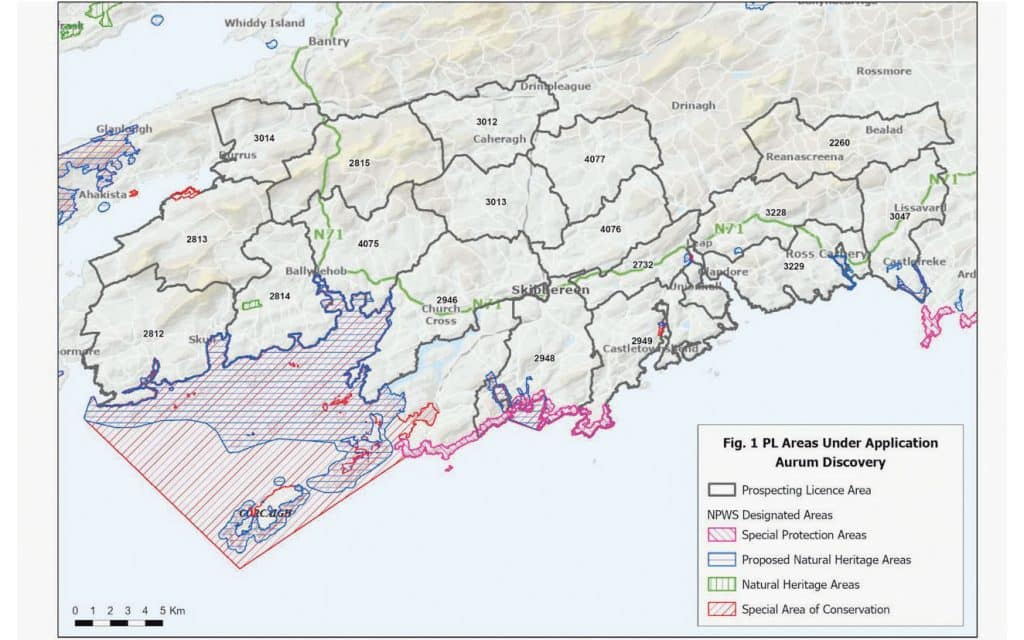
The areas of West Cork being considered occur along up-plunge folds of land between the Sheep’s Head and Glandore. The initial investigations have identified sediment-hosted copper and silver (Cu-Ag) deposits comparable to several other world-class sites. To determine whether these sites would yield a profitable level of mineral extraction, it is likely that further work, including some drilling, will need to be done. This will require landowner permission and Environmental Screening Assessment.
The GSRO considered 48 submissions opposing the grant of these licences, however practically all the submissions focused on mining rather than prospecting; thus were discounted as reasons for withholding the licences.
Mining, rather than prospecting however, requires three separate consents obtained from three different agencies: Planning permission from the relevant Local Authority; An Integrated Pollution Control (IPC) or an Industrial Emissions (IE) Licence from the Environmental Protection Agency (EPA). These licences contain strict conditions on how a mine must operate to protect the environment from pollution; A mining lease or licence issued by the Minister for Climate, Energy and the Environment .
If a mining licence were to be considered, a public consultation period would be published in a local newspaper and at experience.arcgis.com.
All of this however, raises serious questions for people interested in environmental protection and climate change.
The prospecting company is interested in copper because it is one of the most useful metals in the push for clean energy. Renewable energy systems use four to six times the amount of copper as do fossil fuel or nuclear plants. A photovoltaic solar power plant contains approximately 5.5 tons of copper per megawatt of power generation. A single 660-kW turbine is estimated to contain some 800 pounds (350 kg) of copper. Industry is predicting a 70 per cent increase in copper mining to meet the 2050 climate decarbonisation goals.
Mining copper however can pollute the atmosphere with dust and contaminate the water table with chemicals used to extract the mineral. Some modern mines fear having to pump contaminated wastewater around the mine forever to prevent it entering the water table.
Innovative solutions are needed. As materials scientist Prof Mary Ryan of Imperial University, London said, “The world needs to electrify its energy systems, and success will absolutely depend on copper. The metal is going to be the biggest bottleneck in this process.”
Prof Mary Ryan heads up the Rio Tinto Centre for Future Materials opened in 2024 and based at Imperial College London, in partnership with several international university groups.
The centre’s first project is looking for responsible ways to source copper. Of course, ensuring improved recycling of copper from batteries, cables and so on will be important, but the centre is looking at questions such as, can the mineral be extracted without disturbing the rocks at all? For example, could viruses and bacteria be used to harvest copper?
The team have also been searching for underground sites where copper-rich brines, created by volcanic systems are still in liquid form. The volcanic systems could provide geothermal energy to pump the brine to the surface via boreholes. Sites in New Zealand and Japan have been identified as possibilities for this technology.
Franklin Keck and Ion Ioannou co-founded the company RemePhy Technologies, a spinout from Imperial University PhD research. RemePhy are pioneering the use of GM technology to develop plant-bacterial systems that have an enhanced ability to extract metal from the soil. They state, “We’re building plant–microbe systems that clean contaminated soil and recover critical metals as the plants grow. Thereby reducing disruption, versus dig-and-dump approaches; and unlocking stranded brownfield and mining-legacy sites.”
The Irish Government, in response to the latest energy crisis precipitated by war between USA/Israel and Iran, has stated it will pursue energy sovereignty focusing more on renewables. This will require copper.
Possibly, technical solutions such as the ones RemePhy are developing, hold the key to finding the quantities of copper we need for this transition. Perhaps new prospecting licences will not lead to new mines but, by using innovative technologies, will nevertheless enable our 80 per cent renewable electricity target by 2030. Let’s hope so.