


In October 2026, more than 300,000 public sectors went out on strike during a year that has seen the cost of living and inflation skyrocket. The same cost of living issues brought out the hauliers, farmers and others earlier this year in a fuel protest that stopped a nation. Yet many remain critical of the legally constituted and registered unions because of the disruptions. But is that not the whole point – to disrupt? If you don’t inconvenience, then a strike is ineffective.
So what about this for a solution to deal with unions? Fire anyone in a union or those who refuse to give up their union membership. Saving that, ask the police to baton charge strikers even if it means fatalities and scores of injuries. Amidst all of this, commandeer some of the major newspaper outlets to blacken the name of the union leaders and use the papers’ voice to paint a blatantly pejorative picture of the strike leaders. Finally, if the strike goes into weeks and months (thankfully it didn’t), then simply announce to all the workers that you possess enough money to outlast them and that “the strike will collapse because the workman’s families will feel the pinch of hunger”. Imagine? You don’t have to! All this happened in Dublin, under the orchestration of William Martin Murphy, in what would be called the Lockout.
Let’s set the scene. The Industrial Revolution, a century earlier, had created a distinctive new class. A sprawling mass of urban labourers, men, women and children. On the other side of the spectrum, it created an upwardly mobile middle class of entrepreneurs, who rapidly benefitted from the profits accrued from the advances made in technology and ultimately the toil of the underpaid workforce. Like all spectrums you have opposing sides. Yet the difference in this spectrum was the imbalance in numbers. On one side were the millions that did all the labour, against the few who pocketed vast profits. Karl Marx and Friedrich Engels recognised this, co-authoring one of the most significant pamphlets of the 19th century – ‘The Communist Manifesto’. Simply put, the central message was to create a situation where the exploitation of labourers (proletariat) would end and they would share the surplus of their labour, arresting the vast profiteering of the bourgeoisie (those who controlled capital – factory owners, landlords, banks). This could only be achieved through revolution. Some call it Marxism, or communism, or even socialism. In 1913, William Martin Murphy, called it ‘Larkinism’, and he wanted to crush it.
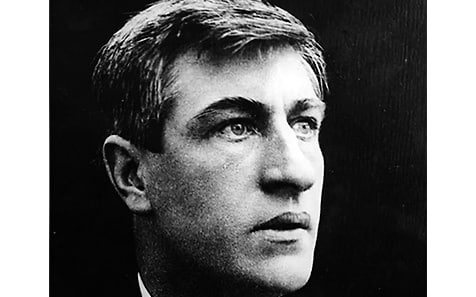
The forces of labour and capitalism would fight it out from August 1913 to April 1914. At the top of those opposing forces, were two contrasting figures: union leader James Larkin and businessman William Martin Murphy.
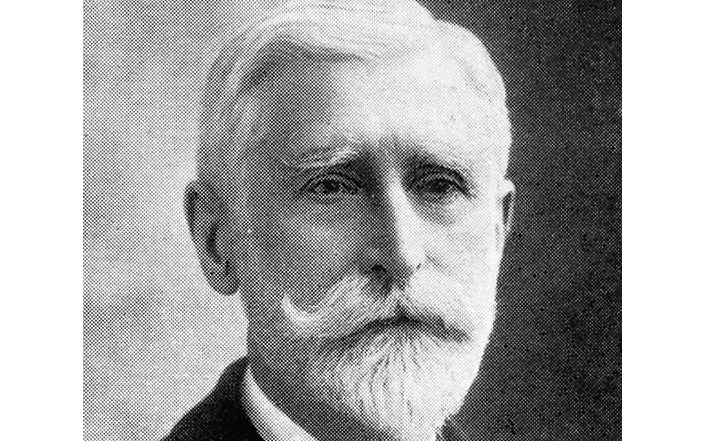
Larkin was born to Irish parent in the slums of Liverpool. William Martin Murphy was born near Castletownbere, his father a successful building contractor. According to the dictionary of Irish biography, Larkin received a ‘poverty-stricken’ education. But his values of socialism would be forged in the furnaces of child labour from the age of eleven. Murphy’s upwardly middle class trajectory began in Bantry national school and the elite academic Belvedere College in Dublin (alma mater of James Joyce, Cathal Brugha and Joseph Plunkett). Larkin’s charismatic and mesmeric speaking style, coupled with tremendous organisational skills, would see him rise within the ranks of the British Trade Union Congress (TUC), taking him from Liverpool, to Belfast and on to Dublin. Murphy’s ambition and capabilities, would ensure he would become a Home Rule MP under Parnell, as well as an entrepreneur of great success. This impressive CV included owning a range of newspaper outlets such as the Evening Herald, The Irish Catholic, and the Irish Independent, Clery’s department store and the building of vital infrastructure such as Dublin’s tramlines, which he also operated as the Dublin United Tram Company. Larkin was a nuisance, moved on by the TUC for starting so many strikes. King Edward wanted to knight Murphy in 1907 for his entrepreneurship. Larkin’s ITGWU would be defeated in the Lockout, and would leave for the US in 1914. Murphy the victor, would die at home in 1919, leaving a fortune of fifteen million in today’s money. Larkin, a co-founder of the Labour Party with Connolly, briefly enjoyed a stint as a TD, but mainly served on Dublin City Council championing the causes of housing and health.
Looming large in the city centre of Dublin, is an imposing statue of Jim Larkin, hands aloft, in preaching mode. It stands tall and proud on O’Connell Street, holding court with some of the most revered of our nation; Parnell and O’Connell. The three statues stand out like planets, within the sphere of GPO, the birthplace of the Irish Republic. Outside of Glasnevin cemetery, there is no greater a tribute to Irish heroes than to be on this street. William Martin Murphy has no statue in Dublin. Nor in West Cork, outside of a modest plaque erected at his home in Derrymihan. He was a captain of industry and Home Rule Party nationalist. He was an example of a successful catholic businessman who employed hundreds, in a time where sectarianism would often thwart one’s potential. And he is, perhaps unfairly, largely remembered for being the pantomime villain of Irish history. Yet Larkin, who at one stage had been imprisoned for misappropriation of union funds, and deemed a nuisance within the British TUC hierarchy, is memorialised as the stage hero. How did this happen?
Larkin’s goal was simple. Like Marx and Engels, he believed that workers, particularly unskilled ones, were being exploited by the Murphys of this world. He advocated syndicalism; to overthrow the capitalist system with worker control. The average income of an unskilled worker was £45 a week. A skilled worker could earn double that – by no means good money. Murphy’s income per annum, was £20,000. Could it have been possible to celebrate Larkin and Murphy as examples of Irishmen who in their field were exemplary? Perhaps if they had spanned different times. Murphy rose from modest means to be a captain of industry, in a world dominated by the protestant unionist class. Larkin a slum child, would rise to carry the hopes of the workers on his broad shoulders. Murphy, by the standards of the time, paid his Dublin tram workers a decent wage. He also allowed his employees to be union members – just not ITGWU ones, formed by Larkin. Most of those workers did not have a vote because they were too poor to meet the property valuation that would have qualified them. So the ordinary men and women were toothless politically. But in a union they had a voice.
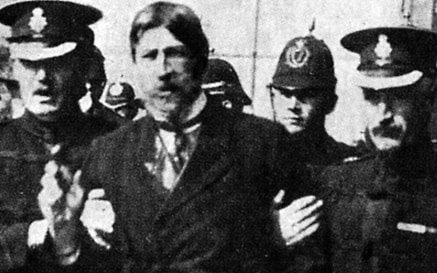
September 1913, shows the arrest of
Larkin (disguised) on Bloody Sunday.
Hypocrisy is a damning charge and Murphy must face that with historical introspection. Here was a man who, as a Home Rule MP, fought for fair rent for rural labourers, yet was blinded to the fair wage that urban workers sought. After a meeting with the Dublin Employers Federation (DEF) in July 1913, he fired six workers who had ITGWU membership. Within a month he had fired almost 300. He replaced those workers with ‘scabs’, which was always going to leave a very bad legacy amongst Dubliners for years to come. When Larkin proposed a tram strike on the day of the Dublin races, Murphy used his influence to draft in the RIC and DMP. It was akin to the influence of English landlords over the RIC at evictions during the dark days of the famine and, in more recent memory, against the Land League boycotters, who faced down the landed elite. Before there was ever a bloody Sunday in Croke Park in 1920 or Derry in 1972, there was one in Dublin on August 31, 1913. The DMP and RIC attacked strikers, injuring hundreds and killing two – in support of Murphy and the DEF. His promise to outspend the strikes smacked of arrogance and pride, particularly when juxtaposed with the many families who suffered terribly, some until April, when the last of the strikes petered out. The imbalances in society were never so stark. The DEF represented 300 wealthy businessmen. The strikers in their tens of thousands, men and women, came from all quarters. Larkin used the sympathetic strike, which encompassed not only ITGWU members and tram workers, but the Irish Women’s Workers Union, builders, railwaymen, sailors, firemen, paperboys, drivers that carried Murphy’s newspapers and all the families that went with it. But the employers locked out those workers and replaced them with ‘blacklegs’ and ‘scabs’. £100,000 was sent from sympathetic union members in the UK, barely able to afford their own way. Support grew – the Lord Mayor, Lorcan Sherlock, raised money for the impoverished families. So did the Catholic church and SVP. Countess Markievicz set up a soup kitchen. The GAA raised funds through matches and 60,000 boxes of food arrived in Dublin, put together by English families. In contrast, Murphy shipped in labourers from England, fitting out the ships, so they could live rent free, while his original employees dwelled in the worst slums in Europe. It all added to a perception of a bubble of insular rich men, unable, unwilling or unsympathetic to the depth of depravity in urban Dublin. Yes, indeed, hypocrisy has a long memory and, in the changing tide in Ireland, a generation that wanted to break from the old, would sink Murphy’s reputation. His newspapers used personal attacks on Larkin and did not report fairly. He further diminished his reputation after the 1916 Rising, when the Irish Independent, ran with an editorial calling for the leaders of the Rising (including socialist and union leader Connolly) to be executed – because of the damage to property. Times were changing. Men and women who had no vote or stake in society, within a decade would have both, and men like Murphy would only be remembered for the Lockout. Larkin, far from perfect, represented those who had neither a vote, equality or property – and it was never forgotten. Murphy’s inglorious words to, “spend 100,000 or more to put down the terrorism”, contrast sharply to the virtuous, majestic words that are emblazoned across the statue of Larkin: “The great appear great because we are on our knee. Let us rise.”