


“God in his wisdom made the fly, but then forgot to tell us why.” So wrote American poet Ogden Nash, and few people, enraged by a buzzing bluebottle, would not agree. But like everything in the animal kingdom, flies have their reasons and their charms. Many flies annoy us, some spread diseases, but others are important ecologically and commercially, and a few are quite beautiful.
Many insects are called flies that aren’t, for example butterflies, mayflies and dragonflies. True flies belong to the order Diptera, which means “two wing”; this distinguishes them from most flying insects which have four wings. What were once the second pair of wings have, in true flies, become modified into minute gyroscopes called halteres. These send information to the flies’ brains about orientation, contributing to their brilliant maneuverability, and making them so difficult to catch.
There are about 150,000 species of flies. Their classification is very complicated, but basically, there are two groups. The nematocerans, such as craneflies, gnats and mosquitoes, have long, thin bodies and rather feathery, many segmented antennae; the brachycerans, including the house flies, hoverflies and fruit flies, are generally stouter and have smaller antennae with fewer segments.
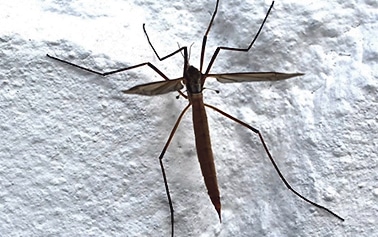
Craneflies are often called “daddy long legs”, a silly and confusing name because it is also shared by both cellar spiders and harvestmen, which are arachnids, not insects. Apart from blundering around lights at night if they get indoors, adult craneflies don’t bother us, but their larvae, commonly called leatherjackets, are garden pests.
Other members of the group are called gnats or midges. There are thousands of species of them, in many families; over 1,000 are found in Ireland alone. The non-biting midges, of the family Chironomidae, are all harmless, though annoying in large numbers. They are notoriously difficult to identify. One of the world’s foremost chironomid experts worked at Trinity when I was there; Dr. Paddy Ashe had a genus of midge named after him. Tragically, he died during the Covid pandemic.
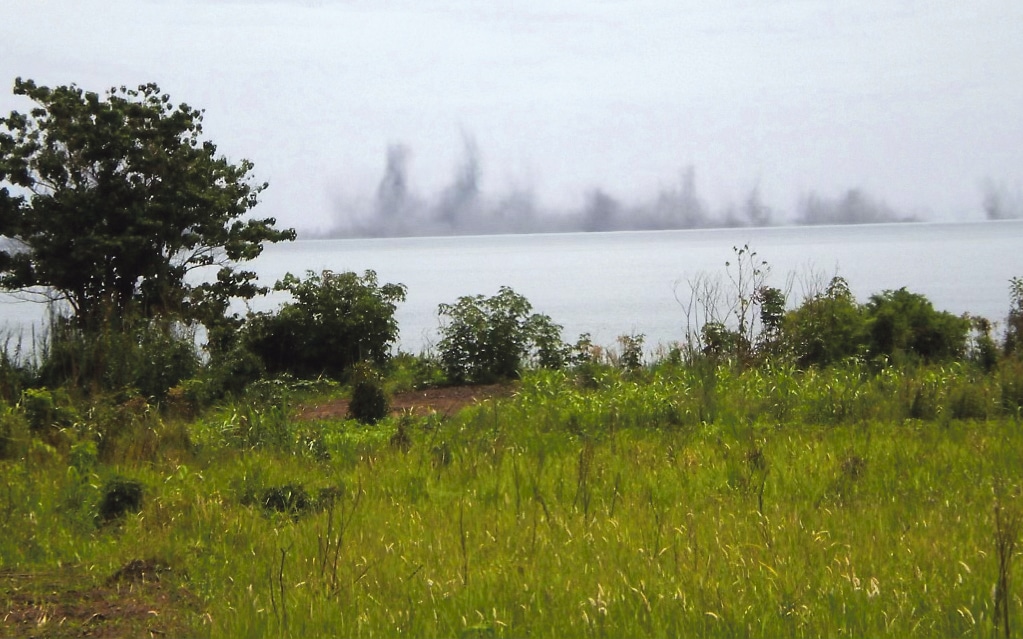
Midges in the family Chaoboridae are known as lake flies. In Malawi, the annual appearance of the lake fly, Chaoborus edulis, is one of the great natural phenomena of Africa. Their larvae spend a year deep down in the lake, far from predators. When the rains come, they pupate, rise to the surface and hatch into adults which take to the sky in unimaginable quadrillions. Gigantic swarms, vast dipteran orgies, travel down the lake in tall, smoking spires, or are transformed into what look like islands, or ships, or monsters. Once mating is completed, they fall to the water and provide a feast for the lake’s fish, and if they are blown ashore, for humans too. The women of the lakeside villages rush out with baskets and catch them. They are then squashed into burger shapes and fried. I tried them a couple of times; they were salty, slightly fishy, and gritty from all the legs and wings, but not unpleasant.
The biting midges, Ceratopogonidae, are the infuriating little flies that bite us, but some species are the principal pollinators of cocoa trees; without them, there would be no chocolate. Unfortunately, several other species are vectors for nasty diseases such as blue tongue, which affects sheep and cattle. Related too are the black flies, of the family Simulidae, which are responsible for transmitting the nematode worm that causes African river blindness.
Then there is the family Culicidae, the mosquitoes. The females of all species are blood suckers, and so have the potential to spread disease. Two genera of mosquitoes in particular carry dangerous pathogens. The Aedes mosquitoes, recognisable by their zebra-striped legs, can transmit Dengue fever, yellow fever and Zika virus; Anopheles carry Plasmodium, which causes malaria. Up to a million people die of malaria every year, mostly in Sub-Saharan Africa. If you live for any length of time in the tropics, you will probably get malaria, or know someone who has. I got it twice.
If untreated, the worst form of malaria, cerebral, is very often fatal; the history teacher in my old school in Zambia died of it. The usual symptoms are headaches, fevers and chills, and often diarrhoea and vomiting. Sometimes it produces hallucinations: Henry Morton Stanley saw hideous and terrible reptiles, which constantly changed shape; fellow explorer Richard Burton became so delirious he thought he could fly. All I got was Scottish dance music.
I was staying in a mud hut in the Kakamega rain forest in western Kenya. Head throbbing, shivering and barely conscious, I imagined I could hear music coming from the forest. I thought I must have cerebral malaria, and was afraid I’d never reach a hospital in time. But actually, the music was real: a group of Scottish school children arrived by truck that day and decided to have a ‘cèilidh’ in the middle of the forest. I eventually found a doctor, was given a course of artemisinin, and recovered after a week.
The brachycerans are generally not so dangerous. There are nearly 2,000 species found in Ireland, including dung flies, flesh flies, cluster flies and blow flies. House flies are very bothersome, and bluebottles even more so. The Latin name of one of the common bluebottles is Calliphora vomitoria, which sounds appropriate. Bluebottle adults feed on nectar, or anything juicy in your house. But the larvae, or maggots, eat carrion, including human remains. As their life-cycles are well studied, forensic scientists can use fly maggots found in dead bodies to accurately calculate time of death.
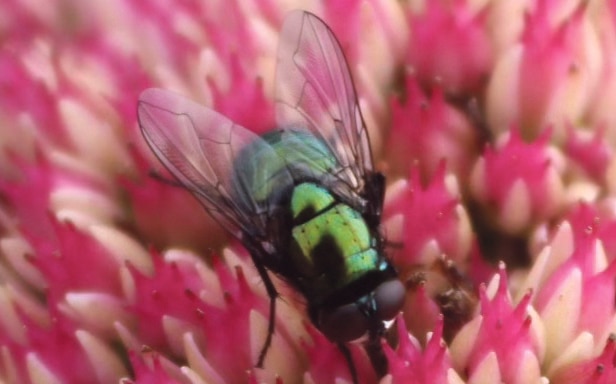
The closely-related greenbottles are very attractive, metallic green flies. They are especially plentiful at the moment in our garden, sipping nectar from the Sedum plant outside my door. They too are used in forensic medicine. Unfortunately, they are also responsible for blowfly strike – they often lay their eggs in the wool of sheep and when the maggots hatch out, they eat into the poor sheep’s skin.
One of the largest and fiercest of the dipterans in this country is the horsefly. Males feed on nectar, but females, who need extra protein for making eggs, have stabbing mouthparts capable of giving mammals, like us, a painful bite.
In Africa, two of the most notorious insects are the tumbu fly and the tsetse fly. The former lays its eggs on the ground, or on damp clothing left on a washing line or bush. If you then put on that garment without ironing it, the eggs will hatch out, and the larvae burrow into your skin, where they grow. After a couple of weeks, they dig their way out and fall to the ground, pupate and eventually develop into adults.
The tsetse fly is worse, because it carries Trypanosoma, the protist responsible for sleeping sickness in humans; untreated, it is nearly always fatal. The same organism causes similar diseases in domestic livestock and wild animals, from ostriches to giraffes.
Fruit flies are both troublesome and useful. They buzz around fermenting fruit or anywhere beer or wine is left uncovered, and as they carry acetic acid bacteria, they will turn good drink into vinegar. However, one species, Drosophila melanogaster, is the most studied and important tool in the field of genetics. American biologist Thomas Hunt Morgan used this fly to prove that genes are carried on the chromosomes, which won him the 1933 Nobel Prize for Physiology and Medicine.
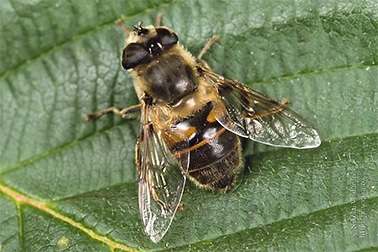
The nicest dipterans are the hoverflies, in the family Syrphidae. They mimic wasps and bees, fooling predators into leaving them alone in case they get stung; e.g. the drone fly, Eristalis tenax, looks like a bee, while others such as Episyrphus balteatus resemble wasps. Unfortunately, because most people can’t tell a syrphid from a wasp, many get killed anyway, not by birds but by ignorant humans. This is a shame because not only are hoverflies harmless, they are important pollinators. Also, the larvae of some species eat aphids and other plant-sucking insects, so they are a gardener’s friend.
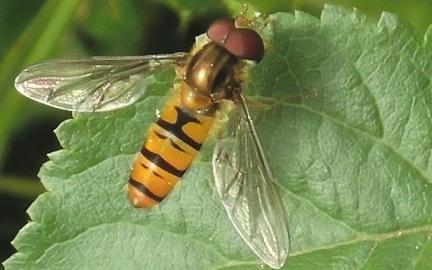
Some flies may be maddening or even dangerous to us, but they are a major source of food for a great many other animals, from spiders to birds. Without all the thousands of small flies that buzz around our fields in the summer, birds such as swallows and martins, having flown all the way from Africa, would have little to eat, which is why spraying of pesticides, replacement of gorse and heather in favour of grazing land, and the never-ending mowing, strimming and hedge mutilation is so detrimental to wildlife.
Next time you meet a fly, watch it rubbing its legs together, look at it with a magnifying glass and admire its massive compound eyes and the delicate beauty of its wings. Then let it out of the window; it might feed a hungry wagtail or wren. And please learn to tell a hoverfly from a wasp.