

‘Ní hé lé na báistí’ (the day of the rain is not the day of the children). Anyone who has ever tried to entertain young children when it is too wet to go outside – especially on holidays – will appreciate the accuracy of this proverb. There is hardly anything like relentless Irish rain to achieve the twin feats of dampening people’s spirits and increasing their irritability.
Talking about the weather is a constant theme when Irish people meet. In a metaphorical sense, people speak of ‘being under the weather’ when they feel unwell or of ‘making heavy weather’ of a task when it proves to be unexpectedly difficult. The misery of working in inclement weather has long been recognised in Irish folk wisdom. For example, an old saying warns us of ‘the four worst things – ploughing in frost, harrowing in rain, making a ditch in summer and building a wall in winter’.
Nevertheless. climatic adversity has inspired many Irish writers. The damp tapestry of Frank McCourt’s early life is evoked in his book, ‘Angela’s Ashes’, in a vivid account of how ‘great sheets of rain gathered to drift slowly up the river Shannon and settle forever in Limerick’, thereby creating ‘a cacophony of hacking coughs, bronchial rattles, asthmatic wheezes, consumptive croaks’.
It is notable that certain Irish weather phrases are very poetic and rich in imagery. For example, a cold morning has been described as one which causes people ’to kiss their kneecaps’ (ag pógadh na gcopán) or to curl up in bed with their knees underneath their chins. We are preoccupied with the subject because Irish weather is quite capricious and unpredictable. Supporting this view, an Irish phrase describes the many different weather conditions the one can encounter on any given day. ‘Lá na seacht síon – gaoth mhór, báisteach, sioc agus sneachta, tintreach, tóirneach agus lonrú gréine (On the day of seven weathers, there is high wind, rain, frost and snow, thunder, lightening and sunshine).
Some people are never happy with the weather even when it is pleasant. Consider the old Irish saying ‘Dá mbeach soineann go Samhain, bheadh breall ar dhuine éigín (If fine weather lasted until November, somebody would be complaining).
In the interests of economical survival, people, especially fishermen, sailors, farmers and shepherds have tried to anticipate impending weather conditions through careful observation of a variety of natural phenomena. Long before the advent of scientific weather forecasting, changes in the appearance of the sun, moon, stars, clouds and waves were studied to forecast weather. These observations were passed down from generation to generation, often termed in rhymes and easily remembered sayings. A common weather saying ‘Red sky at night, shepherd’s delight, red sky in the morning, shepherd’s warning’ dates back to biblical times.
The significance of red skies is echoed in several Irish phrases: ‘Dearg anuas, fearthainn is fuacht,’ / ‘Dearg anoir, fearthainn is sic,’ / Dearg aníos, fearthainn is gaoth,’ / Dearg aniar, soineann is grian.’
(‘Red high up, rain and cold,’ / ‘Red in the east, rain and frost,’ Red low down, rain and wind,’ / Red in the west, fine weather and sunshine.’)
The sun and the moon were significant omens for the ancient Irish. In the pre-Christian era, the sun was portrayed as a god of the heavens, which lay down in the evening. Perceived in this way, the sun’s long rays were interpreted as its legs. Certain weather signs could be detected from the position of these ‘legs’. For example, we hear ‘Togha na haimsire chughainn – cosa na gréine suas ar maiden ages síos tráthnóna (the best of weather is coming – the sun’s legs are up in the morning and down in the evening).
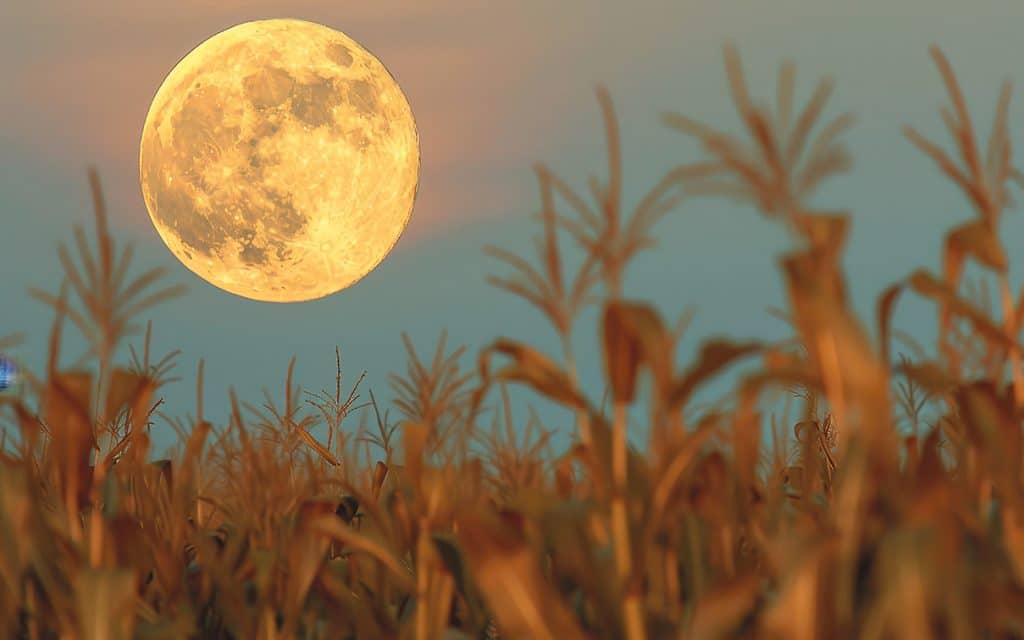
The appearance of the moon was a good indicator of the weather. For example, bad weather was likely if the moon appeared to be lying on its back. The harvest moon in September (nearest to the Autumn equinox) is the brightest of the year. ‘Gealach na gcoinleach is gile sa bhliain (the moon of the stubble field is the brightest of the year). A similar phenomenon occurs around mid-October and is known as the hunter’s moon.
Other weather signs that feature in Irish folk sayings come from the wind, mist, the sea – the appearance of the sea and the sound it makes. The following saying distinguishes the different types of wind: ‘Trí bríos gala,’ trí gála feothan,’ trí feothan stoirm,’ ‘trí stoirm airic.’ (‘Three breezes make a gale,’ ‘three gales make a winnowing wind,’ three winnowing winds make a storm,’ three storms make a hurricane.’) These winds were sometimes described in graphic terms. For example a harsh east wind was regarded as one that would ‘skin a dogfish’ – ‘Gaoth a bhainfeadh an craicreann difhíogach’.
Strong winds were often attributed to the movement of the sí or fairies. A whirlwind in summer was called a ‘sí gaoithe’ (a fairy wind), which was also known as ‘deamhain aeir’ (demons of the air). Another cause of the windows a mythical being called ‘Beartlaí na Gaoithe’.