


In May this year, I had a really enjoyable time attending the British Association for Counselling and Psychotherapy’s (BACP) 32nd Annual BACP International Research Conference, which was titled ‘Collaboration for a just society – Multidisciplinary research in counselling and mental health’. The conference took place in London and ran across a few days. I was also very grateful to have had the opportunity to present my published research at the conference. To stand on stage and present my work to an audience of peers was very invigorating but also somewhat nerve-wracking, naturally enough. I was presenting my research along with some people who I have been inspired by over the years, so in many ways it felt like I was standing on the shoulders of giants.
The presentation itself was recorded, which I recently had time to watch. I watched it from a position of reflexivity, with the intention of seeing myself through as much of an objective lens as possible. I always find it somewhat unsettling to watch myself but also very helpful. In this case I used a simple and effective framework called The Johari Window to take notes, which provided me the ability to bring different aspects of my experience into my awareness, including things I had not been aware of previously.
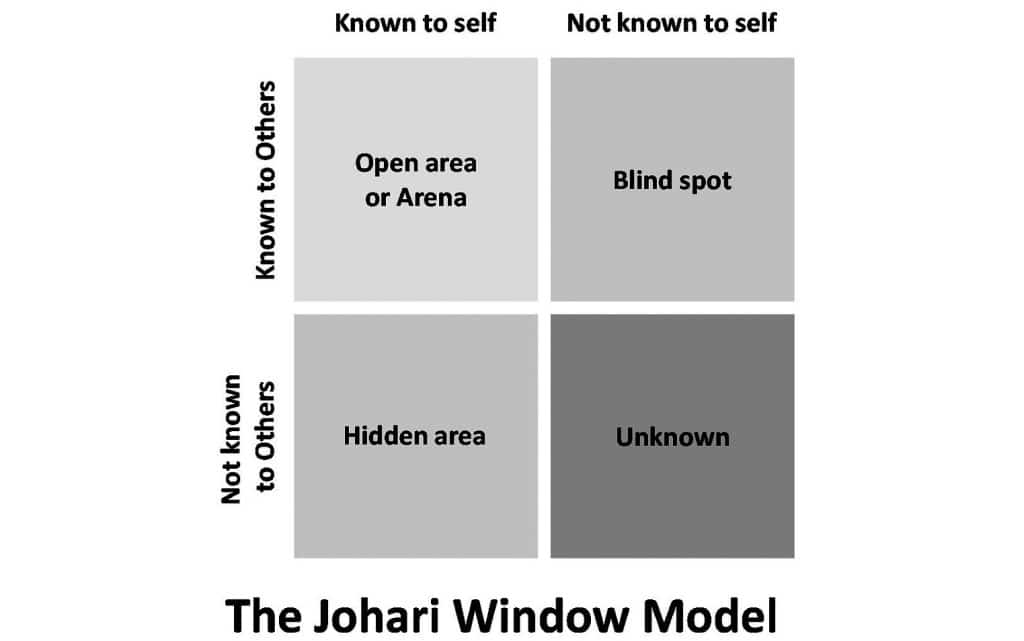
The Johari Window is one of many models for understanding ourselves in relation to our self, others and the world around us. Developed by psychologists Joseph Luft and Harrington Ingham in 1955, it offers a framework for exploring self-awareness, communication and interpersonal relationships. The principles of its use are very relevant to psychotherapy because they invite curiosity about what is known, hidden, misunderstood and yet to be discovered within our experience. As Luft wrote in his book ‘Of Human Interaction’ in 1969, “There are things known to us and known to others, things unknown to us but known to others, things known to us but not to others, and things unknown both to us and to others.” This simple idea reflects the complexity of being human.
The model consists of four quadrants within an overall square. The ‘Open Area’ represents aspects of ourselves that are known both to us and to others. The ‘Hidden Area’ contains experiences, thoughts and feelings that we know but choose not to disclose. The ‘Blind Area’ consists of qualities that others perceive but that remain outside of our own awareness. Finally, the ‘Unknown Area’ represents untapped potential and unconscious processes or experiences that neither we nor others have yet to recognise. Rather than viewing these quadrants as fixed categories, the Johari Window encourages us to see them as fluid. This is very reflective of how we grow and develop over time.
Our understanding of ourselves is shaped through interaction with other people, and equally, our relationships are influenced by what we reveal, conceal, ignore and discover. This idea echoes Carl Rogers’ – an American Psychologist and one of the founders of Humanistic Psychology, assertion, in his 1954 book titled ‘On Becoming A Person’ – that “The curious paradox is that when I accept myself just as I am, then I can change.” Acceptance more often than not creates the conditions for greater openness, both intra-personally, in relation to one’s self, and interpersonally, in relation to others. Within the Johari Window, this can be understood as gradually enlarging the ‘Open Area’ through honest self-reflection and authenticity.
The ‘Open Area’ is perhaps the space most associated with psychological wellbeing. When people are able to express thoughts, emotions and needs authentically, relationships tend to become characterised by greater transparency and mutual understanding. This does not imply indiscriminate self-disclosure. More-so, it suggests developing the confidence to communicate in ways that feel safe and appropriate. When I was watching the recording of myself, I noticed a striving for authenticity throughout, as I shared my thoughts and emotions and my behaviour aligned with that. It led to a feeling of ease in the moment and this reinforces to me to continue striving for authenticity at all times, even in the nerve-wracking presentation moments! In therapy, the relationship itself often becomes a place where this process can unfold or even be experienced for the first time. A person attending therapy can begin to feel psychologically safe, frequently disclose experiences that have remained hidden for years and, as a result, allow those experiences to be witnessed, understood and integrated.
The Hidden Area refers to the fact that everyone carries parts of themselves that remain private. When I was rewatching my presentation, I noticed that I appeared quite calm, I even received feedback from some people in the audience afterwards that I came across very well. Yet, that didn’t quite match what was happening privately for me at certain moments. I experienced moments of stress and even anxiousness during the presentation and, using this framework, I can see now that was hidden. It was hidden, as it was not relevant to what was happening, but it may have been useful for me to recognise those things in the moment, even privately, as they would have not felt so intense if I did.
Sometimes what we keep in the ‘Hidden Area’ are simply personal preferences or memories, while at other times they reflect shame, fear or experiences of trauma. Many people arrive in therapy having spent years protecting these hidden aspects of themselves, often because disclosure once carried significant emotional or relational risk. These protective strategies are understandable attempts to remain safe. Therapy, therefore, does not seek to eliminate the ‘Hidden Area’, the endeavour can be more about creating sufficient safety for clients to decide whether keeping something hidden continues to serve them.
The ‘Blind Area’ highlights another important dimension of therapeutic work. While watching myself talk and joke on the stage, I realised that I do not see myself clearly at all. I watched myself moving about the stage and translating my research into easy-to-understand concepts linked to what therapists experience in their practices every day. In more simple terms, I don’t give myself enough grace and recognise my strengths…which are hard to ignore when they are on a recording! This was a blind spot, in the ‘Blind Area’, for me, which was useful to see and recognise for myself and my own development and growth. Whereas, when people say these things to me as feedback, I usually don’t fully believe them or give the feedback much weight.
Objective non-judgemental feedback, for lack of a better word, can be an essential mechanism for growth. Within therapy, such feedback is offered with empathy, congruence and unconditional positive regard, reducing the likelihood that it will be experienced as criticism. What emerges between therapist and client may illuminate relational patterns that exist outside the therapy room that can be curiously and gently addressed offering clients the opportunity to reflect upon themselves.
The ‘Unknown Area’ captures the greatest sense of hope within the Johari Window. It acknowledges that every person possesses capacities and possibilities that have yet to emerge. In many cases, for clients coming to therapy, those capabilities may have been buried deeply under life experiences and a bit of excavating can reveal them. When I watched the recording of the conference, I noticed that for the first couple of minutes I was staring at my slides while speaking but I then naturally moved into looking at the audience. I wasn’t aware of this but now I have had time to reflect, I see how that was part of me moving from feeling safe into becoming comfortable in that experience. Useful information for myself moving forward that I would not have known otherwise, and nobody else has ever commented on to date, which will serve me in future. The beauty of The Johari Window, and therapy, is having a chance to look at oneself without judgement and potentially grow into the fullest version of one’s self as result, and what a gift that truly is.