

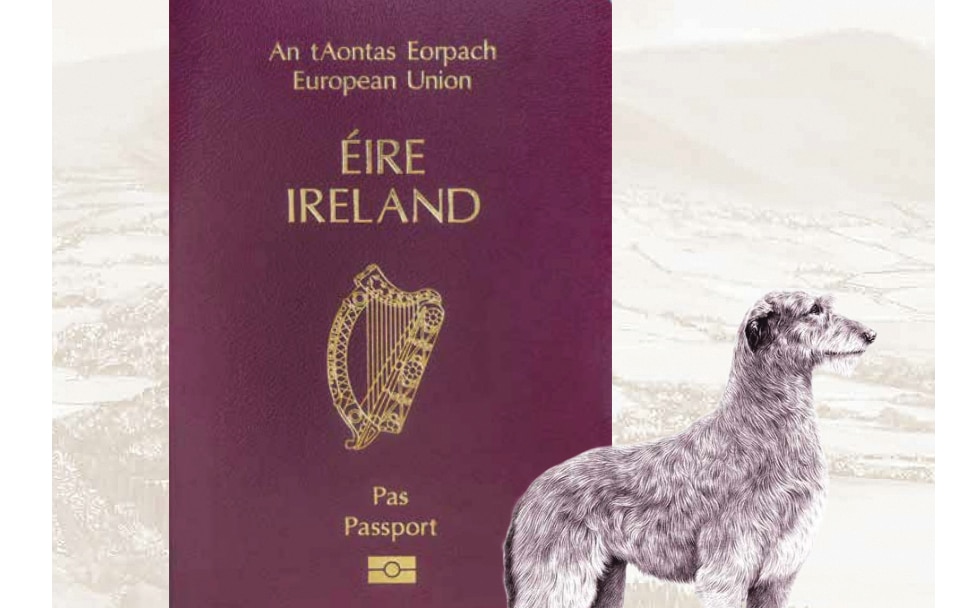
The dog has always been seen as the loyal and faithful companion of man, guarding his home and livestock and following his master wherever he went. The dog was valued for his skill in helping with the hunt; its saliva was believed to have healing properties. This meant that it was regarded in Celtic legends as the guardian animal of gods and heroes and linked with stories of hunting and with healing shrines.
A general belief about dogs in Britain and Ireland was that they were able to see ghosts and could, at times, become ghosts after their death. In Ireland dogs were believed to howl rather than bark in the presence of fairies and spirits. The baying hound or ‘gaidhrín caointeach’ sometimes took the place of the banshee, and was heard before a death in certain families, such as the O’Keeffe’s of West Cork. Even for an ordinary dog to howl near a sickroom was a very bad sign, as it meant that the patient had little hope of recovering. In parts of County Cork it was believed that when a person was dying, a morsel of bread should be thrown out, to entice away the death hounds that would be watching his soul.
Tales of ghostly black dogs were common in Irish folklore, usually large and vicious animals seen by those who were out late at night. In the folklore of Heir Island, off the West Cork coast, there are stories about such an animal known as the ‘Dog of the Stray’. He was seen; it is claimed, on the road that leads to the Reen on the island.
In Co. Clare a spectral dog, the spirit of a well-known local called ‘Robin of Ross’ was said to haunt the road between Carrignabolt and Ross. It was a good omen if it ran alongside the carriage, but a bad omen if it leaped at the carriage. On one occasion the dog leaped at the mail coach; the driver was thrown off and killed at the spot.
A well-known folk tale about a demon dog explains why one should never say, ‘God Bless it’, about a dog. According to the story, a priest was making his way to the home of the dying man, when he hear a sweet voice singing the old tune, ‘Cailín Deas Crúite na mBó’ (The lovely milkmaid). The priest was curious, as it was the most beautiful rendition of the song he had ever heard, and he lingered to listen. A lover of music, he wanted to find out who had such a lovely singing voice, so he climbed into the adjoining field. To his horror he saw that the voice came from a demon dog. Suddenly remembering his urgent mission, he hurried off to the man’s house to give the last rites. Sadly, when he reached the house the man was already dead, as the priest had delayed much longer than he realised. Full of remorse, the priest declared that no-one should ever say ‘God bless it’ of a dog again.
In Co. Clare it was believed that to dream of a dog foretold a meeting with a friend that you had not met for a long time. An Irish cure for chapped skin, bunions or burns was to get the dog to lick the affected part. In Scotland it was thought to be bad luck to drive a dog from the door on New Year’s Eve, as it would carry the luck of the year with it.
Dogs feature in many Irish ‘seanfhocail’ (proverbs). Examples include ‘Tabhair drochainm ar mhadra’ (Give a dog a bad name) i.e. when a person gets a bad reputation it is hard to shake it off. ‘Tarraing do lámh go mall raid as béal an mhadra’ (Take your hand slowly out of the mouth of the dog) ie ease your way out of a dangerous situation. Do not act rashly. ‘Is dána gach madra i ndoras a thí féin (Every dog is brave in the doorway of its own house).
In Irish mythology, the leader of the Fianna, Fionn Mac Chumail, had many hounds, but his favourite was Bran. In a book called ‘The Lays of Fionn’, there is a poem which tells the story of Bran. Bran’s mother was Queen ‘Uime Aithbhéil’, who was turned into the shape of a dog by an enchantress. In that shape she gave birth to both Bran and Sceolaing, another famous hound of the Fianna. The poem praises Bran’s virtues and bravery and describes his exploits. The poem has a sad ending as it goes on to tell of Bran’s death. This occurred when Fionn struck Bran to urge him on in the hunt, and the metal chain of Bran’s leash hit him painfully on the head. So hurt was Bran by this injustice that tears streamed down his face. He then broke free from Fionn’s hold and raced to a nearby mountain lake and plunged into it to drown. The poem ends with Fionn’s anguish and remorse over his careless cruelty.