

The illegal wildlife trade is the second biggest international crime after drug smuggling, but one hears about it less often. Personally, I think that wildlife smugglers should be punished far more harshly than drug dealers – after all, if someone wants to inject himself with heroin or addle his brain with cannabis, that is his own business, and there is an infinite quantity of such drugs available, but the smuggled animal has done nothing to deserve its horrid fate, and one day its kind will probably be extinct.
Hundreds of animal species are traded illegally, many for spurious Chinese medicine, some for meat, others to become exotic pets for wealthy fools who know little about them. While most people are aware of the slaughter of elephants, rhinos and pangolins for their body parts, it might be surprising to learn that there is also a thriving illegal trade in insects, e.g. rhinoceros beetles into Japan, praying mantises into the USA, butterflies out of Sri Lanka.
Recently, criminals have been caught trying to smuggle thousands of ants out of Kenya. The particular species were harvester ants, which are popular with collectors because the queens are so big – up to 25 mm in length. On the black market, a single queen ant can make €200. One smuggler, a Chinese national, was caught with 2,000 queens, each caged in a little plastic tube. The same man was apparently behind a similar smuggling operation a year ago, when three foreigners and a Kenyan were caught with 5,540 queen ants; they were each fined just $7,700.
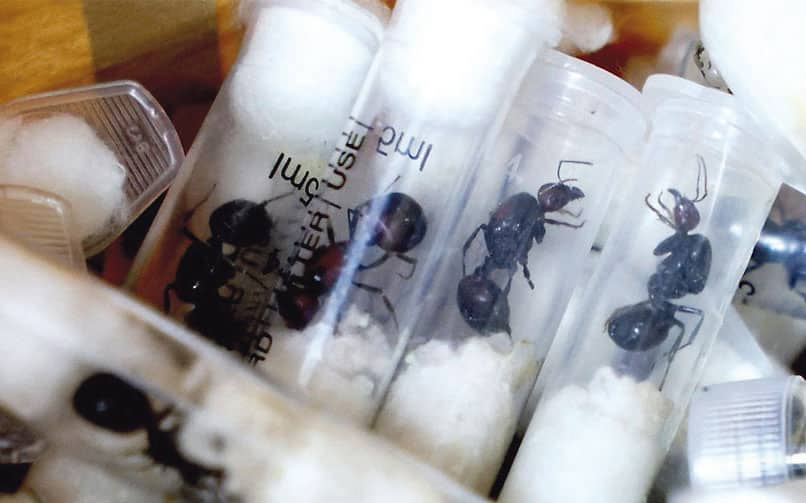
Harvester ants are seed-eaters, and while they carry seeds back to their nest, they invariably drop some, thus helping dispersal. There are many millions of ants in one nest, but only one queen, without whom the colony cannot function, so the collection of queens on such an industrial scale could seriously endanger their survival, as well as upset the local ecology.
Ants belong to the order Hymenoptera, which also includes sawflies, bees and wasps. Ants have been found preserved in amber dating back to the Cretaceous period, when the dinosaurs were still ruling the planet. They are social insects – there are no solitary ant species – and like social bees, they have different castes: queens, males and sterile workers. There are sub-divisions of workers too, such as nurse maids, foragers and soldiers. Ants resemble termites in some ways, and termites are often called ‘white ants’, but they are not at all related. Worldwide, there are over 13,000 described ant species, and no doubt many thousands more; 20 species live in Ireland. Being so small, ants are frequently overlooked, and are often considered pests; they certainly can be in the tropics – leave any food uncovered, and you will soon have battalions of ants marching away with it. But ants are not only important ecologically, they are also fascinating little creatures.
The Sahara silver ant is the second fastest insect, after the Australian tiger beetle. It has been recorded at 3.1 kph which, relative to body size, corresponds to a human running at 720 kph. The reason for the ant’s swiftness is its habitat – it lives in the Sahara Desert, and has to find food quickly before the mid-day sun becomes too hot – 53 degrees kills them. To minimise the effects of heat on their feet, they use only four legs for running, the first pair being raised like arms.
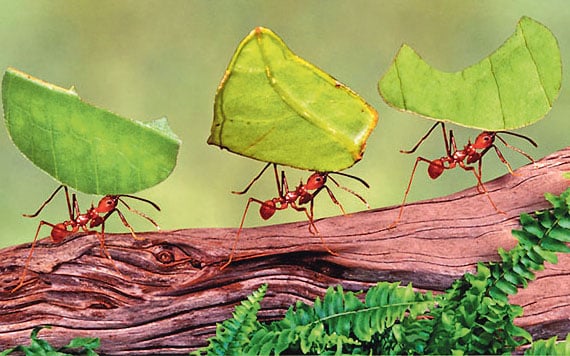
Leaf-cutter ants live in Central and South America. They spend their lives cutting pieces of leaves and carrying them, like large green sails, back to their nests. Each ant can carry a piece of leaf 50 times its own body weight. The leaves are used to nourish a fungus, which is then fed to the ant larvae; different species of leaf-cutter ants use different species of fungus. The adult ants feed on leaf sap.
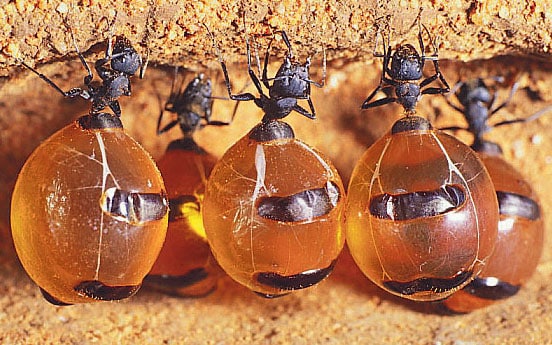
Many insects store nectar and other sugary liquids in special compartments within their nests – honey bees of course make honeycombs. But honeypot ants use their own bodies to store food. Special types of workers, called repletes, are fed by other workers until their bodies become so swollen with honey that they can no longer move, and they form a sort of living wine cellar. When other ants are thirsty, they tickle the repletes with their antennae until honey is regurgitated. There are many species of honeypot ants in the tropics; Australian Aborigines eat them.
Ants defend themselves in three ways: they can bite, sting or spray formic acid (the name of the ant family is Formicidae). The stings of some species can be painful or even fatal to humans. The bullet ant of tropical America is said to have the most painful sting of any animal. The jack jumper ant from Australia can be fatal to those allergic to ant stings.
Most invasive animals and plants cause problems. Ants, being so small and industrious, are very likely to escape from captivity and wreak havoc. One famous example is what happened on Christmas Island, a tiny Australian territory in the Indian Ocean renowned for its red crabs. These brightly coloured crustaceans live for most of the year in forests, but like all crabs, they must return to the sea to spawn. They do this in unbelievable numbers, marching across roads, getting squashed by cars, puncturing tyres and causing accidents. Once considered pests themselves, the islanders have come to appreciate these crabs; park rangers now help them across the roads, special underpasses have been built for them, and locals drive more carefully. After spawning, the crabs return to their forests, and later, the juveniles follow them from the sea.
Unfortunately, yellow crazy ants, a particularly aggressive species that forms immense super-colonies, were introduced onto Christmas Island in the early 20th century. The ants evict the crabs from their burrows, and eat them; they have killed 10-15 million crabs, perhaps a third of the population. This has changed the ecology of the island, because the plants that the crabs used to eat have now started to take over areas of forest.
I had an alarming experience with red driver ants when I lived in Zambia. I saw them occasionally on the walk to school, and then one day a sticky mass of them appeared in my little garden pond, as the ants made a living bridge to get across it. I just thought that was rather interesting – until they invaded the house.
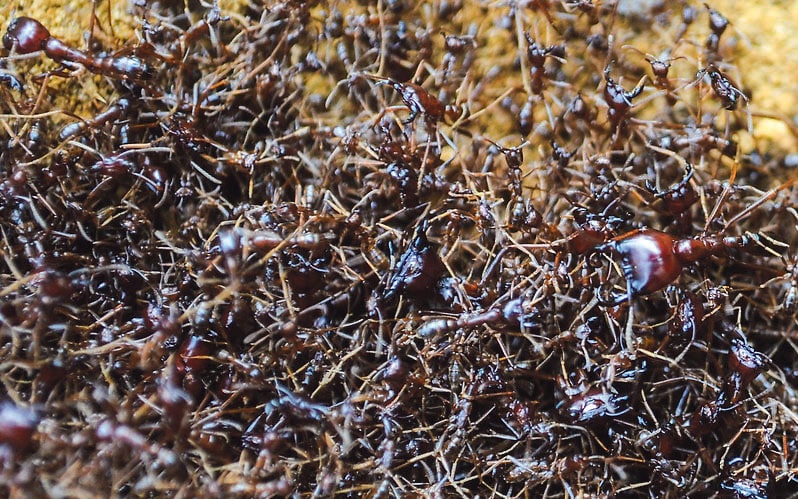
My maid screamed out: ‘Mpashi!’ [their name in Bemba]. ‘They will eat us!’ The whole veranda seemed to be alive, crawling and crackling, the outside wall covered by millions of ants. We shut the doors and windows, but soon the ants were pouring into the lounge through a hole in the wall. If I had been asleep, they would indeed have started to devour me.
I like and respect ants, but those ones had to go. We filled up buckets of hot water and washed them all into the garden where the birds had a feast.
There are about 60 species of driver ants in Africa; they are called siafu in Swahili. The ones in my garden were probably Dorylus helvolus, but I wasn’t thinking too much about positive identification at the time. They usually live in gigantic underground nests, but when food runs out, they set off in columns, up to 50 million strong. The workers are small, and march in the centre of the column, with the large and very pugnacious soldiers, who have square heads and big jaws, on either side; all are coloured a dark reddish brown. If one is careless when out walking and gets too close to a marching line of these ants, the soldiers will soon be up your legs and biting badly. The Maasai use them as sutures to heal cuts, because once their jaws clamp down, they don’t ever let go. The queens of this species are huge, up to five centimetres long; the clumsy winged males, which are attracted to lights and often crash-land in one’s evening whisky, are not much smaller, and are known as sausage flies.
Globally, most insect species are declining, because of pesticides, climate change, urbanisation, and all of you who insist on mowing your lawns every time the sun comes out. Illegal trading will only make things worse. Few people care much about insects, even though they are by far the most important animals on the planet. Many will not survive. But ants will. One day, when human overpopulation, unnecessary technology and idiotic consumerism render the Earth uninhabitable for higher animals, the ants, with their organisation and vast numbers, will still be here.