


Some English animal names don’t precisely define any one particular creature: prawn is a good example. According to my old seashore guide book, Palaemon serratus is the common prawn. In Ireland, however, fishermen call this a shrimp, and prawn to them is Nephrops norvegicus. But Nephrops, the Dublin Bay prawn, is a member of the lobster family, and not closely related to a shrimp or any of the other crustaceans called prawns; the French name, langoustine, is more accurate – it means ‘little lobster’.
In Italy, a Dublin Bay prawn is a scampo (plural scampi). Here in the 1970s, scampi tails with chips became a popular dish, but it was not cheap, so sometimes restaurants used substitutes such as monkfish. At the time, monkfish was thought too hideous and unfamiliar for our tastes, but cut into small prawn-shaped pieces and deep-fried, it could be served up, dishonestly, as scampi. No restaurateur would do that today, because their customers have learned that monkfish itself is delicious too.
But what exactly is a monkfish? The word is as ambiguous as prawn. In Alwyne Wheeler’s definitive Key to the Fishes of Northern Europe, the monkfish is Squatina squatina, an angel shark; it was the same in the Irish Specimen Fish Committee’s annual report. But in a restaurant or at the fishmonger’s, a monkfish is Lophius piscatorius, the anglerfish, something completely different.
The monastic connection goes back to 1546 when a creature called a ‘sea monk’ was captured in the Øresund, that narrow stretch of water between Sweden and Denmark. The sea monk was said to be a fish that resembled a monk dressed in his religious habit. It appeared in several serious scientific books of the time; those of Guillaume Rondelet in 1554 and Pierre Belon in 1555 both had, among relatively accurate drawings of fish and other marine animals, pictures of a beast with scaly tunic, spiky limbs and the tonsured head of a monk. It was thought by some to be either a badly-drawn giant squid, a merman or perhaps a Jenny Haniver – one of those fanciful creatures that sailors used to construct out of various dried animals. Renaissance academics were still inclined to believe in sea monsters – Rondelet’s book also has a drawing of a ‘sea bishop’, which had a vaguely human torso and head (plus bishop’s mitre) all covered in scales, but bare legs, like those of an ostrich.
Rondelet and Belon both knew the difference between the sea monk, the angel shark and the anglerfish. They called the angel shark Squatina (the name used by Linnaeus over 200 years later); Belon also named it ‘angelot de mer’, or angel of the sea – the large pectoral fins of the fish could be said to resemble angelic wings. The anglerfish, he called ‘grenouille de mer’ (sea frog) and ‘diable de mer’ (sea devil), both names applied today to certain types of anglerfish.
An angel shark does, with a little imagination, resemble a cowled monk, an anglerfish really doesn’t, so quite why and when sea monk, angel shark and anglerfish became conflated, I don’t know.
The anglerfish order, Lophiiformes, is made up of fifteen families, including the common anglerfish, the batfish, the frogfish and the truly bizarre deep-water anglerfish. There are hundreds of species. They are so named because of their method of catching prey – they all have a fishing rod, actually modified dorsal fin rays, the first of which has a fleshy knob, the lure, at its end. They are unique among bony fish in having their gill openings behind their pectoral fins instead of in front; also, they have depressible teeth, extensible stomachs, and no scales.
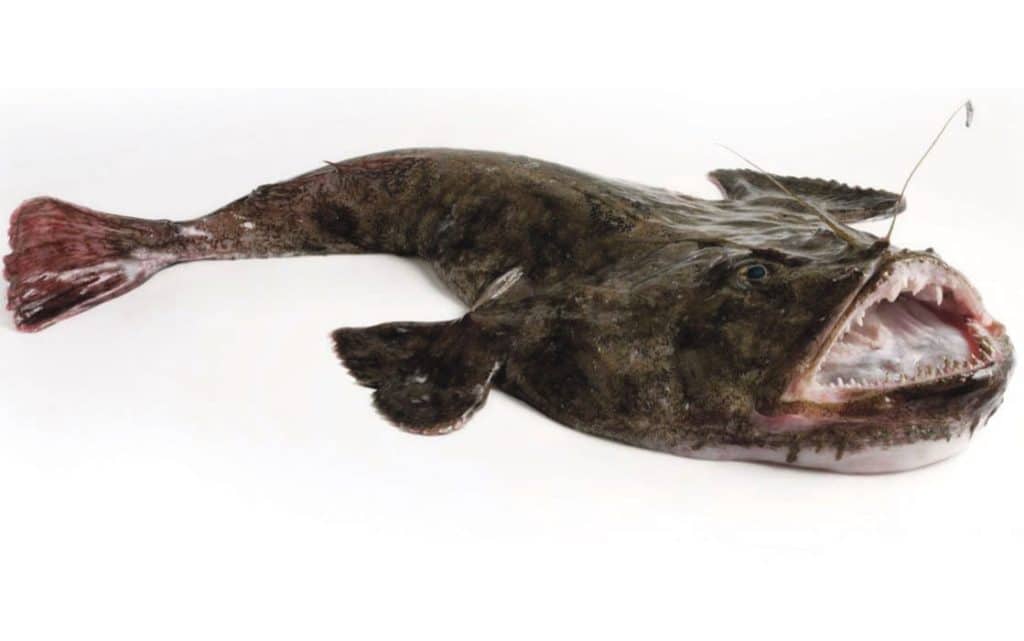
In Irish waters we have two species – the common anglerfish, Lophius piscatorius, and the smaller and rarer black-bellied anglerfish, L. budegassa, though other species live in very deep water. If you order monkfish in a restaurant here, it is the common anglerfish that you will be eating. It is very ugly; most of its body seems to be head, and its enormous mouth is armed with sharp, backward pointing teeth. For this reason, you will usually see only the tail on a fishmonger’s slab. It is found from shallow water down to 600 metres or more, where it lies buried in sand or gravel, waving the fishing rod in front of its jaws to entice a potential meal. When a fish approaches, thinking the lure is something edible, the angler opens its huge mouth, and the smaller fish quickly becomes the prey instead. Anglerfish eat all kinds of bottom-dwelling species and anything else they can catch, even rising to the surface to take sea birds.
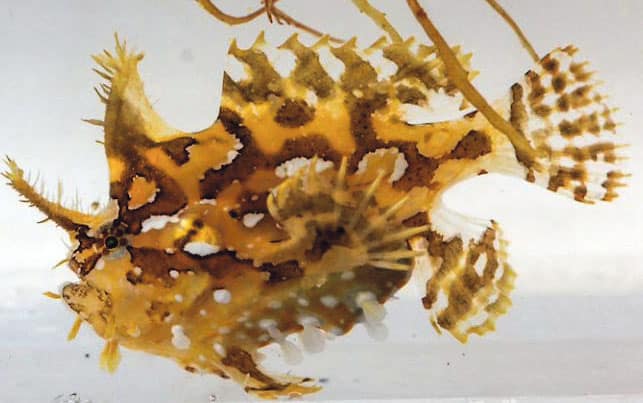
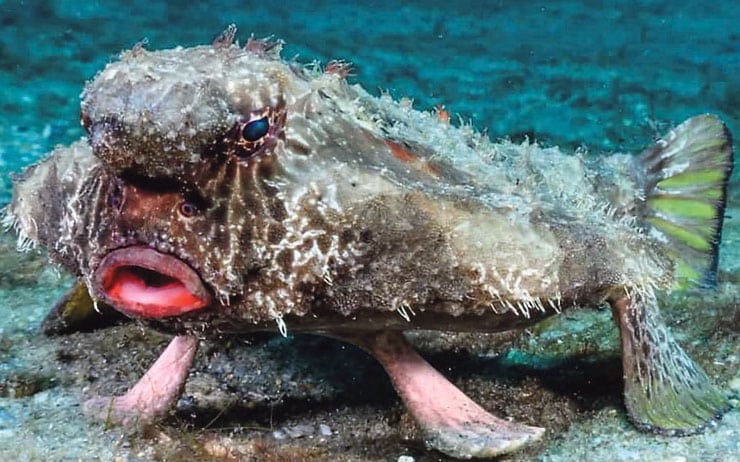
Other members of the order are still uglier, and some quite extraordinary. The many species of frogfish include the Sargassum fish, a small angler which is camouflaged to resemble the clumps of Sargassum weed in which it floats in tropical seas. The batfish have their pelvic fins modified into leg-like structures with which they can walk on the sea bed. The weirdest of all the anglerfish, however, are the deep-sea species; some are quite terrifying to look at. The names of the different families give clues as to their grotesque appearances: football fish, whip-nosed anglers, wolf-trap anglers, black sea devils, warty sea devils. They are the fish of nightmares.
Deep-sea anglerfish live in mid-water, down to depths of 3,000 metres, where there is no light. So they have two big problems – finding food and finding a mate. They solve the first difficulty by having a lamp on the end of their fishing rod; the bioluminescence is produced by bacteria. Other fish see something shining in the dark, they swim closer to investigate, the huge open mouth snaps shut and the backward pointing teeth ensure no escape. As food is so scarce in their bathypelagic habitat, they must be able to swallow whatever they find, hence their enormously stretchable stomachs.
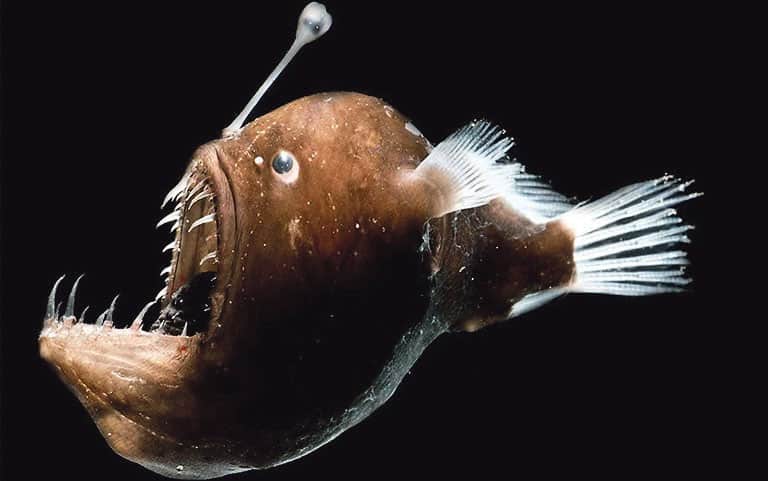
Reproduction is even stranger. They lay millions of eggs which hatch into planktonic larvae. The female grows normally, but the male becomes a dwarf with special biting jaws and no fishing rod. When he finds a female, guided by her luminous lure, he bites into her skin, and there he stays. In some species, their body tissues actually fuse, and the male becomes a parasite, getting his nutrients from the female’s blood, and releasing sperm whenever she wants to reproduce. Sometimes, one female will have several parasitic males attached. Males who never find a female will die because they can’t fish for themselves. The warty sea devil, Ceratias holboeli, is one of the largest species; the female grows up to 120 cm, but the male is never more than 6 cm long.
The other fish called monkfish – the angel sharks – also have flattened bodies for life on the sea bed, but that is really the only similarity to anglerfish. Being sharks, they have cartilaginous skeletons – no bones. Their gills open to the exterior via five slits on either side of the head, and their skin is covered in dermal denticles, like tiny teeth, which give all sharks their rough feel, as any fisherman will know who has been grazed by a dogfish. They live in relatively shallow waters, lying concealed in sand or mud until an unsuspecting fish passes by, and then the shark lunges up and grabs it.
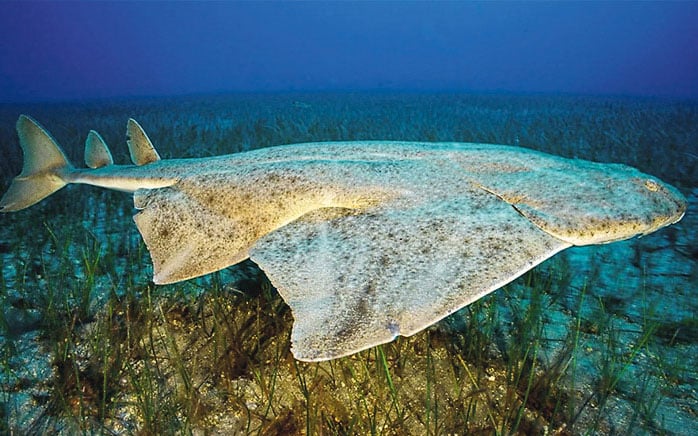
There are 26 species of angel shark, all in the genus Squatina. Many of them are in trouble because of fishing, deliberately or as by-catch; the three species found in the eastern Atlantic, including S. squatina, the common angel shark, are all critically endangered. S. squatina was once plentiful in Ireland, and frequently caught by human anglers, especially in places such as Tralee Bay and Clew Bay. In the 1970s, like flapper skate and blue sharks, they were all killed, just for fun and photographs, and dumped back in the sea – there was no market for their meat here. But then anglers began tagging them, and they might have been all right but for the introduction of the tangle net. These death traps, set primarily for crayfish, also catch anything that swims into them, including angel sharks.
Much of the angel shark’s territory in Kerry is a designated national park, and last year Tralee Bay was declared an ‘important shark and ray area’ by the International Union for the Conservation of Nature, yet fishermen still use tangle nets in these places. Ireland is one of the last refuges of the common angel shark, a fish whose ancestors swam in Jurassic seas and outlived the dinosaurs. What an absolute disgrace it would be if, whether due to politics, economics, or because the government just didn’t care, this shark was to become extinct.